Read the patio before you replace it
A tired flagstone patio in Arden is rarely tired stone. Walk one in Royal Pines or off Sweeten Creek Road after a wet Buncombe County spring and you can usually diagnose it in ten minutes: if the stones are puddled and rocking at the joints, the base and drainage failed; if the stone itself is spalling or delaminating, the wrong stone was set. Those are different repairs. A crew that quotes a full tear-out before kneeling on your patio is quoting a default, not your patio. The right first move is a read: probe two or three joints, lift a settled stone, and check the sand or screenings under it. If the sub-base is still tight, resetting and re-leveling can save most of the project. If it's mush, the whole courtyard is coming up anyway, and now you know why.
Reading before quoting is not a sales technique; it is the difference between a fix that holds and a repeat invoice. In Arden, the common failure pattern is a patio that drained fine for fifteen years, then a gutter was re-routed, or a neighboring lot was cleared, and now sheet flow crosses the pavers every storm. The stone did not change. The water did. If a bidder never asks about where the water comes from, ask them yourself. The NC Office of State Fire Marshal code services treats drainage and frost-depth base prep as core requirements for a reason: a patio is a small drainage structure before it is a hardscape. That is also why we sometimes recommend repairing only part of a patio while the rest keeps working — the failing panel usually tells you exactly where the water problem sits.
One more read step that costs nothing: look at the edge. A patio that has crept downhill at the border, with a visible lip or a gap at the house side, has a base issue, not a stone issue. A patio whose stones are cracked across the middle, with sharp shards, has a stone issue. Both end in excavation, but only one ends in buying new stone.
What stone is actually under your feet here
Buncombe County sits in a belt where flagstone suppliers mix native stone with trucked-in Tennessee and Pennsylvania sandstone. That matters because Arden patios from the 1980s forward are a grab-bag: some are one-and-a-half-inch sawn sandstone on a sand bed, some are three-inch ledgestone set in mortar, some are a homeowner mix of both. The mortar-set patios crack at the joints when the slab beneath them moves; the dry-set patios shift when the screenings wash out. If you can't tell which you have, a careful hand-lift at the edge tells you more than any bid. Repairing one style with the other style's method is the most common way Arden patios get wasted money — the new part fails because it's bonded to a moving neighbor. That's also the honest reason a small repair can balloon: once one panel moves, the adjoining panels under a roof of gutter discharge usually follow.
Stone thickness also drives the decision. Thin sawn flagstone has almost no bending strength and depends entirely on a perfect base; it can be reset, but it will not bridge a soft spot. Thick ledgestone can sometimes be re-bedded in place and will tolerate more movement before it complains. If your patio was built with a mix, we often reset the thick pieces into a corrected base and replace only the thin, broken ones — which is usually cheaper than a uniform rebuild and looks more natural than a patch of one stone type.
Color and texture are a real constraint, too. Native stone quarried years ago does not match today's stock exactly, so a partial rebuild will always show a seam where old and new meet. On shaded, wooded Arden lots, that seam weathers in faster than most homeowners expect. On a sunny, exposed courtyard off Long Shoals Road, it stays visible for years. Knowing that ahead of time is part of an honest quote, not a surprise after the fact.
The price picture for Arden patios
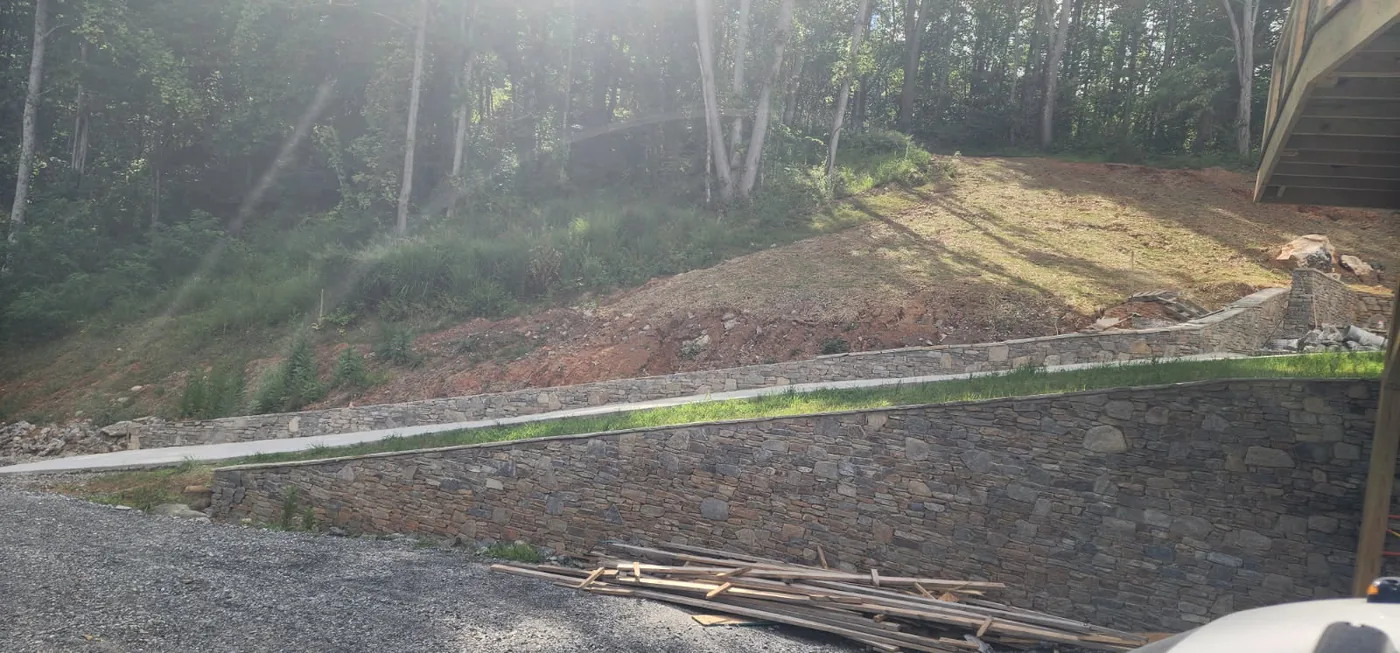
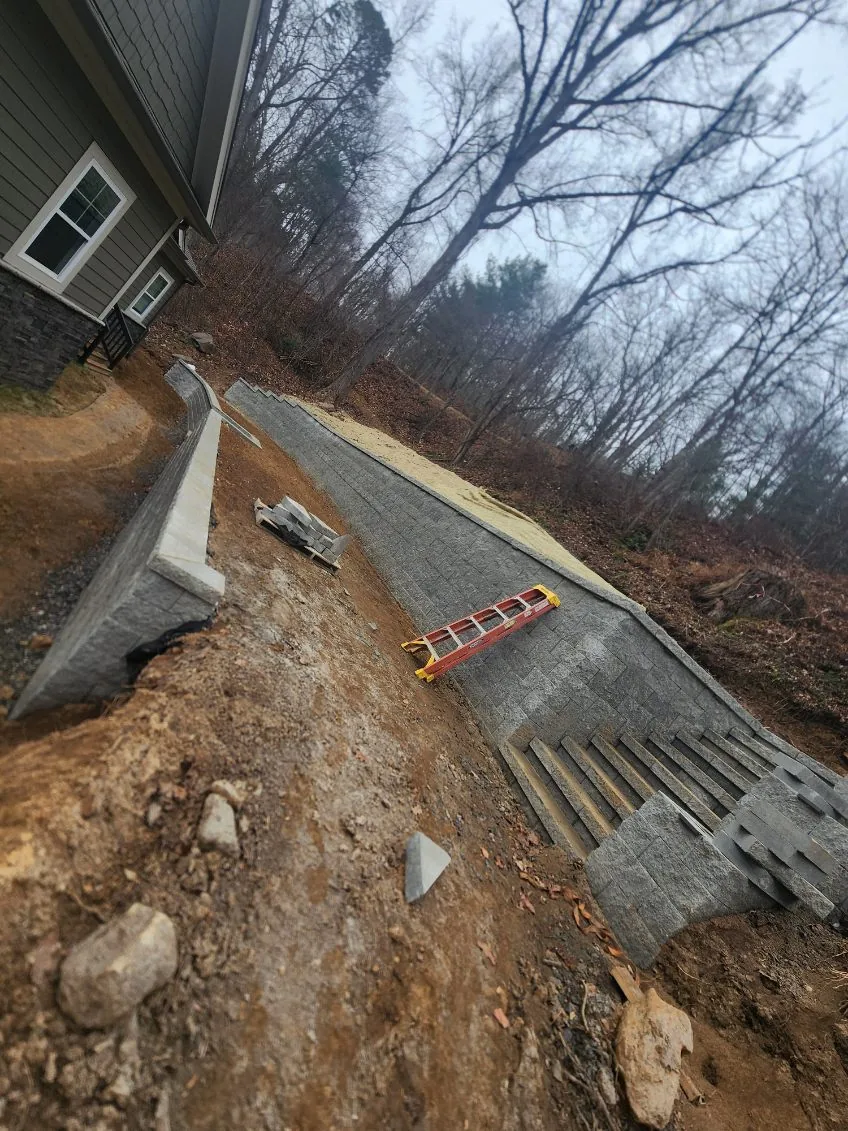
Asheville-area hardscape pricing tracks the county; the Buncombe County cost breakdown covers the wall side, and patios run on the same labor, haul, and base-material curve. The short version is in the table below. Two Arden-specific movers: steep backyard grades behind the older ranch lots off Long Shoals Road force more base and often a low retaining edge, and tree-root heaving on wooded lots means more excavation than a flat, open yard. Any quote that doesn't include a line for base depth and drainage is leaving the expensive part out.
| Scope | Typical range | Notes |
|---|---|---|
| Reset and re-level existing flagstone | $1,800–$4,500 | Base sound, stones reusable |
| Partial rebuild (one section, new base) | $3,500–$7,500 | Common where one panel failed |
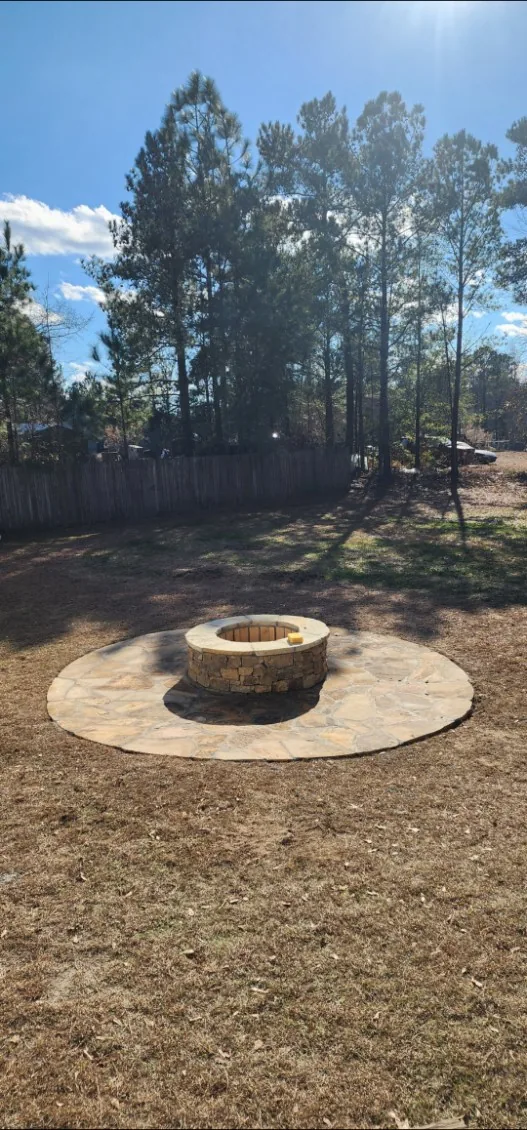
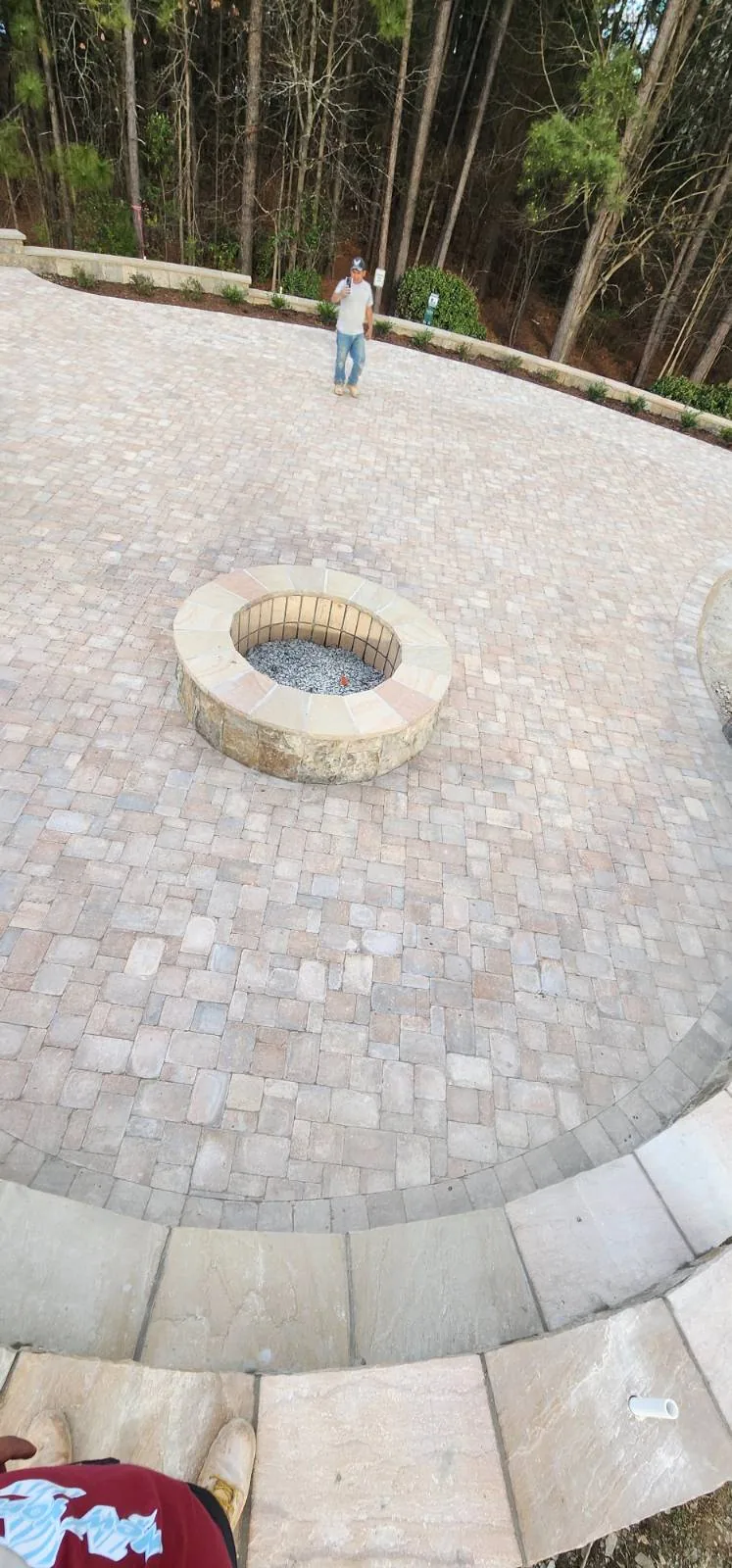
| Full flagstone patio, new construction | $6,500–$18,000 | Driven by sq ft, stone type, grade |
| Add low retaining edge / grade correction | $1,200–$4,000 | Frequent on sloped Arden yards |
| Drainage correction (grade, french drain) | $800–$3,500 | Fix before stone goes back down |
Two things push a job to the top of those ranges in Arden. First, access: a back yard reachable only through a narrow gate or across a slope adds wheelbarrow labor that a flat, driveway-side yard never sees. Second, disposal. Old mortar-set stone and broken concrete have to be hauled, and the county landfill tipping and haul distance show up in the bid whether a contractor itemizes it or not. Ask what is included — excavation spoils, old stone haul-off, base gravel, and drainage — because the cheapest-looking number is often the one missing three of those lines.
It also pays to compare like scopes. A reset that reuses your stone will almost always undercut a rebuild, but only if the base is sound. If two bidders are thousands apart, one of them is probably pricing a different job. Ask each to write down what is under the stone and how deep, and the gap usually explains itself.
Water, roots, and the base nobody sees
The federal disaster record explains a lot of Arden hardscape calls: 19 declared events touch this county (1973-2026), overwhelmingly storm and flood family. Each one pushed runoff at patios built for a drier assumption. Before any stone is reset, the base and the water path have to be answered — where the gutter discharges, where the uphill neighbor's runoff lands, and where the water goes when it leaves the patio edge. The NC Office of State Fire Marshal code services and the state residential code treat drainage and frost-depth base prep as first-class requirements, and it shows in how long a patio lasts. Tree roots are the other Arden variable: a maple fifteen feet from a patio will heave it within a decade, and no amount of good compaction stops that. Sometimes the right repair is a smaller patio moved off the root zone.
Our freeze-thaw swing matters as much as rain volume. Western North Carolina can cycle above and below freezing repeatedly in a single late-winter week, and each cycle pumps saturated fines upward through a base that was never designed to shed water. That is why dry-set patios on a compacted, drained base outlast mortar-set ones on a marginal slab here, and why the International Code Council frost-depth provisions exist in the first place. It is also why we would rather spend a day correcting grade and discharge before laying a single stone than lay stone twice.
Roof water is the single biggest avoidable cause of failed Arden patios. A downspout that dumps at the patio edge washes out the screenings under the first two rows of stone, and the failure walks inward from there. Extending the discharge, or adding a simple french drain along the uphill edge, is cheap compared to a rebuild and is often the whole fix for a patio that is only mildly out of level. Fix the water first, then decide what the stone needs.
Hiring a mason who reads before quoting
Three checks worth making in this market. First, ask whether the crew has worked your stone type and setting method — dry-set and mortar-set are different trades, and the NC Licensing Board for General Contractors threshold applies once a job crosses into structural or combined work. Second, ask for the base plan: what goes under the stone, how deep, and how water leaves. Third, ask whether they'll quote repair and rebuild separately so you can see the trade-off. If you're also weighing a wall along the patio edge, the retaining wall contractors in Arden page covers how that scoping works. And when you're comparing options across stone and pavers, the flagstone patio guide lays out what each surface does well in mountain-climate yards.
A good sign in this trade is a contractor who tells you when not to spend. If the base is sound and three stones are rocking, that is a reset, not a rebuild, and a mason who says so is worth keeping. A bad sign is a tear-out quoted at the curb, before anyone has been in the back yard with a probe. Ask any bidder to show you, in writing, what they found when they lifted a stone. If they never lifted one, they priced a default.
Finally, ask how the job is sequenced around weather and access. On sloped Arden lots, base work and drainage often need to go in on dry days, and stone delivery sometimes can't reach the back yard with a truck. A crew that plans around that avoids tearing up your side yard and re-grading it twice. Ask who restores lawn and planting beds when the haul is done — a fair quote names it, and the final walkthrough should match the plan you agreed to before the first stone was lifted.