Why Montreat walls fail the way they do
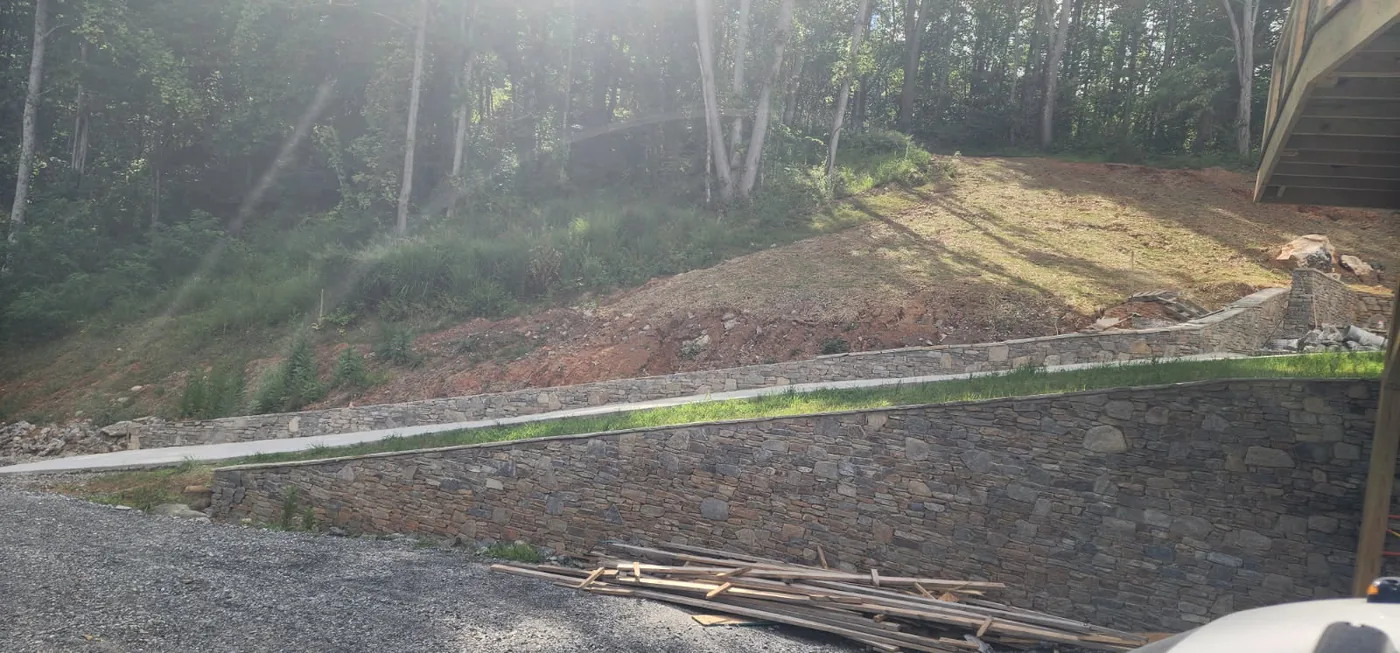
Drive the lanes off Montreat Road and you see the pattern: short lots stacked up a mountainside, each one holding back the neighbor above it with a wall that is tall for its length. That ratio is the whole story. A wall in Montreat is often 3 to 8 feet high but only 20 to 40 feet long, sitting on graded fill over native slope, catching water from every uphill property and every storm that rolls off the ridge. Where a low ranch wall in a flatter part of Buncombe County can absorb a wet season, a tall short wall above a driveway has almost no room to move before it starts to lean, bow, or shed blocks.
The tells are consistent. Bulging in the middle third of the wall. A visible lean toward the downhill side. Horizontal cracks stepping through block courses. Soil pushing out between timbers. Water weeping at the base or standing behind the wall after rain. Any of those mean the wall has already lost the drainage fight and is now working on the structural one.
Montreat's lots also differ from Asheville proper in ways that shape the work. Plots here were often cut into the slope decades ago, leaving narrow benches where a wall doubles as the property line and the driveway edge. That means a failing wall can threaten a neighbor's grade as well as your own, and repair sequencing has to account for both sides. Soils tend to be thin mountain clay over weathered rock, which drains slowly once saturated and pushes hard against a wall face. Equipment access is tight: many lanes are single-width, and a mini excavator may be the largest machine that can reach the wall. Crews that work flat Asheville lots with wide equipment approaches sometimes underestimate how much hand work and staged hauling a Montreat repair involves. That is why local experience matters more here than in flatter parts of the county, and why drainage details that would be optional elsewhere are mandatory on these slopes.
Water is the first line item, not the last
Most retaining wall failures in Montreat are drainage failures wearing a structural costume. Mountain rainfall concentrates fast, and when the drain behind a wall clogs or was never installed to mountain standards, hydrostatic pressure builds until the wall moves. Before anyone quotes you new block or new timbers, the drainage question has to be answered: where does the uphill runoff go, is there a functioning footing drain, is the wall backfilled with free-draining stone, and does surface water sheet away from the wall face. The International Code Council treats retaining wall drainage and surcharge as first-class design requirements, and for good reason on slopes like these. Fix the water and half the walls in town stop moving. Skip it and the next wall fails the same way.
In Montreat, stormwater often arrives from above the property line. A wall may be catching runoff from a neighbor's drive, a shared lane, or a hillside that has no storm system at all. A proper repair scope looks uphill first, then at the wall, then downhill. That can mean regrading a swale, extending a downspout, adding a catch basin, or restoring a footing drain that daylights below the wall instead of dead-ending in soil. The EPA publishes stormwater guidance that explains why concentrated flow against a structure is a predictable failure mode, and the same principle applies at residential scale on these slopes. Some walls also need weep holes kept clear and filter fabric replaced so fines do not migrate into the drain stone and clog it. Homeowners who have watched a wall move after a wet spring usually understand this intuitively; the fix is to make the water leave before it pushes.
What repair actually costs here
Tall short walls on mountain lots price by scope, not by square foot. The table below reflects the Buncombe County market; see the full Buncombe County wall cost breakdown for line-item detail. Steep-access jobs above the main road routinely carry a hauling and drainage line item that flatland quotes never show, so treat any bid without them as incomplete rather than cheap.
| Scope | Typical Range |
|---|---|
| Drainage-only fix (clean, re-route, restore footing drain) | $800-$2,800 |
| Timber wall partial rebuild, under 4 ft tall | $1,800-$5,500 |
| Block wall section rebuild with new footing | $3,500-$9,500 |
| Full wall replacement, engineered, 4-8 ft | $8,000-$22,000+ |
| Engineering review add-on | $500-$1,800 |
Asheville's retaining wall repair service spans the whole region, but Montreat jobs tend to sit at the upper end of those bands because access is tighter and the walls are doing more work per foot. A wall that needs a permit, an engineer's letter, or a design for a surcharge from an uphill driveway will carry those costs on top of the construction scope. Homeowners should also expect that a partial rebuild may reveal a footing that is undersized or absent, which changes the scope once the wall is open. A good contractor explains that risk before work starts and prices the unknowns transparently rather than discovering them mid-job.
Where a wall also retains a neighbor's slope or sits near a shared lane, the repair may need a survey or a boundary check before construction. Those are not wall costs, but they are common on Montreat lots and belong in the budget conversation early.
Sourcing a crew that knows mountain lots
Three Montreat-specific checks before you sign anything. First, ask whether the crew has built or rebuilt walls on a slope with limited equipment access, not just on flat lots where a machine can reach every course. Second, ask for the engineer's letter on any wall over a certain height and any wall retaining a slope above a structure; the North Carolina Licensing Board for General Contractors sets the threshold where general contracting licensure applies, and mountain work crosses it faster than owners expect. Third, ask how they sequence drainage versus block. The crews who answer drainage first are the crews who fix walls; the ones who talk block and rebar first are selling you a wall, not a repair. If you want a shortlist, the Montreat wall contractor page covers what a qualified local bid should include.
It also helps to ask what the crew does when they find something unexpected, because on old mountain walls they usually do. A footing may be a single row of block on native soil. A drain may be a perforated pipe wrapped in the wrong fabric or no fabric at all. Timbers may be untreated or half-rotted below grade. A contractor who has worked these lanes can describe those conditions in advance and explain how change orders are handled. Ask for references from jobs with similar access constraints, not just similar wall heights. And confirm who pulls any required permit and who carries liability and workers' compensation coverage, since hillside work carries more risk than flat-lot work.
When to repair and when to replace
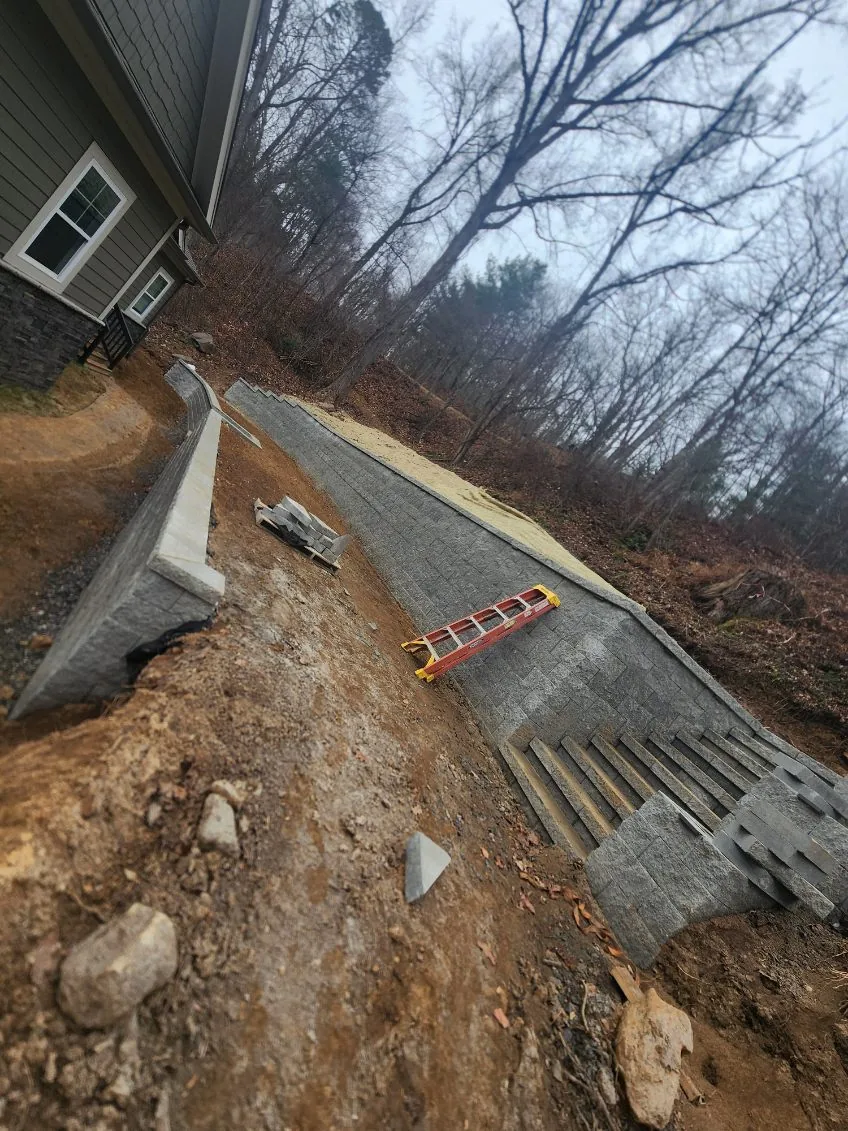
Not every leaning wall needs to come down. A wall with one bulging section, intact footing, and a fixable drainage problem is usually a section repair. A wall that has rotated as a whole, lost its footing, or is retaining a slope above a home or driveway is usually a replacement, and the failure will keep getting worse until it is addressed. In Montreat the decision often comes down to what the wall is protecting. A 3-foot garden wall can be patched for years. A wall holding the grade above a driveway or a structure is a safety wall, and once it moves, the honest answer is rebuild with proper drainage and engineering, not patch it again.
There is also a middle path worth knowing about: a phased repair that stabilizes a section, corrects drainage across the whole run, and defers cosmetic work. That can stretch a budget and keep a functional wall in service while a homeowner plans a larger rebuild. What should not be deferred is anything that signals global movement. A wall that has rotated at the top while the base stays put, or one whose footing has heaved, will not be saved by patching the face. In those cases, replacing with a properly designed wall that accounts for the actual surcharge and drainage is the less expensive choice over time.
Planning the work around mountain weather and access
Montreat's wet seasons and freeze-thaw cycles compress the practical construction window. Saturated soils do not compact well, and a footing poured into mud will not perform. That means scheduling matters: late summer and early fall often offer the best soil conditions for wall work, while a repair that opens a wall face should be closed before a heavy rain event. Contractors working these slopes watch the forecast and stage materials so a job can be secured quickly if weather turns.
Access planning is the other half. On narrow lanes, material delivery may require smaller trucks or staging at the bottom and hauling up by machine. Excavated soil has to go somewhere, and on tight lots that can mean hauling offsite rather than stockpiling. Homeowners can help by clearing the work zone, marking irrigation and utilities, and confirming where equipment can park without blocking a shared lane. 19 federal disaster declarations have touched this region over a 1973-2026 record span, which is a reminder that storm-driven slope and wall problems are a recurring reality in these mountains, not a one-off. Planning for water and access up front is how a Montreat wall repair lasts.