Read the existing patio before you spend a dollar on a new one
Most Mars Hill homes sit on ground that was never flat. Drive out past the college toward Mars Hill Road or up along the ridgelines and you find patios wedged between a grade that cuts into the hill on one side and drops off the other. Those patios fail in readable ways. A settled corner near the downhill edge means base, not pavers. A crack that runs with the slope means water is moving underneath. A wall that leans out by an inch means the block behind it has already started to give.
What separates a repair from a rebuild is simple math: if the base is intact and pavers are the only failure, you lift, re-level, and reset. If the base has moved, or the wall has rotated, you rebuild the assembly. That is the scope conversation this page is about, and it starts with a look at what is already there, not a catalog of pavers.
In this county the reading has to include what the ground does in a wet year. Mars Hill sits at the edge of the Blue Ridge escarpment, and a lot that looks dry in August can carry a sheet of water in February. The families who have owned land here for generations know which hollows drain and which hold. When we walk a patio, we are not just looking at the surface; we are asking where the water went last spring and whether it went under the base or around it. That question often decides repair versus rebuild before a single paver is lifted.
What drives scope on a Mars Hill patio
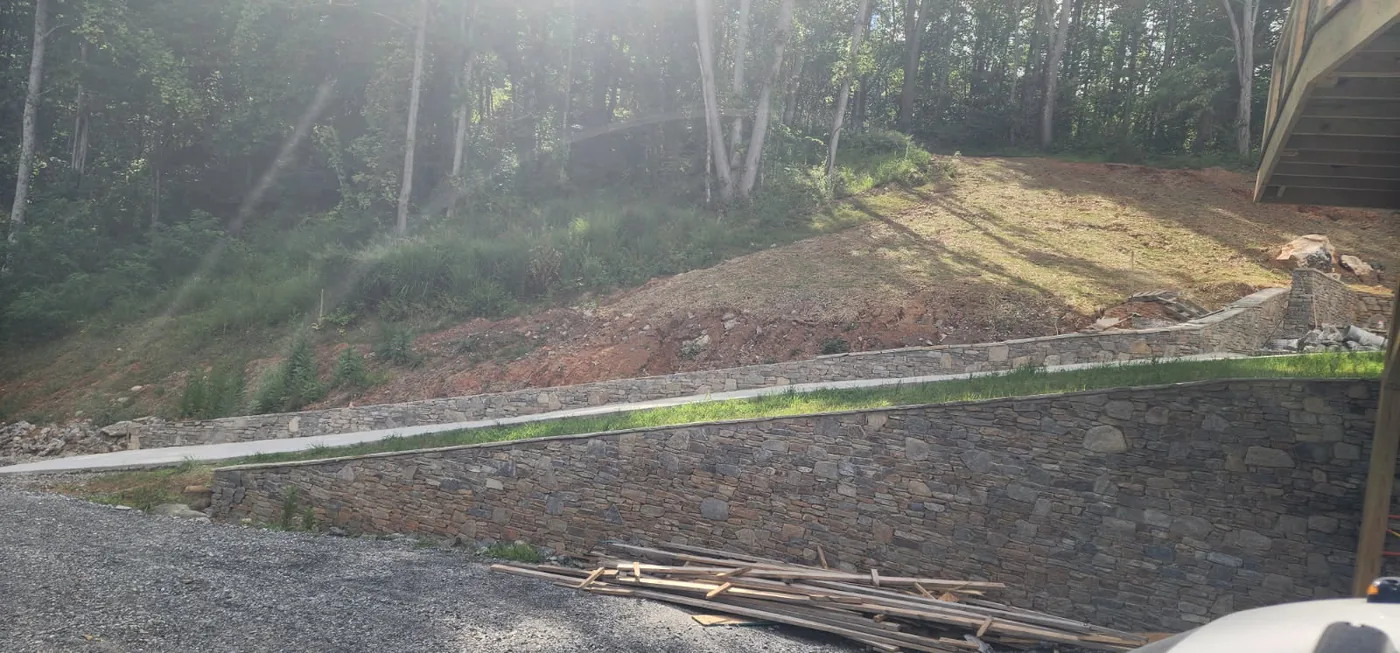
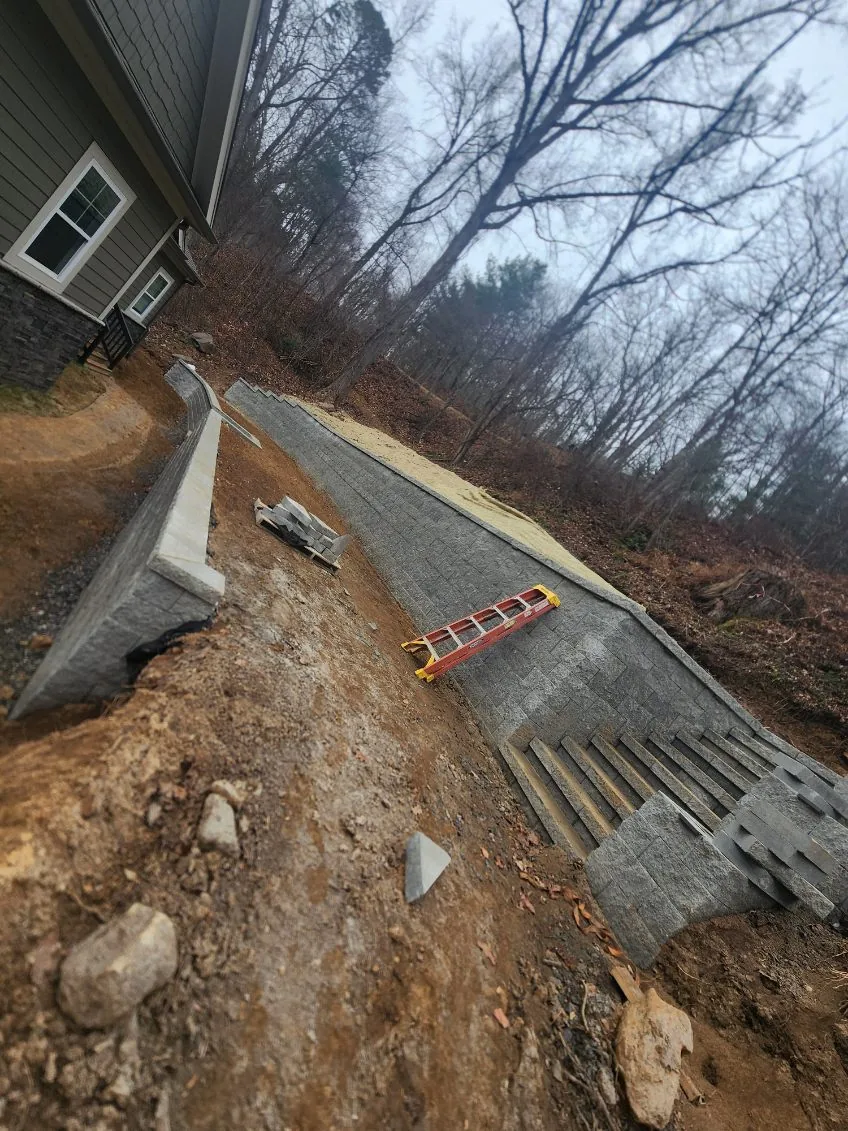
Madison County's terrain pushes three costs that flatland patios do not have. First, grade: any patio cut into a slope needs a retaining wall on the uphill or downhill side, and that wall is engineered, permitted, and priced separately. Second, access: a lot with a long, single-width gravel drive off a county road means equipment, base rock, and pavers move in small loads. Third, drainage: water coming off an uphill neighbor or a steep bank has to go somewhere, and it cannot go under your base.
The Madison County retaining wall cost breakdown covers those line items in detail. For patio work specifically, the working table below shows where each scope lands.
There is a fourth factor that shows up on older Mars Hill properties: what was there before. Around the town center and along the older rural roads, patios were sometimes poured over a former porch slab, a spring house pad, or fill that was never compacted. A new patio laid on top of that history will fail the same way the old surface did. Reading the layers under the existing patio is part of the inspection, and it is why a builder who has worked this county can often tell you more from a shovel test than from a brochure. The paver patios overview explains how base assemblies behave when the subgrade is not uniform.
The price picture, scope by scope
Prices below reflect what this trade charges across the Mars Hill area, phrased as working ranges rather than flat rates. Every job gets its own number after a site look.
| Scope | Typical range | What it covers |
|---|---|---|
| Paver reset / re-level on intact base | $2,800–$6,500 | Lift failing pavers, re-screen bedding, re-set, re-sand. Base stays. |
| Small patio, new build, easy grade | $6,500–$11,000 | 250–400 sq ft, excavate, compacted base, pavers, edge restraint. |
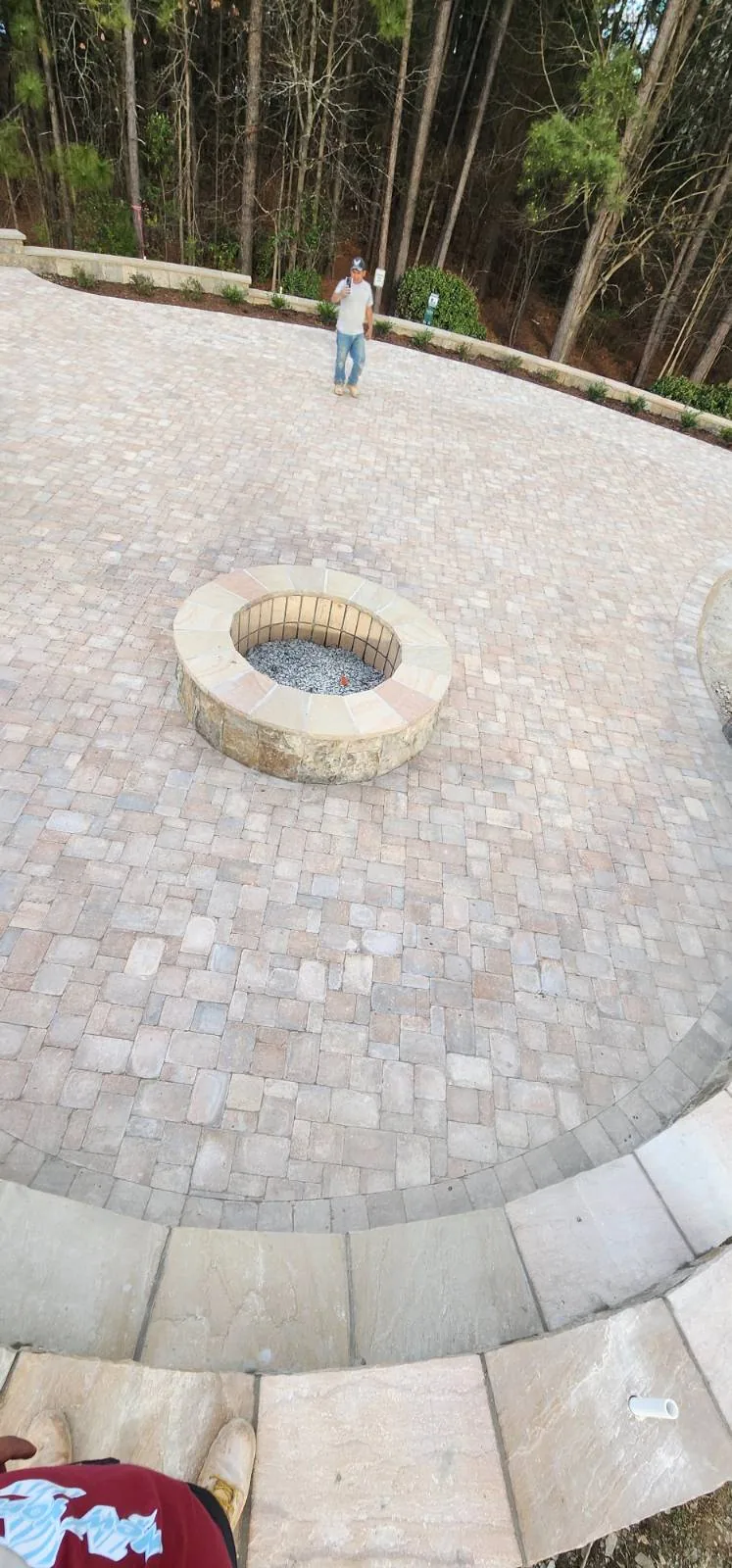
| Mid-size patio with retaining | $11,000–$18,000 | Patio plus a low retaining wall or steps, drainage line, compacted base. |
| Large or terraced patio with wall | $18,000–$24,000+ | Multi-level, engineered retaining, drainage, deep base on slope. |
| Full rebuild, existing patio removed | +$3,500–$7,000 on top | Demo, haul-off, base rebuild, then new surface. |
Two rules of thumb hold. A patio that only needs its surface reset costs a fraction of a rebuild, and a patio that needs retaining costs more than one that does not, by the wall and by the drainage it demands. Any quote that does not distinguish those two cases is answering a question you did not ask.
On a steep Mars Hill lot, the hidden line item is often haul-off. Excavated clay and broken base have to leave the site, and a narrow gravel drive means a small truck making more trips. That is not a reason to avoid the work; it is a reason to have the number in the quote before you compare bids, rather than discovering it as a change order. The same applies to base stone, which may need to be staged on the roadside if the drive cannot take a loaded dump truck.
Water, walls, and what the code cares about
Federal disaster records explain a lot of Madison County patio and wall calls: 21 declared events touch this county across 1978-2026, with storm and flood families dominating. Every one of those events pushed saturated ground against retaining walls and under patio base that was installed for a drier assumption. The NC Building Code Council treats retaining walls and foundation drainage as first-class requirements for a reason, and any wall over the code threshold triggers engineering.
Contractor selection matters here too. North Carolina's Licensing Board for General Contractors sets the threshold at which a project needs a licensed general contractor, and patio-plus-wall jobs cross it more often than homeowners expect. If your project includes a wall of any real height, or a patio cut into a slope, get the license question answered before work starts.
Drainage details are where the code and the terrain meet. A patio on a slope needs a path for water that does not depend on the base absorbing it. That usually means a gravel-filled trench, a perforated line, or a surface swale that carries runoff past the patio edge and down to a stable outfall. The EPA publishes general guidance on managing stormwater on residential sites, and the principle is the same at patio scale: slow the water, spread it, and let it soak in where it will not undermine what you built. On a Madison County hillside, a downspout or a driveway that dumps onto the uphill side of a patio is often the real cause of a failure, and fixing that may matter more than the pavers themselves.
Choosing a patio builder in this county
Two checks separate the crews that last from the crews that get called back. First, ask how they read an existing patio. A builder who can tell you why the current slab failed will build the new one to survive the same ground; a builder who cannot will repeat the error at your expense. Second, ask how the wall and the drainage get sequenced. On a Mars Hill slope, wall first, drainage second, patio third. If the answer is patio first, that is a scope problem, not a scheduling one.
For homeowners weighing wall work as part of the same project, the Mars Hill retaining wall contractors page covers the vetting questions specific to walls. For surface options and material behavior across the trade, the paver patios overview is the starting point.
A third check is local experience with the ground itself. Ask whether the crew has worked on slopes in this county before, and ask what they do when they hit a spring or a vein of clay that will not drain. The honest answer is usually that the design changes: more base stone, a wider drainage swale, or a wall moved a few feet to avoid the wet spot. A crew that has built here will have those conversations without being prompted. A crew that has only worked flat subdivisions may not know the questions to ask until the hole is open and the water is in it.
When repair beats rebuild
Not every failing patio needs to be torn out. If the pavers themselves are sound and the failure is localized settling, a reset is often the honest answer and can save thousands. If the base has failed across the whole area, or a wall has moved, patching the surface sets up the same call in two years. The inspection is what tells you which case you are in, and it should happen before a single quote is written.
A middle path also exists: partial rebuild. When one corner of a patio sits on failed base but the rest is sound, the failed section can be cut out, re-based, and re-laid while the rest stays. That keeps the cost closer to a reset than a full rebuild, provided the drainage that caused the failure is corrected at the same time. Skipping that correction is how a repaired corner becomes a repaired patio becomes a full rebuild. The reading at the start of the job is what tells you which of these three paths you are on.