Read the wall before you price the fix
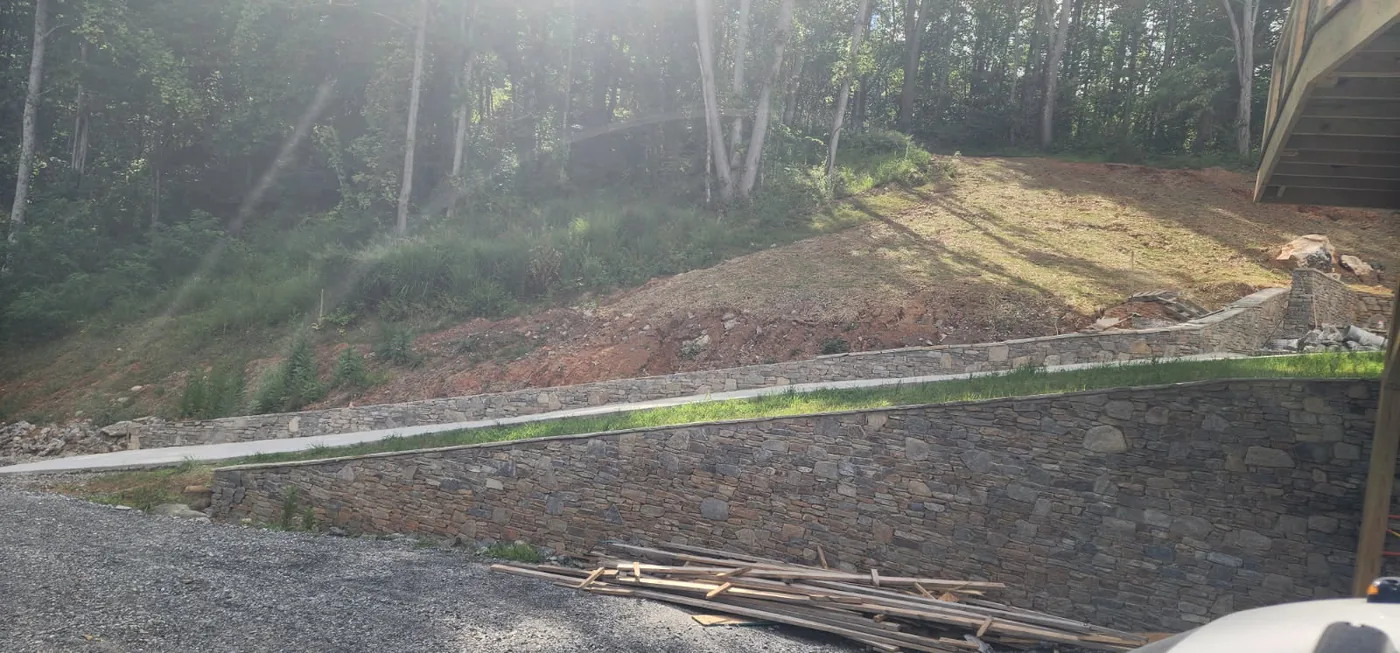
Most retaining wall calls in Maggie Valley start the same way: a homeowner points at a leaning wall and asks how much to straighten it. Two minutes of honest reading usually changes the question. A timber wall that's leaning because its posts have rotted through is a rebuild wearing a repair bill. A block wall bulging outward midspan because the drainage behind it quit is often fixable at a fraction of replacement. Same complaint, opposite answers — and the difference is what's holding the wall up and what's pushing it over.
Haywood County's terrain makes this sharper than in flatter places. Stands off Plott Creek Road or up toward the Blue Ridge Parkway sit on grades that push groundwater at walls from above, not just behind. Walls on valley-floor lots near Jonathan Creek fail differently again — often from saturated base soil rather than uphill slope load. The wall you own was built for one of those conditions. Reading which one is the first real step, and it's why our retaining wall repair pages start with diagnosis, not a square-foot number.
What repair versus rebuild actually looks like
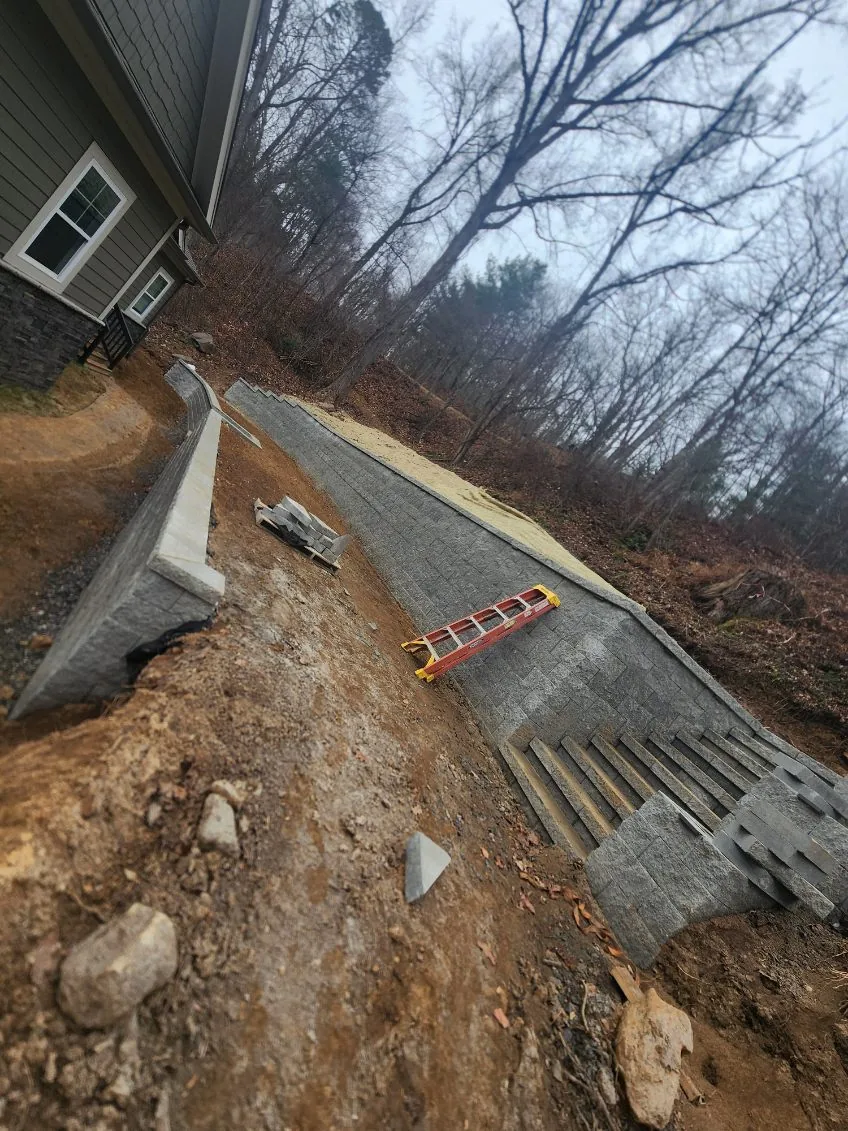
The repair-or-rebuild call usually resolves into one of four outcomes. Cosmetic work — repointing, cap replacement, minor cracking — is genuinely cheap. Structural repair, meaning drainage restoration, tieback, or partial reconstruction of a section, sits in the middle. Full rebuild happens when the wall's geometry has failed (it's already rotating out of plumb past the point where re-straightening is honest) or when the base is gone. And there's the fourth outcome nobody likes: the wall can't be saved at the current height, and the right answer is a shorter, properly drained replacement that does less work.
Where the wall is engineered — anything holding back a slope above a dwelling, or above a certain height and surcharge — North Carolina general contractor licensing thresholds kick in, and plan review may be required depending on the county's current adoption of the NC Building Code Council residential code. If a contractor waves off that question, that's your signal.
Maggie Valley wall repair price picture
Regional bands for wall work in Haywood County, phrased the way we actually quote it — ranges, driven by access and by what the wall is doing. The full working table lives on our Haywood County retaining wall cost page; the short version:
| Scope | Typical range | What drives the price |
|---|---|---|
| Cosmetic repair (repoint, cap, minor crack) | $600–$1,800 | Wall length, access, masonry type |
| Drainage restoration behind existing wall | $1,200–$3,500 | Excavation depth, drain length, disposal |
| Sectional structural repair (10–20 linear ft) | $2,000–$5,500 | Whether base is intact, tieback needs |
| Full rebuild, timber wall under 4 ft | $3,500–$7,500 | Linear feet, material grade, slope |
| Full rebuild, block or stone, engineered | $8,000–$28,000+ | Height, engineering, drainage, access |
| Emergency shoring or temporary stabilization | $1,500–$6,000 | Urgency, equipment access, safety plan |
Access is the local wild card. A wall you can reach with a mini excavator prices very differently than one behind a Soco-area cabin where every load moves by hand down a switchback. Ask any quote to state the access assumption explicitly — vague quotes on steep lots are how jobs go sideways.
The drainage question that decides the job
Ask a Maggie Valley wall contractor what killed the last wall they rebuilt and you'll almost always hear the same answer: water. Not the wall material, not the block, not the freeze-thaw. Water behind the wall that had nowhere to go, and a base that lost its bearing because of it.
This is why the federal disaster record matters here. Haywood County has seen 19 declared events over 1973-2026, overwhelmingly storm and flood family — every one of those events pushed saturated soil at walls that were designed for a drier assumption. Before spending on a rebuild, the uphill drainage, the wall's own weep and drain provisions, and where the outlet actually goes should all have answers. The EPA's guidance on stormwater and erosion control at epa.gov is a useful reference for what proper conveyance looks like; the NC State Board of Examiners at nclicensing.org matters if the scope crosses into plumbing or drainage trades that require separate licensure.
If your contractor's rebuild plan doesn't name where the water exits, that plan isn't finished. When you've got the diagnosis and the water answer, the question of who to hire gets concrete — see the Maggie Valley retaining wall contractors page for the vetting checklist we actually use.
When to stop reading and start shoring
Most wall problems wait. A few don't. If the wall is tilting noticeably toward a structure, if soil is visibly sloughing from behind it after rain, if a section has already dropped or cracked through, or if anything uphill of it is now exposed down to bare subsoil — that's not a repair decision, that's a stabilization call, and the cost of waiting is nonlinear.
For everything else, the honest order is: read the wall, answer the drainage question, then price the scope you actually need. Repair-or-rebuild is a judgment about the existing wall, not a sales tier — and the right answer is usually the one that respects what's still doing work.