Fairview's lots are the reason the work looks different here
Fairview isn't a flat town with a stonework problem. It's a town of ridge roads and hollows west of Asheville, where a driveway can climb forty feet from the road to the house and where most every yard has a cut bank on one side and a drop on the other. Lots here are irregular — long and narrow along the ridge, or pie-shaped where a road switchbacks. That shape drives everything: where a wall can bear, how tall it has to be before it needs engineering, and whether water from the uphill neighbor ends up behind your wall or in your crawl space. In Asheville proper you often fight old foundations; in Fairview you fight grade, and the stonework is how you answer it.
Soils matter too. Much of this area sits on weathered clay and micaceous bedrock, which drains slowly and swells when saturated. A wall built the same way here as on a sandy flatland lot will fail within a few winters. That isn't opinion — it's the reason retaining structures in western North Carolina are treated as engineered work above certain heights under the North Carolina Building Code Council rules.
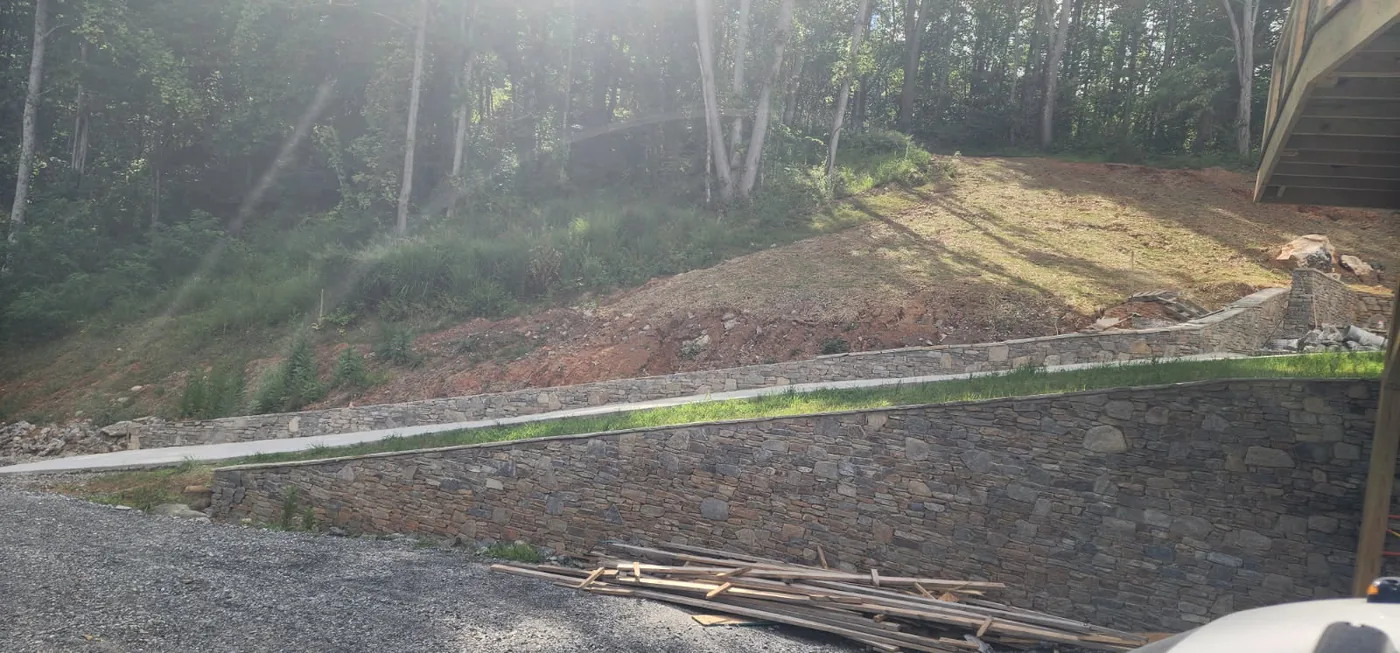
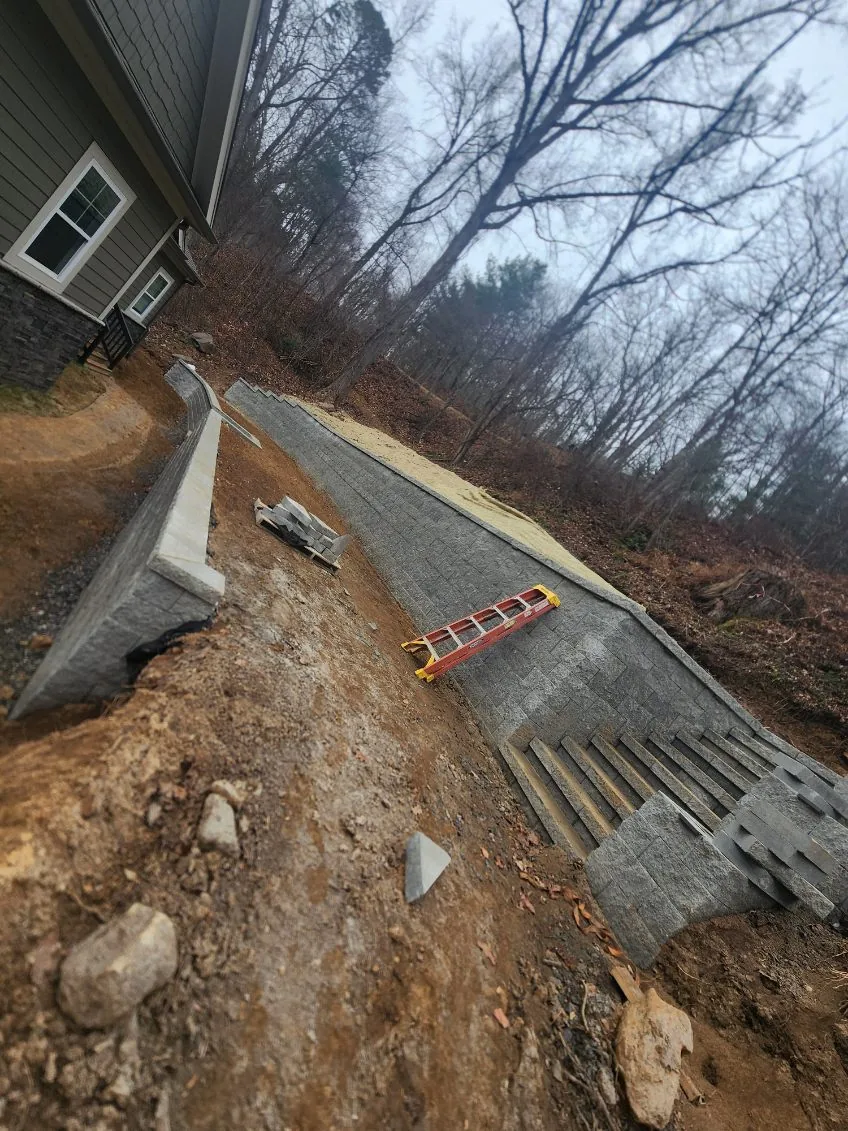
Drive a few of the ridge roads that climb off the main corridors and you'll see what this produces in practice: walls stepped in two or three tiers instead of one tall face, drainage swales cut across the uphill grade, and steps that land on stone piers because the ground isn't stable enough to just stack risers. None of that is decoration. It's a response to how the land moves and holds water. A crew that doesn't know Fairview will bid the same wall they'd bid in a flat subdivision, and the difference won't show up until the second wet spring.
What stonework actually costs on a Fairview slope
Price follows wall height, footing depth, drainage scope, and stone source. Native stone from local quarries tends to run higher than veneer, but it's also what most Fairview homeowners want for a wall that reads as part of the landscape. The table below reflects regional bands you'll see across Buncombe County — treat any quote far below these as a scope problem, not a bargain.
| Scope | Typical price range | Notes |
|---|---|---|
| Dry-stack garden wall, under 2 ft | $38–$58 / sq ft face | Simple footing, minimal drainage |
| Mortared veneer on existing wall | $42–$72 / sq ft face | Prep and flashing drive the spread |
| Retaining wall, 2–4 ft with drainage | $65–$110 / sq ft face | Footing, gravel, drain tile included |
| Retaining wall over 4 ft, engineered | $5,500–$28,000+ per job | Stamped plans, geogrid, inspection |
| Stone steps, per riser | $450–$1,200 | Site access changes everything |
| Stone patio or walkway | $28–$65 / sq ft | Base prep and slope control |
For the line-item view across the county, the retaining wall cost breakdown shows how footing, drainage, and permitting split out on a typical project.
Two things push Fairview jobs toward the top of those bands more often than in town. The first is machine access. A lot where the only route to the wall face is a narrow switchback means the excavation, the gravel, and every ton of stone comes in by hand or by a small walk-behind machine, and that labor is real. The second is what's underground. Hitting rock a foot into a footing trench is common on these ridges, and it changes the cost of every cubic yard you remove. A bid that assumes soft digging on a Fairview slope is a bid that will come back for more money.
Drainage: the line item nobody wants to pay for
The federal disaster record tells the story behind most Fairview wall failures: 19 declared events touch Buncombe County across 1973-2026, and they're overwhelmingly storm and flood family. Every one of those events pushed water downhill at walls that were designed as if water would politely go somewhere else. On a ridge lot, that water has one direction to travel — through your wall's backfill, or through your foundation.
A proper wall here has gravel backfill, filter fabric, and a drain that actually outlets somewhere useful, not just a weep hole at the bottom. Skipping that step saves a few thousand dollars up front and costs a full rebuild later. When you're pricing the scope, the retaining wall service overview walks through why drainage is non-negotiable on this terrain.
What does a working outlet look like on a Fairview lot? It has to discharge to a point lower than the wall's base and away from any foundation, daylight, or downslope neighbor's problem. Sometimes that means a longer run of pipe than the homeowner expected, or a small riprap apron at the discharge. A drain that just dumps behind the wall or into the crawl space hasn't solved anything — it's moved the water a few feet and added a pipe to your bill.
Since the region's heavy rainfall is what makes this soil move, it's also worth checking how local erosion and stormwater expectations are framed at the federal level, since those standards filter down into county review. The U.S. Environmental Protection Agency publishes guidance on stormwater and erosion control that regional designers lean on.
Hiring a mason in this market
Fairview has no shortage of people who can stack stone. The distinction that matters is which crews understand slope lots and which crews are running a flatland playbook. Three checks worth making before you sign anything:
First, ask whether the crew has built on a similar grade — a 6-foot wall on a hillside is a different animal than a 6-foot wall in a backyard. Second, on any wall crossing the engineered threshold, ask for the stamped design; the North Carolina Licensing Board for General Contractors sets the licensing line for that work, and a contractor who can't produce the letter is telling you something. Third, ask where the water goes when it's done — this is the question that separates a wall that lasts thirty years from one that leans in five. If you're comparing crews, the Fairview retaining wall contractor guide covers what a complete bid should include.
It also helps to ask who actually does the work. Some local operators are one person with a helper and a small machine; others run a full crew and sub out excavation. Neither is wrong, but the schedule and the quote structure differ. On a ridge lot, the ability to bring a compact machine up a narrow drive or hand-carry stone to a rear wall face often matters more than crew size. Ask how they'll get material to the work, and listen for a credible answer instead of a shrug.
Finally, ask about protection for the finished wall during construction. On a slope, loose material from uphill can wash into a footing trench overnight, and rushed backfill is how voids form behind stone. A mason who talks about staging, covering trenches, and compacting in lifts is describing the process that keeps the wall from settling.
Materials and finish decisions
Most Fairview projects come down to native stone versus manufactured veneer. Native stone — often a mix of fieldstone and regional granite — costs more per ton and takes longer to lay, but it weathers into the landscape in a way that cultured products don't. Veneer is faster, cheaper, and predictable, which matters when you're facing a large wall face or a tight budget. Neither is wrong; the decision should follow how visible the wall is, how long you plan to own the house, and how much irregularity you want in the finished surface. For safety and structural prep on anything load-bearing, the International Code Council publishes the reference standards most regional inspectors work from.
Freeze-thaw is the long-term judge here. Western North Carolina winters swing above and below freezing repeatedly, and any stone that holds water will spall or crack over enough seasons. Dense, low-absorption stone handles that better; soft, porous stone looks great for a year and then starts shedding flakes. That's the reason a mason who knows the region will steer you toward harder native material for anything structural and save the softer choices for low, purely decorative features.
Finish also affects maintenance. A tight, mortared joint reads formal and holds its line, but it needs repointing eventually. A dry-stack wall moves a little with the ground and looks better as it ages, but it needs the right base and patient selection of stones. On a Fairview slope, the ground is going to move a little no matter what, and a dry-stack wall is often more forgiving of that than a rigid one. Pick the finish that matches both your eye and the reality of the site.