Reading the stonework you already have
Most first calls on Etowah stone steps start the same way: a set of steps that has shifted, a path that pools water after every storm, or a wall that has started leaning away from the house. Before any quote means anything, someone has to walk the feature and answer three questions — is the base still doing its job, is water being managed away from it, and is the failure cosmetic or structural. A hairline step crack over a settled footing is a rebuild. The same crack over a dry, intact base is often a repoint and a reset.
Etowah sits on ground that drains fast downhill and holds moisture in the hollows, and the stonework here reflects that. Steps built into a slope take load differently than steps on flat ground, and a walkway that was fine for a decade can start dropping when the uphill grade changes. The honest first deliverable is a written read of the existing feature — not a price.
Consider a common Etowah scenario: a 1920s farmhouse on a hillside off Old Hendersonville Highway, with a stone walkway that was laid dry in the 1980s. The stones have settled unevenly. One tread rocks when you step on it. The base underneath is still compacted and dry. That is a reset and repoint job, likely $600–$2,400, not a rebuild. Now imagine the same walkway after a neighbor regraded their driveway uphill. Water now sheets across the path during every summer thunderstorm. The base is saturated, and the stones have started walking downhill. That is a rebuild, and the drainage correction is part of the scope, not an add-on.
The difference between those two outcomes is not the stone. It is the read. A crew that walks the feature, probes the base, and asks where the water goes will give you a number that holds. A crew that quotes from the truck is guessing.
Repair, rebuild, or replace: what each one is for
Repair suits a feature with a sound base and a specific failure — a settled tread, a spalled capstone, a joint that has opened up. Rebuild is the right call when the base has moved under the whole run, when drainage has undermined the subgrade, or when earlier work used the wrong bedding and the steps are now walking downhill year over year. Replace comes in when the feature was never sized for the traffic it is getting, or when matching the existing stone is no longer realistic.
On slope lots in Henderson County, the drainage question usually decides it. Water that is not being moved away from the base will keep moving the base, no matter how well the repair is done. Any scope that leaves that out is a cosmetic bid, not a stonework bid.
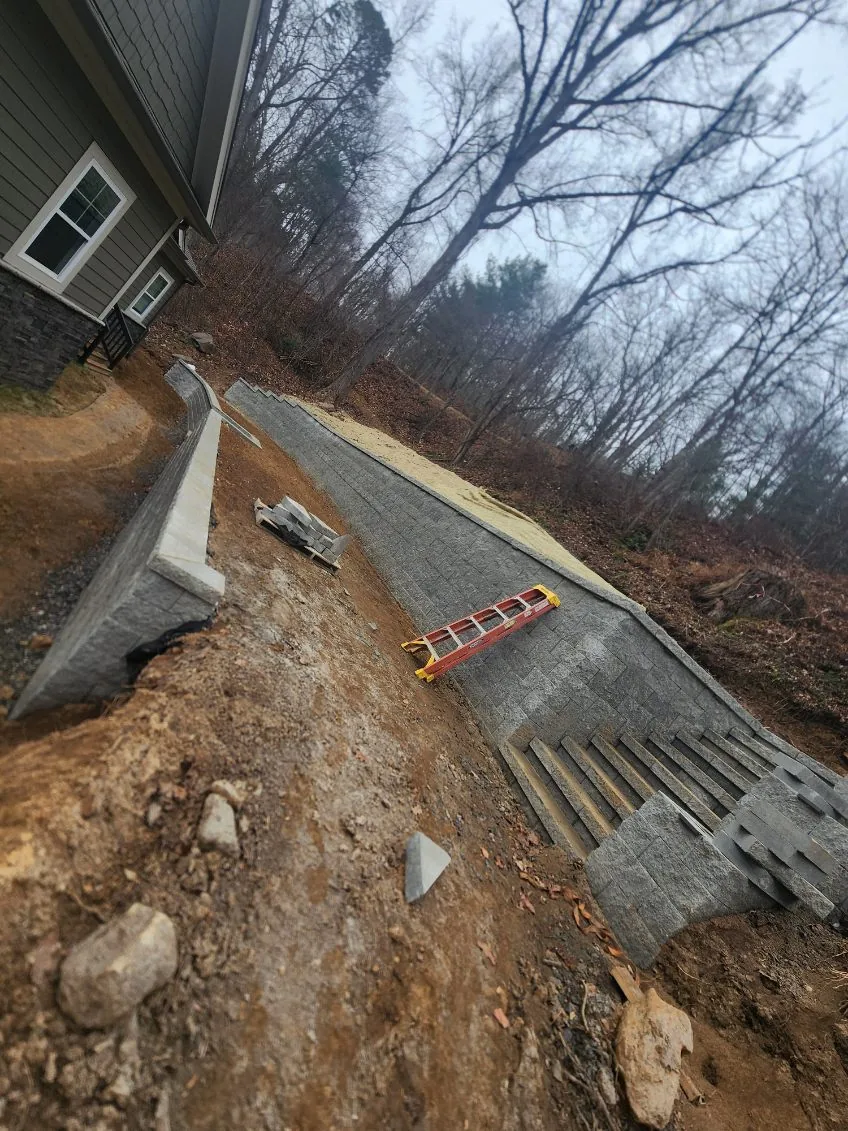
Here is how that plays out in Etowah specifically. Many properties sit on grades that drop 10 to 20 feet from the road to the house pad. A walkway that runs straight down that grade is essentially a seasonal creek bed during heavy rain. If the original builder laid the stones directly on grade with no base course and no diversion, the first repair attempt will fail. The honest scope calls for a rebuild with a compacted gravel base, a slight cross-slope to shed water, and a swale or French drain at the top to intercept runoff. That is a different project than resetting three loose treads.
Replace is rarer but real. If the existing stone is a thin veneer over a failing concrete core, or if the feature was built with a material that is no longer available, matching becomes impossible. In that case, the choice is to rebuild with a new stone that suits the house and the slope, or to repair what is there and accept that it will never look uniform.
What Etowah stone steps and walkways typically cost
Figures below are working regional ranges for Henderson County, not quotes. Slope, access, stone choice, and whether the existing work is being reused are the price movers. Full rebuilds on steep grade run toward the top of the range because of excavation and hauling.
| Scope | Typical range |
|---|---|
| Repoint and reset existing steps (sound base) | $600–$2,400 |
| New dry-laid stone walkway, 30–50 ft, mild grade | $3,500–$8,500 |
| Stone steps, 3–6 risers, mortared, moderate slope | $4,200–$11,000 |
| Steps plus walkway rebuild on steep grade (5+ risers) | $9,000–$18,000 |
| Site drainage added to an existing feature | $1,800–$6,500 |
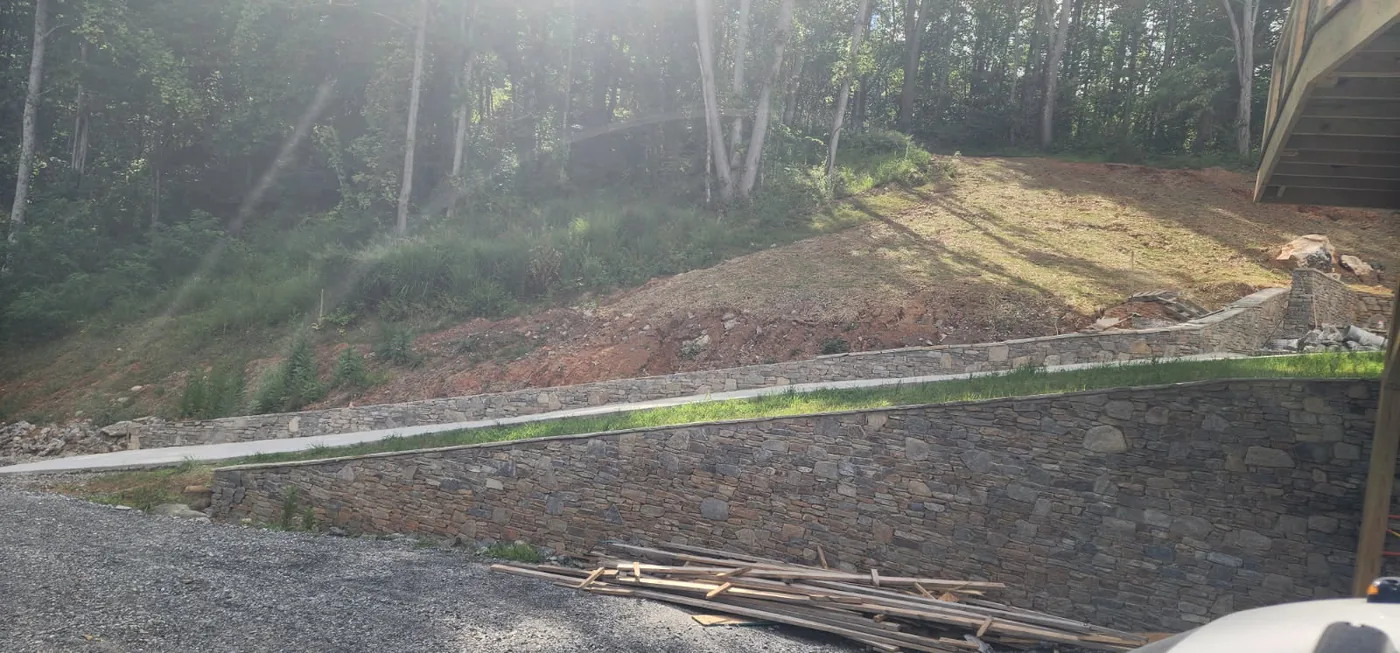
Compare against the Henderson County retaining wall cost table when the project also involves holding back a slope — the two line items usually travel together. The stone steps and walkways overview covers the full scope list.
Access matters more in Etowah than in flatland markets. A narrow driveway off a winding mountain road can mean a mini-excavator cannot reach the work area, and hand excavation adds labor hours. A steep backyard where the only path is through a gate means stone gets carried in by hand or by wheelbarrow. Those are not odd cases here; they are the norm on many lots. A quote that does not account for access is a quote that will change once the crew arrives.
Stone choice moves the number too. Reusing existing stone on site is the cheapest option when it is sound. Bringing in a regional fieldstone or a Tennessee flagstone adds material cost and hauling. Mortared work carries more labor than dry-laid because of the mixing, the jointing, and the curing time. None of that is hidden; it just needs to be in the scope from the start.
Water, code, and the rules that apply here
Almost every premature failure in Etowah stonework traces back to water. Runoff from an uphill neighbor, a roof downspout that dumps at the top of the steps, or a grade that was never corrected after construction — any of these will undo fresh stonework within a season or two. The federal disaster record explains why this is not a theoretical concern in Henderson County: 16 declared events touch this county across 1978-2026, and the storm and flood family dominates. The National Weather Service outlook for the southern Blue Ridge is the practical reference for how much rain a feature has to shed.
On structure, retaining features over a certain height and any work attached to a dwelling start running into code and licensing questions. The NC Licensing Board for General Contractors sets the threshold where a licensed general contractor is required, and the International Code Council publishes the model codes that North Carolina adopts for retaining walls and site work. If the project also disturbs a stream buffer or steep slope near a drainage, NCDEQ is the state agency with jurisdiction. None of that comes up on a small walkway reset — it does on a full rebuild on steep grade.
There is also a practical drainage rule that applies regardless of code: water should never be allowed to cross a set of steps. It should be intercepted above the top riser and diverted around. On Etowah's slopes, that often means a shallow swale, a buried drain line, or a small dry creek bed that carries runoff past the feature. Skipping that step is the single most common reason a rebuilt walkway fails within three years.
Choosing a crew that reads before it quotes
The crews worth hiring on an Etowah stone project ask about drainage before they ask about stone. They want to know where the water goes when it leaves the top step, how the existing base was bedded, and what the feature is actually carrying. A quote that arrives without a site visit or without a written read of the existing work is a placeholder, not a bid.
Ask to see the base exposed on at least one spot before tear-out. Ask what happens to the uphill grade. Ask whether the work will be dry-laid or mortared and why that choice fits this specific slope. When you are ready for a site read, the Etowah retaining wall and stonework contractors page is the right next stop. If the feature is doing structural work or has moved more than a few inches, treat it as a rebuild decision, not a repair decision, and get it looked at before another wet season.
One more local note: in Henderson County, the ground can be heavy clay in the hollows and rocky on the ridges. A crew that has worked both will know how to bed stone differently in each. Clay holds water and heaves in freeze-thaw cycles; rock drains fast but can shift if the base is not keyed in. A good crew adjusts the base detail to the soil they find, not to a standard spec they brought from somewhere else.