Why the driveway decides the price before the wall does
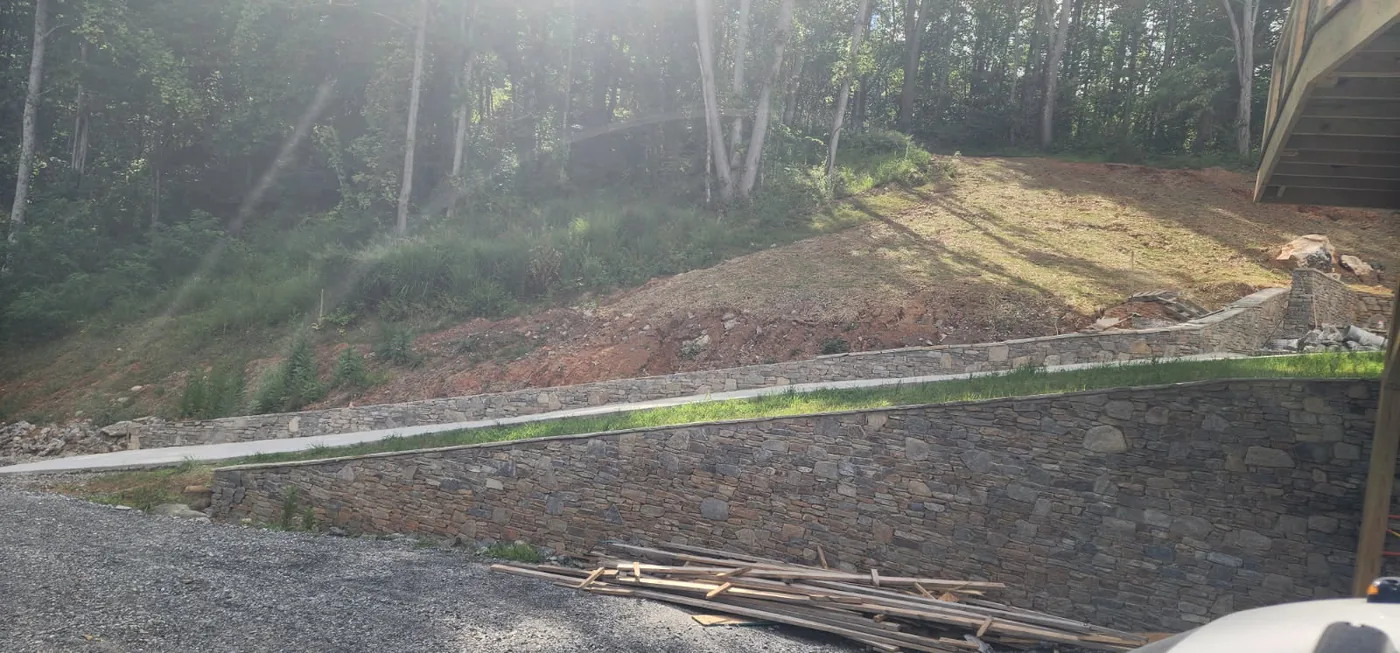
Hot Springs sits in a river gorge where the French Broad has been cutting a channel for a long time, and the town is stacked on the slopes that didn't get washed away. That means most retaining walls here aren't decorative garden terraces. They're holding a driveway pad, a house shoulder, or a switchback cut into a hillside so the property was buildable in the first place.
So the first thing a repair estimate hinges on isn't the wall. It's whether a dump truck and a mini excavator can physically reach the wall. A wall beside a county road with a pull-off is a different job than a wall 200 feet up a one-lane gravel drive with a hairpin and a low branch canopy. Every load of riprap, every pallet of block, every scoop of machine time has to make that trip — and if it can't, it gets moved by hand or by a tracked carrier at a fraction of the pace.
That access question is the reason two neighbors in Madison County can get quotes that differ by thousands for what looks like the same cracked wall. See the full range in the Madison County cost breakdown before you compare bids.
The haul line item nobody explains
This part of Madison County is not sitting on a quarry. Stone, gravel, drainage aggregate, and block all get trucked in from outside the immediate area, and the price of that haul shows up folded into line items rather than called out as freight. A job that needs 30 tons of material isn't just paying for the stone — it's paying for the truck to make the round trip, and paying again for the time it spends crawling up a grade instead of rolling on the highway.
Two things follow from that. One: wall repairs that reuse the existing stone and just rebuild the base and drainage are dramatically cheaper than replacements that bring in all new material. Two: on steep approach drives, it's often worth asking whether a smaller tracked machine and a material shuttle beats bringing in a full-size truck that can't turn around. The crew that raises this question unprompted is usually the crew that has actually worked this terrain. The Hot Springs contractor guide covers what to ask before you hire.
For sitework that involves drainage, soil disturbance, or stormwater, the EPA and International Code Council both publish material on erosion control and retaining structures that's worth a look if you're planning anything near a slope or waterway.
Gravity walls, segmental block, and what actually fails
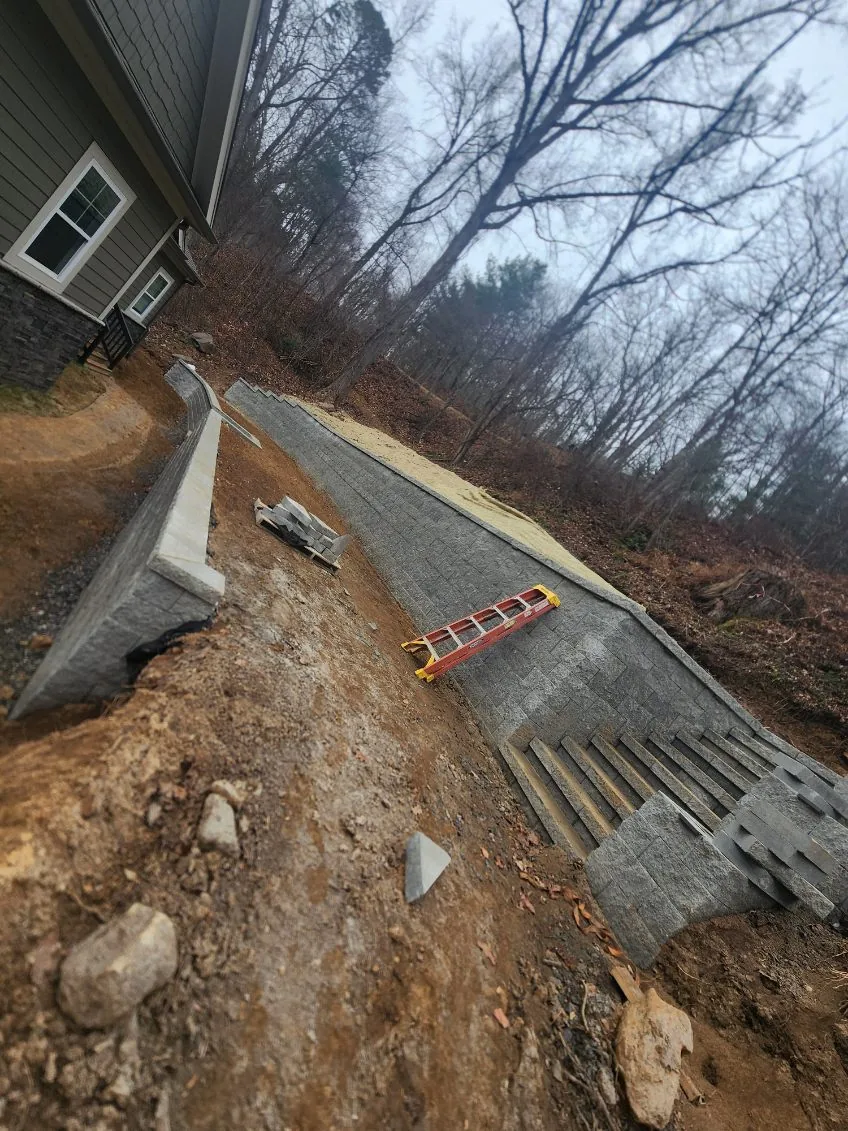
Three wall types dominate the housing stock around Hot Springs. Old gravity walls — stacked fieldstone or dry-laid native rock, often a hundred years old, sometimes built by whoever cleared the lot. Segmental block walls, which are the modern retaining standard and are engineered as a system with geogrid layers tying the block back into the hillside. And timber or crib walls, which were cheap to build decades ago and are now quietly rotting behind a shrub.
They fail differently. Gravity walls fail when water gets behind them and the soil above turns to slurry that pushes the wall outward. Segmental block walls fail when the geogrid was undersized, or drainage aggregate was skipped, or the base wasn't set below frost. Timber walls fail because wood does what wood does in a wet Appalachian climate.
The diagnostic tell is almost always the same: look for bulging, look for a lean that's worse than it was last spring, look for soil stains or fresh voids at the base, and look for water coming out anywhere except a designed weep point. A wall that only leaks after a big rain is a drainage problem. A wall that's leaning when it's dry is a structural one.
Scope and price ranges for Hot Springs wall work
These are regional bands for the work described, not a quote. Access, haul distance, and wall height all move the number, sometimes by a lot.
| Scope | Typical range | What drives it |
|---|---|---|
| Cracked block patching, minor re-pointing, weep points cleared | $1,800 - $3,500 | Wall length, whether scaffolding or ladders reach it |
| Drainage rebuild — footing drain, aggregate, outlet daylighted | $2,500 - $6,000 | Where the outlet can legally go, trench length, haul |
| Partial rebuild of a failed section (up to ~20 ft) | $4,000 - $9,000 | Height, access for machine or hand work, material reuse |
| Full segmental block replacement with geogrid | $8,000 - $30,000+ | Wall face area, engineering letter, tons of material hauled |
| Engineered wall on steep grade (per plan) | Quoted per site | Design, permit, machine access, haul road |
Anything that changes the load path or the grade behind a wall is likely to cross the threshold where North Carolina requires a licensed general contractor — the NC Licensing Board for General Contractors publishes the current dollar threshold and the rules. Ask for the license before the estimate, not after.
Storm history is why the walls here get tested
Madison County has seen 21 federally declared disaster events spanning 1978-2026, and the pattern is consistent — flooding and storm-driven rainfall, not drought. The French Broad corridor and the steep tributary hollows around Hot Springs take the brunt of it. Every one of those events put water behind retaining walls that were built assuming less of it.
The practical takeaway: when you repair a wall here, you're not just fixing a wall. You're deciding where the next big rain's water is going to go. A repair that skips drainage is a repair you'll do again. The retaining wall repair guide walks through how drainage and structure get sequenced on a proper job.