How an Etowah wall repair actually runs, start to finish
Most retaining wall calls in Etowah start the same way: a homeowner on a slope off Brevard Road or a ridge road above the French Broad bottoms notices the wall has begun to lean out at the top, or a course of block has shifted a half-inch after a wet spring. The repair itself follows a fixed order, and understanding that order is the best way to know whether a bid is serious.
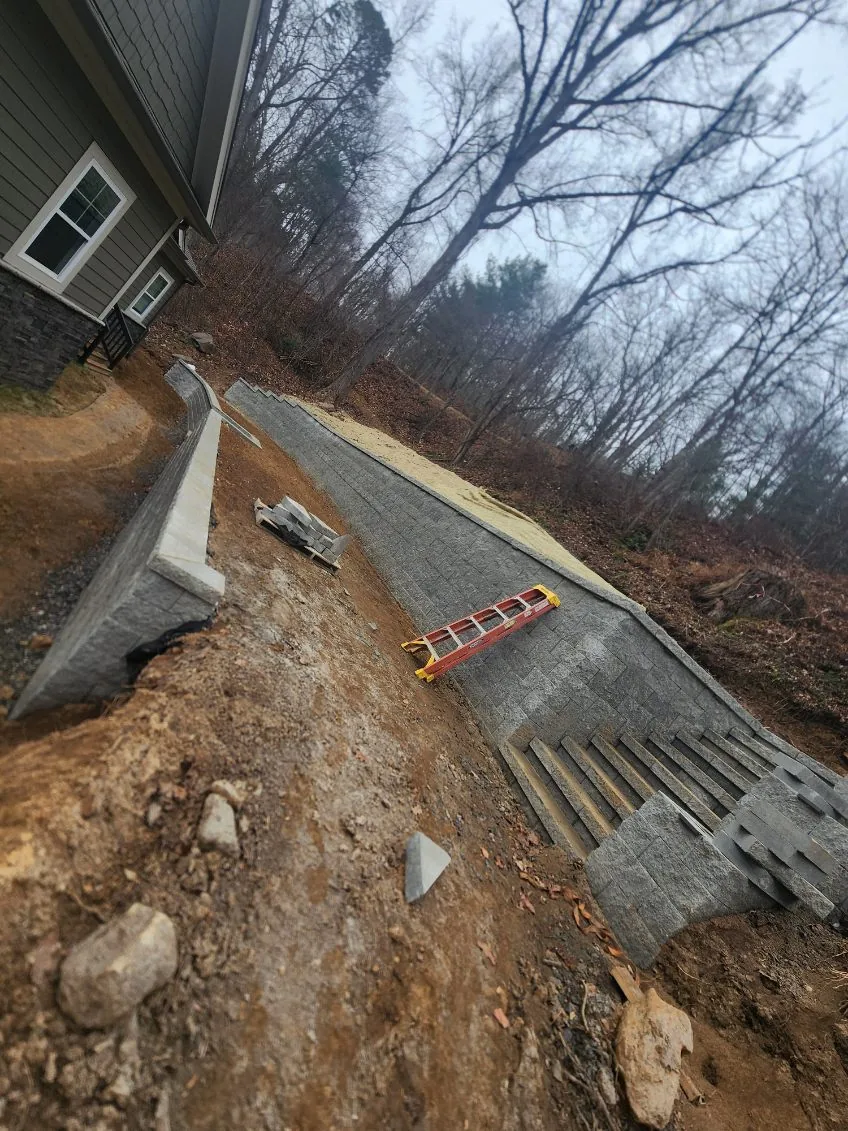
Step one is water, every time. A mason does not touch a leaning wall until the source of the saturation is identified: a downspout dumping behind the top of the wall, a driveway draining toward it, or a spring that surfaces at the base. Step two is excavation — pulling back soil behind the wall, in measured sections, never all at once, so the slope above isn't left unsupported. Step three is assessment once the wall is exposed: footing condition, block or stone integrity, and whether the original wall was ever built with drainage stone and weep holes. Step four is the actual repair or rebuild. Step five is drainage restoration, backfill in compacted lifts, and finish grading so the wall isn't asked to do the same job twice.
A short wall segment repair takes a day or two. A full rebuild of a 4-foot wall along 40 feet, including drainage correction, usually runs three to six working days. Bigger engineered walls on steep cuts can run one to two weeks, plus inspection scheduling.
What Henderson County slopes do to walls
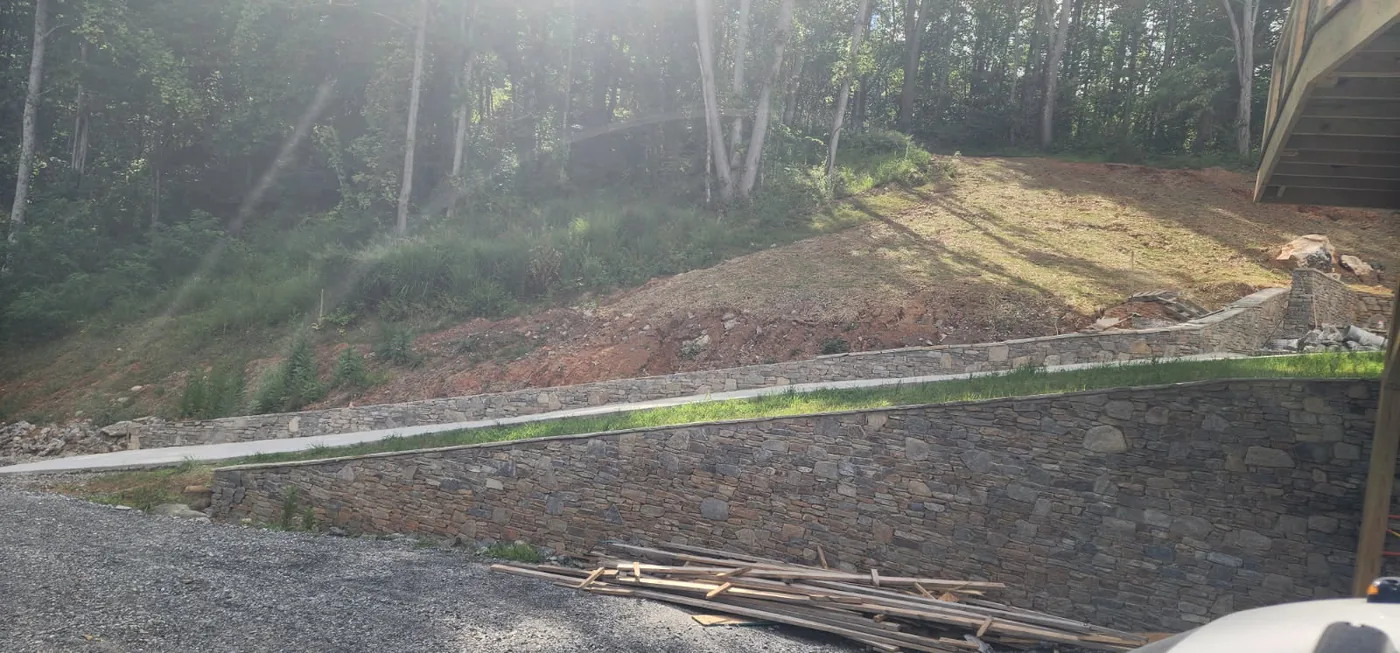
Etowah sits on Henderson County ground that was never flat. Ridge lots above the French Broad valley, cut-and-fill pads for homes built in the last thirty years, and older farm tracts along the river bottoms all produce retaining walls that face different loads. A wall holding back a graded cut on a 20-percent slope is carrying far more lateral force than a 2-foot garden wall on level ground, and the failure patterns look different: bulging mid-face on tall walls, rotation at the top on short ones, and settlement of the entire footing on fill soils.
Henderson County's wet season and the region's storm record both matter here. 16 federally declared disaster events have touched this county over a span of 1978-2026 years, and the pattern is overwhelmingly storm and flood related. Every one of those events put water against walls that were built for a drier assumption. That is why the first line of any honest wall repair in Etowah is drainage, not block.
Scope versus cost, line by line
Numbers below are regional ranges for Henderson County work as of recent seasons. They are not quotes; a real number requires seeing the wall. For a full breakdown by wall type and height, see the Henderson County retaining wall cost page.
| Scope | Typical range | Notes |
|---|---|---|
| Weep hole clearing, minor repointing, cosmetic repair | $300-$900 | Short walls, no movement, water source already handled |
| Section rebuild (10-20 ft, under 3 ft tall) | $1,800-$4,500 | Includes block replacement and drainage stone in that section |
| Full rebuild, 3-4 ft wall, 30-50 ft run, drainage included | $4,500-$11,000 | Geogrid typically added if wall exceeds 4 ft or soil is fill |
| Engineered rebuild, 6 ft+, with geogrid and stamped plan | $12,000-$30,000+ | Requires design; sequencing and inspection add days |
| Drainage correction alone (French drain, regrade, downspout extensions) | $1,200-$5,500 | Often the correct first job before any wall work |
Any bid that skips drainage stone, compaction, or engineering on a tall wall is incomplete rather than cheap. The NC Licensing Board for General Contractors sets the threshold at which a project needs a licensed general contractor, and tall retaining walls with structural design generally cross it.
The order your project will actually be scheduled
Because wall work is sequenced around weather and inspection, the realistic timeline looks like this: initial site visit and slope observation, then a written scope, then drainage diagnosis, then material and inspection scheduling, then excavation and rebuild in measured lifts, then backfill and finish grade. On a typical Etowah job, from signed scope to finished wall runs two to five weeks, with rain pushing the excavation phase.
Two things slow jobs more than anything else locally. First is discovering the original wall had no drainage at all, which means every course has to be pulled rather than patched. Second is steep access, where equipment can't reach the top of the wall and every load of stone or block has to be moved by hand. Both are visible during the site visit, and both should show up in the scope rather than as a surprise change order. When you're comparing bids, the Etowah wall contractor page covers what to look for, and the retaining wall repair overview explains the difference between a patch, a section rebuild, and a full reconstruction.
Rules and conditions that shape the work
Retaining walls that change stormwater flow or sit near a stream buffer can trigger review under state environmental rules — the NC Department of Environmental Quality administers those programs, and Henderson County has its own land-development and setback requirements layered on top. Before a rebuild, check whether the wall's height or location triggers a permit; tall walls near slopes or waterways often do.
Construction safety and soil retention practice follow published standards too, and the International Code Council publishes the model codes that North Carolina adopts and amends. Practical takeaway: on anything taller than about four feet, or any wall on fill soil, get a design, get a permit if it applies, and expect the drainage to be engineered as carefully as the block.
For weather timing, the National Weather Service Greenville-Spartanburg office covers Henderson County forecasts, and the practical rule here is that excavation behind a wall should not be left open through a forecast multi-inch rain event.