The four-foot line that decides your Fletcher patio budget
Fletcher sits in Henderson County on ground that tilts. Lots near the Cane Creek and Hooper's Creek bottoms run flat and wet; lots up toward Howard Gap and the Burney Mountain side fall fast enough that a patio is really a retaining project with pavers on top. That difference isn't cosmetic. It's the four-foot line.
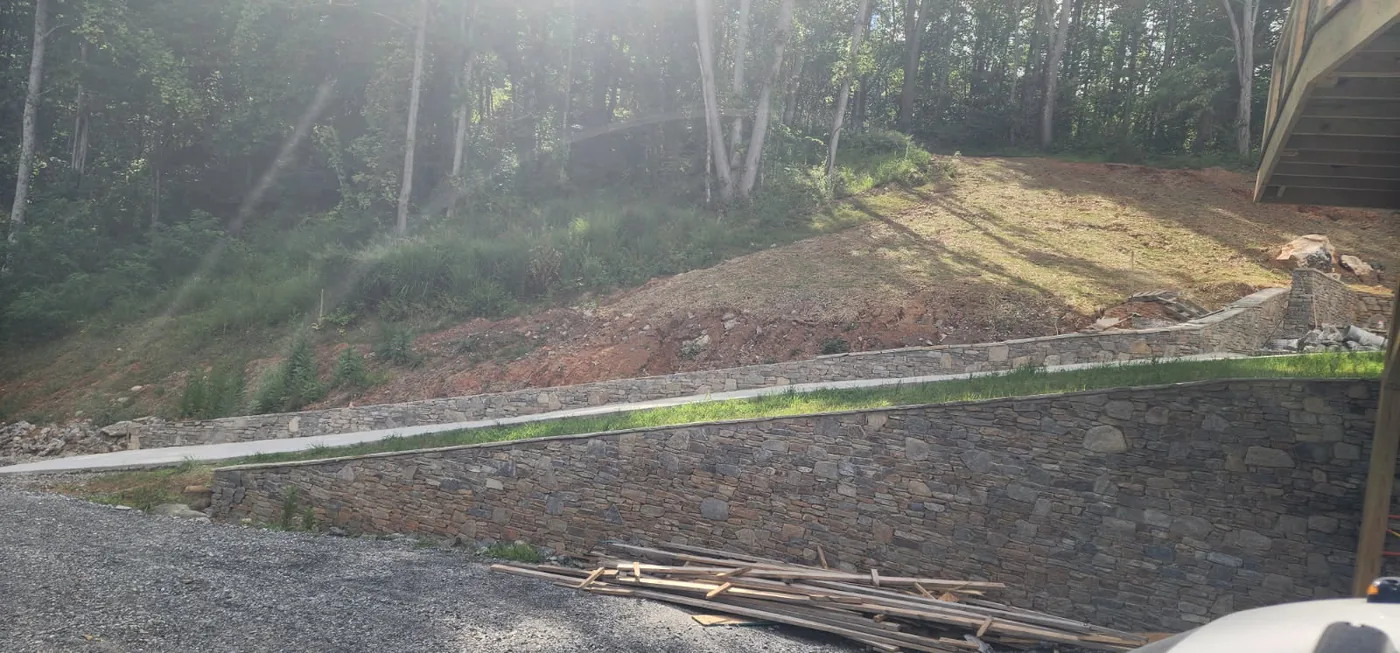
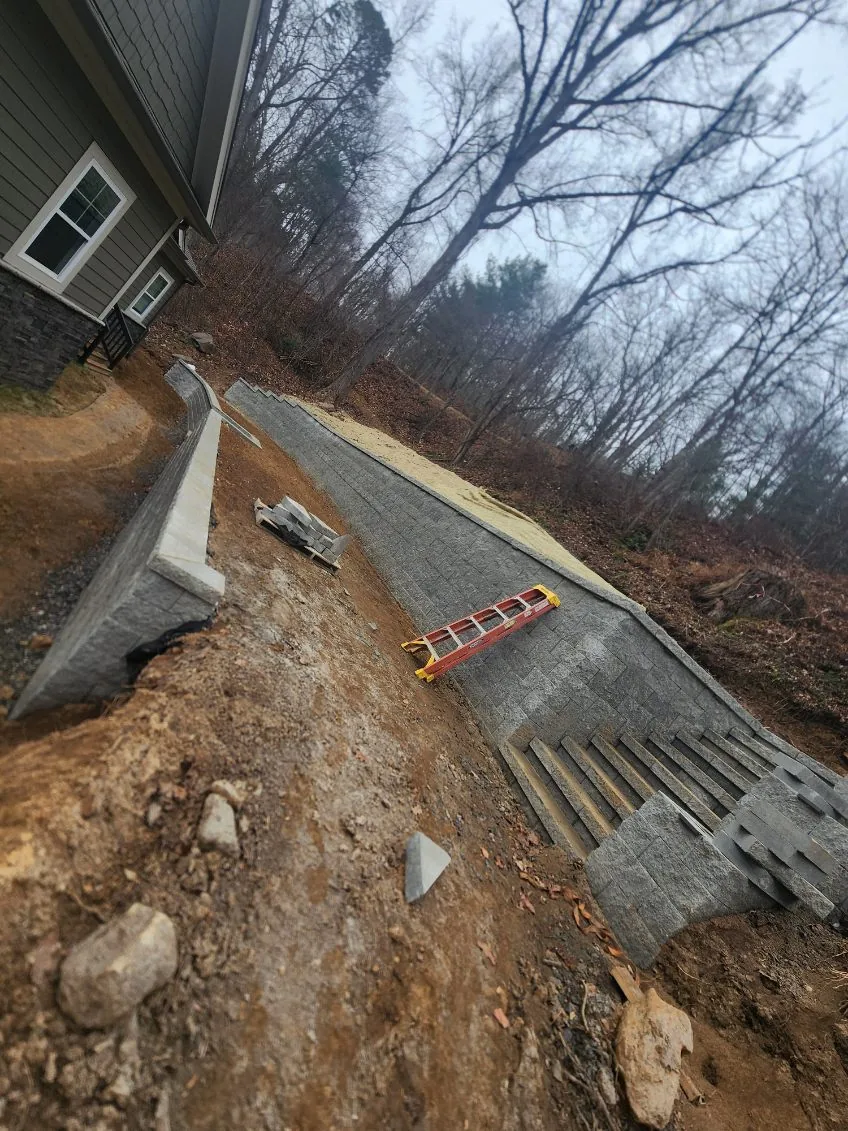
In North Carolina, a retaining wall under 4 feet of retained height is generally treated as a simple structure, but once it holds back more than 4 feet it typically needs design by a licensed professional and a building permit. On a sloped Fletcher lot, that line can double the project scope: excavation, engineered wall sections, drainage behind the wall, and inspection before backfill. If your plan is a patio cut into a hillside, ask every installer where the wall crosses 4 feet and who stamps the drawings. Our Fletcher retaining wall page covers that handoff in detail.
Under 4 feet, the job is usually straightforward paver work. Over it, you're buying engineering. Both are honest; only one is cheap.
Here's a real-world example from a Burney Mountain-area lot: a homeowner wanted a 300-square-foot patio tucked into a slope that dropped about 5 feet from the house to the yard. The initial vision was a simple paver pad. But because the retaining wall at the back edge would hold back 5 feet of soil, the project required a stamped design from a licensed engineer, a building permit through Henderson County, and an inspection of the drainage before backfill. The patio surface itself didn't change, but the wall depth, gravel, and engineering added weeks and thousands. On flatter lots near Cane Creek, that same 300 square feet might be a straightforward weekend of base prep and laying pavers, with no permit at all.
Another local wrinkle: many Fletcher properties sit on clay-heavy soil, which swells when wet and shrinks when dry. When a wall crosses the 4-foot threshold, the engineer will often specify a deeper, wider footing and more robust drainage than you'd see on a sandy lot. That's not upselling; it's because the soil here moves. A wall that would be fine at 3 feet on a well-drained slope might need helical piers or a geogrid-reinforced segmental block system at 5 feet on clay. The four-foot line triggers that analysis, and it's why the same patio size can have wildly different quotes.
What should you ask? First, "Where exactly does my wall cross 4 feet of retained height?" Second, "Who is stamping the drawings, and will the permit be pulled before excavation?" Third, "How will water behind the wall be directed?" A contractor who can answer those three questions in plain language is likely to build a patio that lasts. One who waves them off is hoping you won't notice until the wall leans.
What Fletcher patios actually cost
Prices below are typical regional bands for Henderson County, not quotes. The two biggest movers are base depth (clay or fill soil needs more crushed stone) and access (a wheelbarrow path across a steep side yard adds labor fast).
| Scope | Typical range |
|---|---|
| Small patio, 150–200 sq ft, simple rectangular, good access | $6,500–$9,500 |
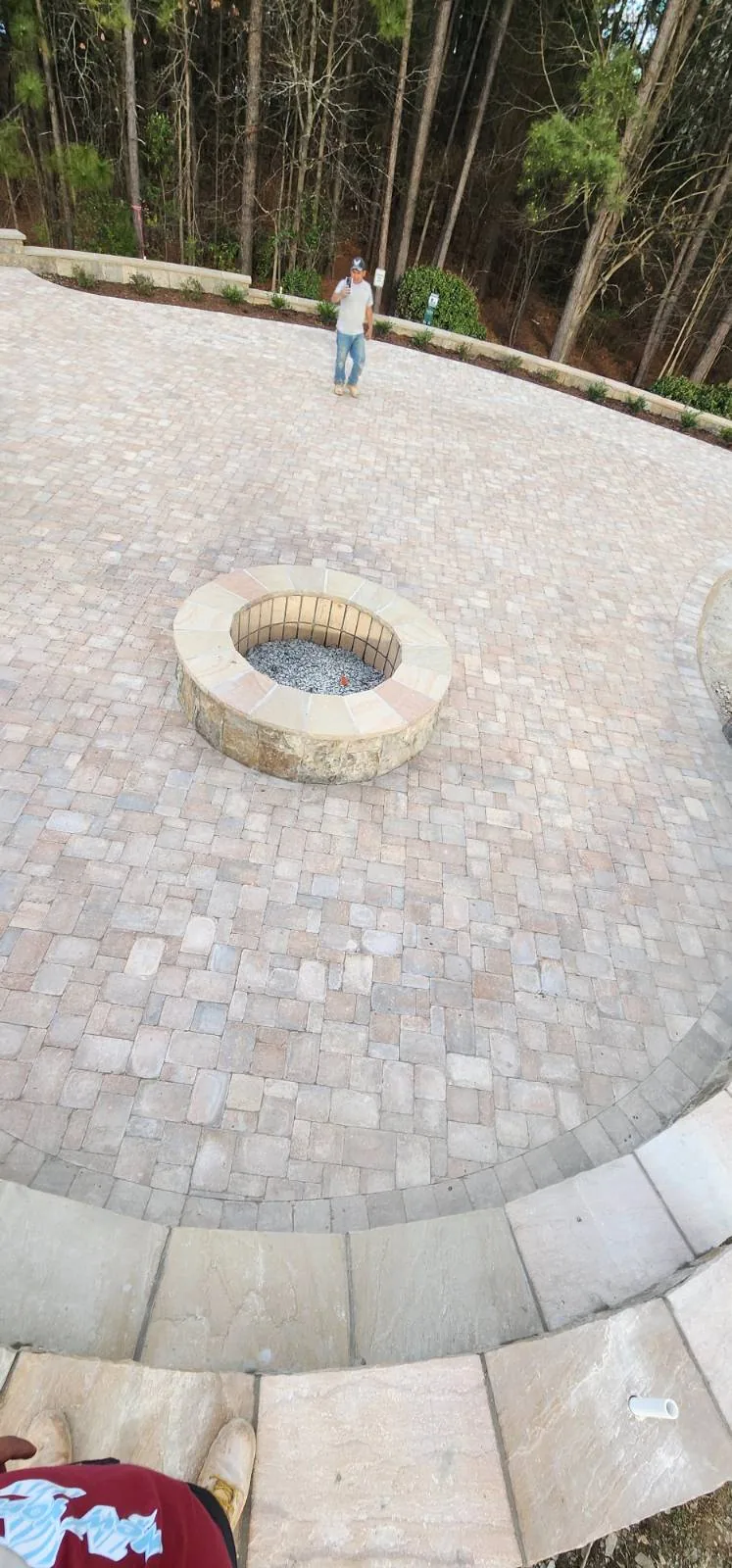
| Mid-size patio, 250–400 sq ft, with a seating wall or step | $9,500–$16,000 |
| Large patio, 400–600 sq ft, curves, steps, and drainage work | $16,000–$22,000 |
| Grade change under 4 ft: added steps, terracing, or low wall | +$2,000–$6,000 |
| Wall over 4 ft: engineering letter, permit, and inspection | +$4,000–$12,000 |
| Standalone retaining wall (no patio) | see the Henderson County wall cost table |
Two things that aren't line items but show up anyway: disposal of excavated clay soil, and a drainage path for water that used to run where the patio now sits. Skipping drainage is how patios heave in year three.
Access is the quiet budget killer. On a lot where the only way to the backyard is a narrow side yard or a steep slope, every paver, bag of stone, and bucket of sand moves by hand or with a compact machine that may or may not fit. That adds labor hours, and labor is the biggest variable in any paver quote. A project quoted at $12,000 on a flat lot with a driveway nearby might be $16,000 on a hillside lot where the base material has to be craned or wheeled in. Ask your installer how they plan to get materials to the work area; the answer tells you whether their quote accounts for reality.
Base depth is the other invisible cost. Fletcher's clay subsoil doesn't drain like sand, so a proper base often runs 6 to 8 inches of compacted crushed stone instead of the 4 inches you might see in drier parts of the state. That's more material and more compaction time, but it's the difference between a patio that stays put and one that ripples after a wet winter. A quote that seems low may simply be skipping base depth; ask what's under the pavers.
Drainage is the third wildcard. If the patio replaces a low, wet spot where water used to pool, you may need a French drain, a dry well, or a swale that moves water to a real outlet. That can add $1,500 to $4,000 or more depending on how far water has to travel and whether the outlet is legal. The EPA's stormwater guidance at epa.gov explains why you can't just push runoff onto a neighbor's property. In Fletcher, where lots often back up to a creek or a wooded slope, the drainage plan is part of the patio, not an accessory.
Why water decides whether the patio survives
Henderson County sits in a wet corner of the state, and the federal record backs it up: 16 declared disaster events have touched this county across 1978-2026, mostly storm and flood family. That history matters for pavers because water is what kills patio base. When rain hits a compacted surface and can't go down or away, it migrates under the edges, softens the bedding sand, and the pavers start rocking and settling out of plane.
The fix is built in, not added later: slope the finished patio a minimum of roughly 1 to 2 percent away from the house, run a proper edge restraint, and give the base a way to drain. The NC Building Code Council treats site drainage and grading as part of the residential code for good reason, and the EPA's stormwater guidance at epa.gov explains why runoff from a new hard surface shouldn't be aimed at a neighbor's lot. On Fletcher lots with clay subsoil, that means a designed outlet, not just a swale that ends at the property line.
Edge restraint is the most overlooked piece. Without a solid edge, pavers spread outward over time, joints widen, and the whole surface loosens. In Fletcher, where freeze-thaw cycles can work on a patio all winter, a concrete curb or paver edging set in concrete is standard for a reason. Ask your installer what they use at the edges; if they say "nothing, the pavers lock together," find someone else.
Another local reality: many Fletcher yards drain toward the house, not away from it. That's often how the lot was graded before the patio existed. A proper installation re-grades the area so water sheds away from the foundation, which may mean raising the patio slightly, adding a step at the door, or cutting a channel drain across the patio surface. None of that is glamorous, but it's the difference between a patio you use for twenty years and one that heaves in year three. The broader paver patio guide covers these details, but the short version is: if water doesn't have a plan, your patio will become the plan.
Who's allowed to build it, and when a permit is required
A simple paver patio on grade is usually not a permitted structure in North Carolina. That changes the moment your project involves a retaining wall over 4 feet, a structural element attached to the house, or substantial grading. Those cross into work that the NC Licensing Board for General Contractors cares about, because the state sets a dollar threshold above which a project must be run by a licensed general contractor.
Practical Fletcher checks before you sign anything: ask who holds the license if the job crosses the threshold, ask for the engineering letter if a wall exceeds 4 feet, and ask whether the wall needs inspection before backfill. A crew that hesitates on any of those three either hasn't done the work at this elevation or is hoping you won't ask. The broader paver patio guide walks through what a complete scope looks like, but the shortcut is simple: whoever you hire should put wall height, base depth, drainage outlet, and permit responsibility in writing.
Permits in Henderson County are handled by the county's building inspections department, and the process generally requires submitting engineered drawings for walls over 4 feet, paying a fee, and scheduling inspections at foundation, drainage, and final stages. The timeline can add several weeks before the first paver is laid. On a simple patio under the threshold, no permit is typically needed, but you still want a written contract that spells out who is responsible for what. If a contractor tells you permits aren't needed for a 6-foot wall, that's a red flag. The state's licensing board at nclbgc.org publishes the thresholds and complaint process if you need to verify.
Insurance and workers' comp are the other checks. Ask for a certificate of insurance showing general liability and, if they have employees, workers' compensation. A contractor without insurance is a risk you shouldn't take, especially on a job that involves excavation and heavy materials. In a small market like Henderson County, word travels, but it's still worth the five minutes to verify. The Fletcher retaining wall page has more on how to vet a crew for wall work specifically.
What a complete paver patio quote looks like
The best way to compare quotes is to see what's included, not just the bottom line. A complete quote for a Fletcher patio should list: square footage and shape; base depth and material (e.g., 6 inches of compacted crusher run); bedding sand type; paver brand and style; edge restraint method; drainage plan and outlet; steps or seating walls with dimensions; and whether permit or engineering is included. If any of those are missing, ask. A low quote that omits base depth or drainage isn't cheaper; it's just incomplete.
Also ask about the schedule and who will be on site. Will the owner be there, or a crew that rotates between jobs? How long will the yard be torn up? Will they protect the lawn and driveway? In Fletcher, where many homes sit on wooded lots with limited access, staging matters. A crew that plans to park a dump trailer on the street for a week may not have thought through your neighborhood's parking realities.
Finally, talk about the long term. Pavers need joint sand replenishment every few years, and a sealed patio may need resealing every three to five years depending on exposure. Ask what maintenance they recommend and whether they offer it. A good installer will give you a straightforward answer, not a sales pitch. The goal is a patio that looks right on day one and still looks right after a decade of Henderson County weather.