Fieldstone, boulder, block, timber: what a Weaverville water feature is actually built from
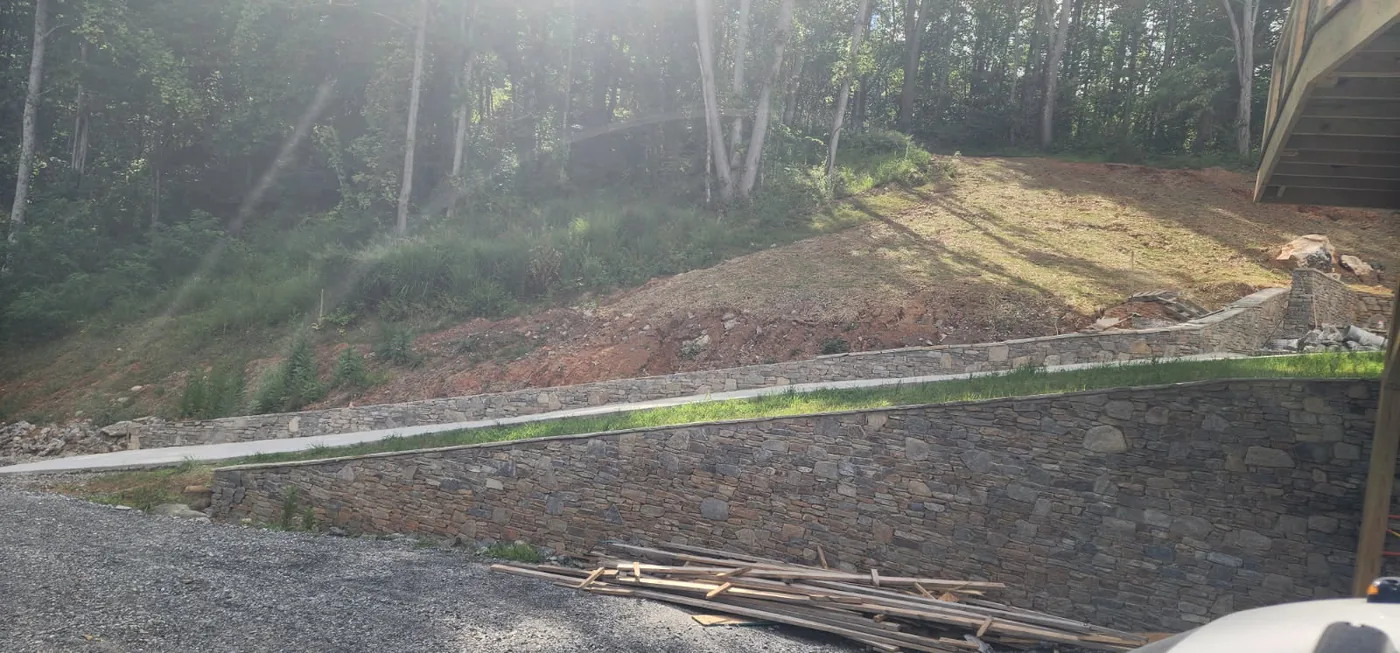
Drive out Reems Creek Road or up toward Barnardsville and you'll see the material palette that defines this corner of Buncombe County: dry-stacked fieldstone retaining the grade, big granite boulders left where the excavator set them, timber cribbing holding older terraces, and cinder block from the mid-century builds that got painted to look like stone. A waterfall or pond here is almost never a catalog kit — it's assembled from what the ground already has, plus whatever gets trucked in when the on-site rock won't stack clean.
That matters for budget. A Weaverville yard with usable fieldstone and a natural fall line is a very different project than a flat lot off Weaverville Highway where every rock and every inch of drop has to be imported. Ask any builder you talk to which of those two lots they think you own — the answer should come before the estimate, not after. Our stone waterfalls and ponds overview covers the build types in more detail.
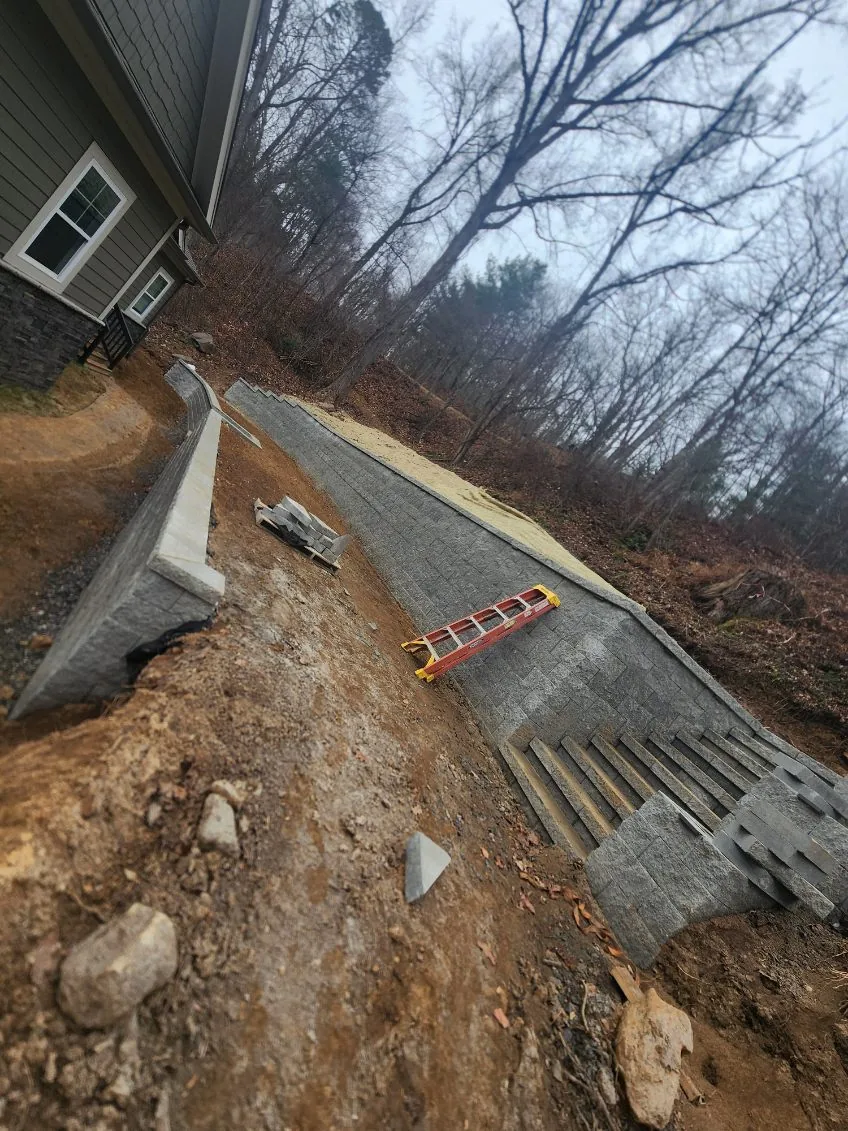
Weaverville's housing stock splits roughly into three groups, and each one changes the water feature conversation. The older farmhouses and mill cottages along Reems Creek and Ivy Creek usually sit on ground that's been worked for generations — there's often a spring box, an old cistern, or a stone foundation remnant already on the property, and matching that existing stone is both cheaper and better-looking than importing pallets of manufactured veneer. The mid-century and 1970s ranchers closer to downtown Weaverville tend to have flatter, graded yards where the fall line has to be created rather than found, which means more excavation and more boulder placement. And the newer ridge and hillside builds off Reems Creek Road, Weaverville Highway, and the roads climbing toward the Blue Ridge divide often have the steepest grades and the most exposed rock — good news for material, tricky news for access. A track hoe or mini excavator may not fit between the house and the slope, and hand-carrying boulders up a 30-degree grade is a real cost line, not a footnote.
Timber shows up more than people expect, too. Older Weaverville properties frequently have locust or oak posts holding a terrace that's been there since the 1960s or 70s. When those come out for a new water feature, the honest move is often to reuse or replace them in kind rather than switch to a modern material that looks out of place against the surrounding stone. Builders who work this county regularly know the local quarries and the local stone yards, and they know which fieldstone from which hollow tends to stack and which tends to shatter.
What a Weaverville waterfall or pond costs
These are regional working ranges, not quotes — Weaverville pricing sits close to the rest of Buncombe County because crews, rock, and liner all come from the same suppliers. Scope drives nearly everything.
| Scope | Typical range | What drives it |
|---|---|---|
| Small recirculating boulder fall, 3-6 ft drop | $3,200-$6,500 | Boulder count, pump and liner, how close a truck can park |
| Pondless stream and fall, 10-20 ft run | $5,500-$11,000 | Linear footage, grade change, basin size |
| Full lined pond with waterfall, 8x12 ft and up | $8,000-$14,000+ | Excavation volume, rock edging, filtration, access |
| Fieldstone retaining plus waterfall integrated | Bundled with wall; see wall table | Overlaps with retaining scope — see below |
| Pump, liner, or filter replacement only | $600-$2,800 | Pump size, liner area, whether rock must be reset |
Retaining and water features frequently ride the same permit and the same crew day, so if your project also holds back slope, read the Buncombe County retaining wall cost breakdown before you sign anything — bundling is where honest savings live.
A few Weaverville-specific cost realities are worth naming plainly. First, access. If the only route to your build site is a gravel drive off a switchback, or a path narrower than a Bobcat, every yard of rock and every bucket of spoil moves by hand or by small machine. That alone can push the same design into a different band. Second, water source and top-off. A recirculating feature loses water to evaporation and splash, and on a mountain lot the make-up water often comes from a well rather than municipal supply. If your well is marginal in late summer, that's a design consideration before it's a cost line, and a builder who asks about it is a builder who has done this before. Third, winter. Weaverville sits high enough that hard freezes and snow-load cycles matter. Pumps, check valves, and biofalls need to be set so they can be drained or left running through a freeze without cracking, and that detailing is part of the build, not an add-on.
On the higher end, a full lined pond with a waterfall and proper filtration is a small civil project: excavation, underlayment, liner, rock placement, pump vault, biological filtration, and often a skimmer and aeration. The $8,000-$14,000+ band reflects that. On the lower end, a compact boulder fall on an existing grade that already drops is genuinely a multi-day job, and $3,200-$6,500 is realistic when the rock is close and the slope does half the work for you. The middle band — a pondless stream of ten to twenty feet — is the most common Weaverville request, because it delivers the sound and the look without the open-water maintenance of a pond, and pondless systems are easier to leave alone through a mountain winter.
Slope, runoff, and the Blue Ridge water problem
Weaverville gets serious rain, and the federal record backs that up: 19 declared disaster events touch this county across 1973-2026, overwhelmingly storm and flood family. A water feature on a mountain lot has to be designed for the storm it will actually see, not the average Tuesday. That means overflow routing, a basin that can take a surge without washing out, and rock set so a hard rain doesn't rearrange it down your neighbor's hill.
The Environmental Protection Agency's stormwater guidance at epa.gov is worth a read if your pond will sit anywhere near a drainage way or a creek buffer — Weaverville sits in the Reems Creek and Ivy Creek watersheds, and what leaves your yard ends up in somebody's drinking water. Set the overflow deliberately and you avoid the repair call later.
Here's what that looks like in practice on a Weaverville slope. Water arrives at the top of the lot faster than it leaves the bottom, so a feature placed mid-slope is catching drainage from everything above it. The overflow has to be sized for that contributing area, not just for the feature's own volume. In a hard rain, a pond with an undersized overflow becomes a dam, and a dam eventually becomes a washout — usually at the worst moment, usually taking rock and liner with it. Builders who work this county build in a defined overflow path, often a rock-lined spillway that daylight somewhere safe, and they build the basin with a freeboard margin above the normal water line so a surge has somewhere to go before it goes over the edge.
There's also the freeze-thaw question. Buncombe County's winter cycles can push water into cracks, freeze, and pry rock apart over a few seasons. Underlayment and liner selection, and the way boulders are seated and chinked, all affect how a feature holds up after several mountain winters. None of that is exotic — it's just the local weather, and a builder who has built here for a while has watched features survive and fail and will design for the former.
Permits, licensing, and who should be on the job
Two thresholds matter here. First, if the project includes retaining structure over a certain height or any structure tied to a dwelling, North Carolina general contractor licensing rules kick in — check the NC Licensing Board for General Contractors before you hire. Second, any work that ties into household plumbing, a dedicated water supply, or an outdoor kitchen sink falls under the NC State Board of Examiners of Plumbing, Heating and Fire Sprinkler Contractors. Electrical for pumps and lighting is its own licensed trade. A good Weaverville builder will name which parts of your job need which license instead of waving the question off.
For the code side, the NC Building Code Council publishes the residential provisions that govern retaining walls and exterior structures. Local permitting runs through Buncombe County, and requirements shift with slope and proximity to water — verify before you dig, not after.
In practice, most small recirculating boulder features and pondless streams in Weaverville do not require a building permit. But the moment the feature involves a retaining structure tall enough to trigger the code threshold, a pump circuit wired to a permanent outdoor outlet, or any placement inside a creek buffer or a mapped floodplain, the permitting picture changes. Buncombe County reviews vary with slope and with proximity to water, and the county has its own rules about grading and stormwater on steep sites. The honest answer is that the same design can be a permit-free weekend project on one Weaverville lot and a permitted, engineered build on the next lot over. That's why a site visit before the estimate is not a sales tactic — it's the only way to know which lot you actually own.
The licensing question is separate from permitting. A stone mason can build a beautiful dry-stacked feature without a general contractor license. But when the work is structural, when it's tied to a dwelling, or when it crosses a dollar threshold set by the state, the general contractor license becomes a legal requirement, not a nice-to-have. Similarly, if the feature includes an outdoor sink, a fill line tied into the home's plumbing, or a permanent water supply, that portion is plumbing work and belongs to a licensed plumbing contractor. Electrical for pumps, lighting, and any outdoor outlets belongs to a licensed electrician. A qualified Weaverville builder will tell you which parts of your job need which license and won't try to do licensed trade work on an unlicensed basis.
Choosing a builder in this market
Ask three things. Whether they'll set rock from your own lot if it's usable — that's real money back in your pocket and it's the difference between a Weaverville feature and a generic one. Whether they show you the overflow plan in writing. And whether their reference jobs are on slope, because a flat-lot pond builder is not the same trade as someone who has stacked boulders on a 30-degree Blue Ridge grade.
If retaining is part of the scope, cross-check against our Weaverville retaining wall contractors page for the questions specific to wall work. Then get two or three builds walked in person — water features are one of the few trades where a site visit tells you more than any portfolio photo ever will.
A few more things worth doing. Drive by a finished job after a heavy rain if you can — a feature that handles a Weaverville storm without muddy water, displaced rock, or a washed-out edge is a feature built by someone who knows this county. Ask whether the builder is local or comes in from out of the area; someone who works this terrain regularly knows the soil, the rock, the access problems, and the freeze cycles, and that knowledge shows up in how the thing holds up after three winters. Ask for a written scope that names the pump model, the liner type, and the overflow design, not just a lump-sum number. And ask what happens if a boulder shifts or a pump fails in the first year — a builder with a clear answer is a builder who stands behind the work.
Finally, look at the jobs they've done on the same kind of ground yours is on. A Weaverville feature built into a hillside off Reems Creek Road is a very different animal from one built on a flat graded yard, and a portfolio that's all flat-lot ponds tells you something. The right builder for your project is the one whose past jobs look like your lot, not the one with the biggest portfolio.