How the work unfolds, start to finish
Weaverville sits just north of Asheville in Buncombe County, and its housing splits into three rough groups: early-1900s mill-era homes near the downtown core, mid-century brick ranches on flatter ground toward Lake Louise, and newer builds cut into the slopes along Reems Creek and Weaverville Highway. Each produces a different stone veneer job, and the sequence matters as much as the finish.
The order is fairly fixed. Day one is demolition and surface prep: pulling old siding, checking the sheathing, and deciding whether a drainage plane or new moisture barrier is needed. Days two and three are weather barrier, metal lath, and weep screed at the bottom. Then the scratch coat goes on and needs at least 24 hours to cure before any stone touches it. Stone setting usually runs five to twelve working days depending on square footage and pattern complexity, followed by grouting, cap or sill detail, and cleanup. Two to five weeks total is normal here, longer if weather or inspections intervene.
On the mill-era homes near downtown, day one is rarely just demolition. Pulling siding on a 1920s house often exposes knotted board sheathing that has to be addressed before anything new goes on. On the Reems Creek slope builds, day one may start with staging and access setup because the crew cannot walk a wheelbarrow around the house. On brick ranches toward Lake Louise, the wildcard is the existing brick: if it's sound and flat, lath can sometimes go directly over it with the right bonding approach, saving days. If it's spalling or sealed, prep changes the whole schedule.
Material delivery is its own step in Weaverville because many lots have short or steep driveways. Stone arrives on pallets, and if the truck cannot get close to the wall, the crew hand-carries or uses a conveyor, adding a day up front. That is one reason two quotes for the same wall can differ: one estimator assumed easy access, the other walked the driveway.
What each scope actually costs here
Below is what a real quote breaks into. These are regional bands for Buncombe County work, not a flat rate and not a promise until someone looks at your wall. See the full stone veneer service guide for what a proper scope letter should contain.
| Scope | Typical range | What drives it |
|---|---|---|
| Single accent wall (interior or porch) | $2,400-$6,500 | Square footage, stone type |
| Front entry + porch piers | $6,000-$14,000 | Detail work, corners, cap |
| Full front facade of a ranch | $14,000-$28,000 | Sheathing replacement, lath area |
| Chimney re-clad | $4,500-$11,000 | Height, staging, access |
| Full house (multi-story, sloped lot) | $28,000-$55,000 | Scaffolding, drainage plane, prep |
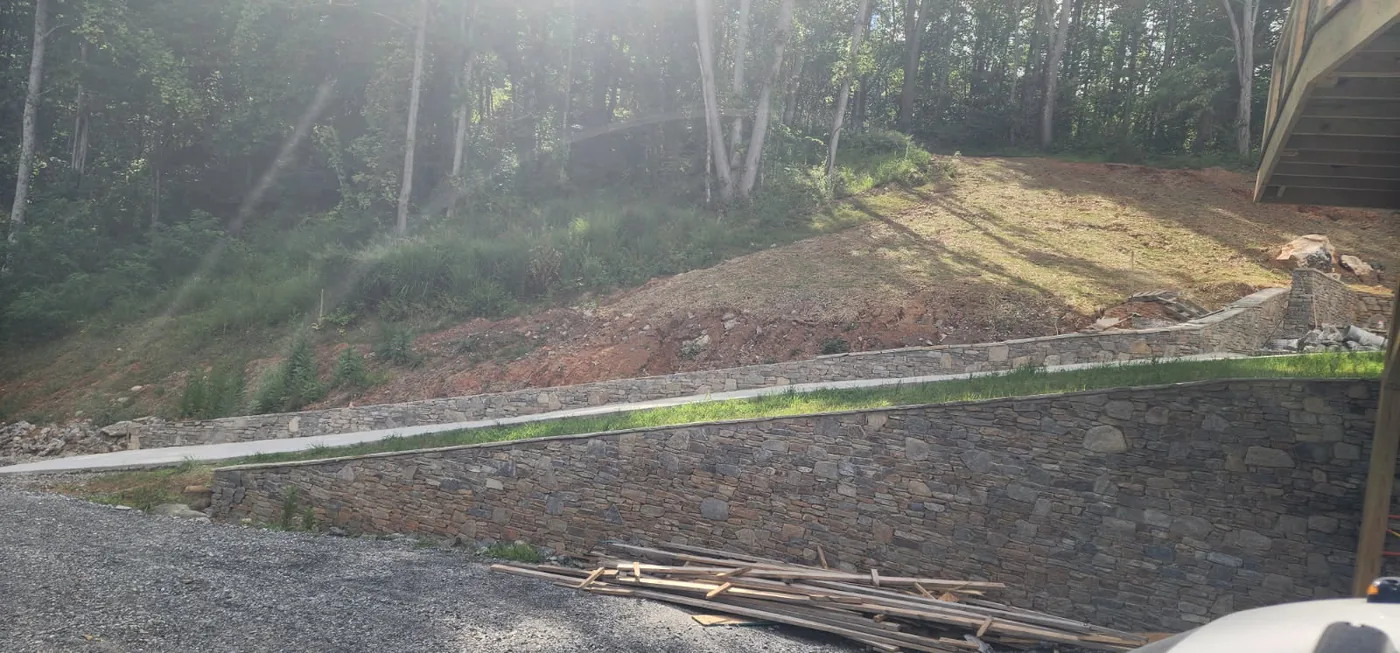
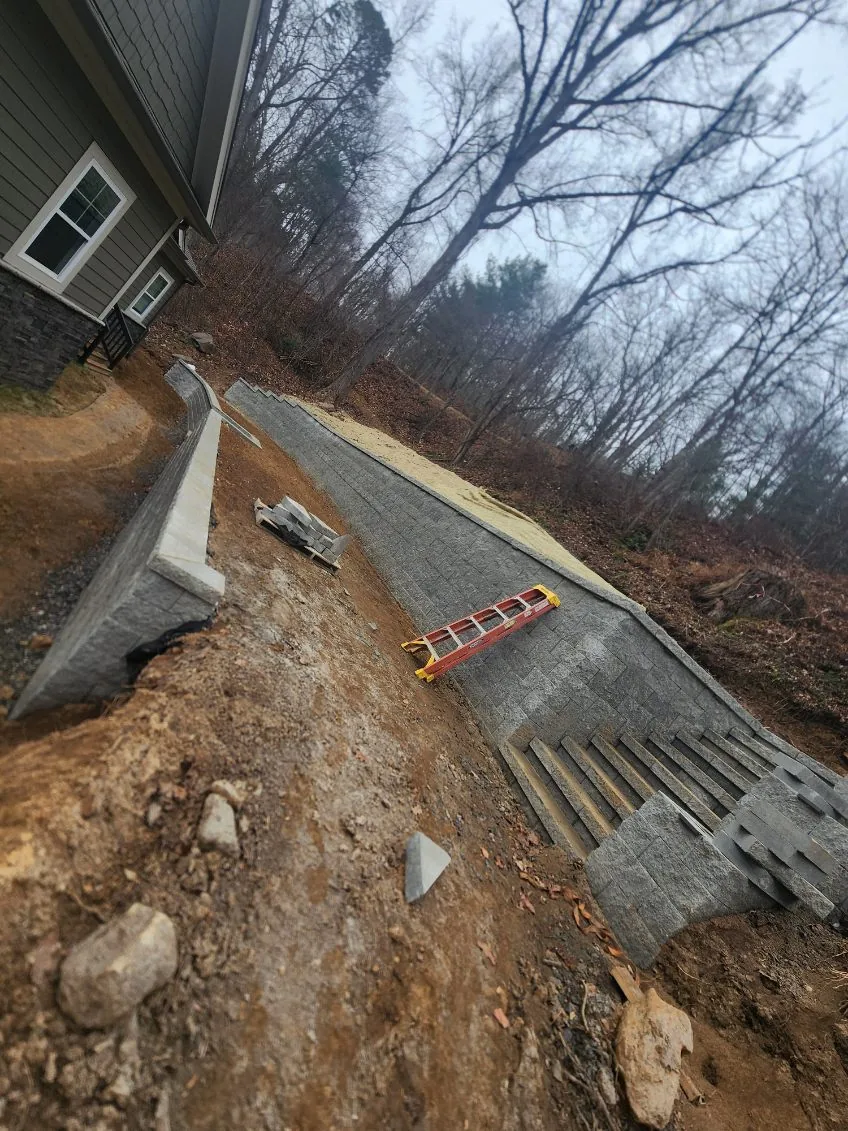
| Retaining wall veneer over block | $2,800-$9,000 | Linear feet, coping stone |
Slope access, old sheathing that fails inspection, and natural stone instead of manufactured thin veneer are the three line items that move a number most. Any bid without a prep line item is incomplete rather than low.
Two more Weaverville-specific cost drivers are worth naming. First, chimney re-clads here often involve older masonry chimneys that need repointing before veneer goes over them, a separate line from the veneer itself. Second, retaining wall veneer on the clay-heavy soils common to the Reems Creek and Weaverville Highway corridors sometimes requires drainage improvement behind the wall before facing stone is set, and that drainage work is not veneer labor. A quote that lumps these together without naming them is harder to compare against one that separates them.
Why water management comes before any stone
Weaverville's rainfall pattern makes this non-negotiable. Buncombe County has seen 19 federal disaster declarations across 1973-2026, overwhelmingly storm and flood family. That history is why a veneer install that skips the drainage plane fails within a decade: water gets behind the stone and has nowhere to go. The NC Department of Insurance, Engineering and Codes division enforces the state residential code, which treats weather-resistive barriers and flashing as first-class requirements, and a weep screed at the base of a veneer wall is not optional. Roughly 20 percent of our callbacks in this county trace back to a skipped detail at the bottom of the wall.
The order matters: grade and drainage first, wall prep and barrier second, stone third. If your hillside lot has water running toward the house, that problem is addressed before any lath goes up, not after.
Practically, the sequence shows up in the schedule as extra days. On a sloped lot with uphill runoff, the crew may spend part of day one cutting a swale or clearing a French drain path before demolition starts, because stone set on a wet wall is stone set on a future callback. On a flat lot, that step is often just confirming grading slopes away from the foundation. In Weaverville, a single property can have a flat front yard and a steep side slope, so the prep plan has to address both.
Flashing at roof and window intersections is the other sequencing trap. If a window is being replaced as part of the project, the flashing detail has to be coordinated before the weather barrier goes up, not after stone is set. When a homeowner is combining veneer with a window replacement, that coordination is a scheduling conversation, not just a materials conversation.
Retaining wall veneer follows different rules
Weaverville's sloped lots mean stone veneer often goes over a retaining wall rather than a framed wall, and that changes the trade. The wall itself has to be structurally sound before any facing stone is set — veneer adds dead load, and a wall already bulging will bulge faster with stone on it. If a wall needs rebuilding first, price that separately; see the Buncombe County retaining wall cost breakdown for honest ranges, and the Weaverville retaining wall contractor guide for what to ask before hiring.
One Weaverville-specific note: block retaining walls in this area often sit on clay-heavy soil that moves seasonally. Veneer over a wall that moves will crack at the mortar joints. If the wall is more than ten years old and has never been assessed, get it checked before the veneer goes on.
On the construction side, retaining wall veneer also changes the sequence. There is no lath-and-scratch coat in the same sense as a framed wall, because the substrate is masonry, not sheathing. Instead, the block face is cleaned and prepared, a bonding approach suited to masonry is used, and the stone is set directly against the prepared block. That shortens the on-site timeline compared to a framed wall, but it front-loads the assessment: if the block wall has settled or cracked, that shows up before setting begins, not during.
Coping stone at the top of a retaining wall is the detail that gets overlooked most. It is the cap that sheds water off the wall face, and skipping it or substituting a lesser material is one of the quieter ways a wall veneer job fails early. It is a small line item and worth insisting on.
Screening installers in Buncombe County
Stone veneer is a specialty trade, and North Carolina does not license masons as such — but general contracting thresholds and the residential code still apply. Check any contractor through the North Carolina Licensing Board for General Contractors if the job crosses the dollar threshold that triggers licensure, and ask for the name of the installer who will actually set stone, not just the company that quoted. The International Code Council publishes the model code North Carolina's adopted residential code is based on, which includes the veneer attachment requirements a good installer works to.
Three questions that separate real installers from order-takers in this market: what is your weep detail at the base of the wall, how do you handle a sloped lot with uphill runoff, and can you show photos of a job you completed two or more years ago so the mortar has had time to show movement. If the answer to the last one is vague, keep calling.
A fourth question matters in Weaverville specifically: how do you schedule around fall and early winter, when the region gets freeze-thaw cycles that affect mortar curing? A scratch coat or freshly set stone that freezes before it cures can lose bond strength, and a crew that does not watch the forecast in shoulder season is a crew that will eventually have a callback.
Finally, ask what the quote does not include. On older Weaverville homes, sheathing replacement, rotten trim, and repointing work often surface once siding comes off, and whether those are handled as change orders or built into the original scope tells you a lot about how the job will actually go.