Read the wall by what it is made of, not how it looks
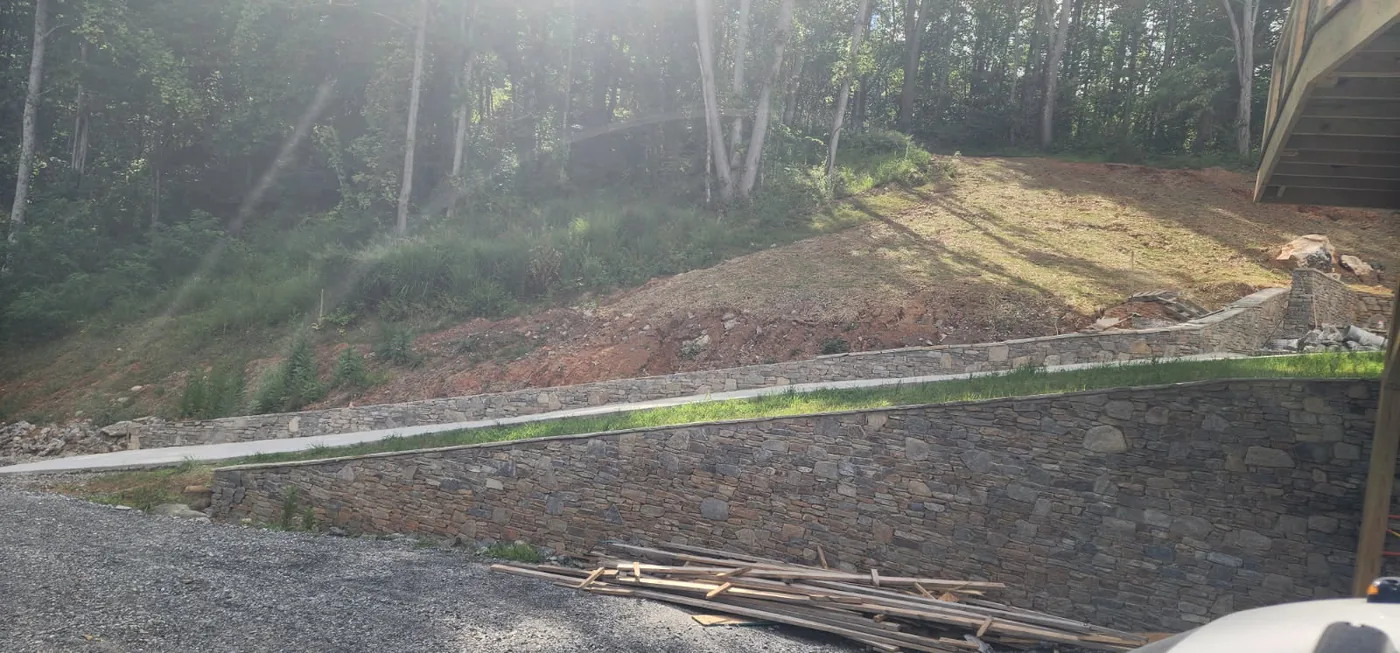
Drive Fairview's ridge roads and you can date the housing by its walls. The older places off the Garren Creek side sit behind hand-stacked fieldstone that has leaned into the slope for generations; 1980s and 1990s builds on cut lots tend to be timber crib or plain block; newer ridge homes above the valley often carry big boulder walls holding a driveway or a house pad. Each of those walls fails on its own schedule, and a repair quote that doesn't name the material first is a quote for a different property.
The Fairview-specific complication is grade combined with mountain rainfall. National Weather Service records show this county gets soaked by the same storm families that trigger federal declarations — 19 events across 1973-2026 in Buncombe County, most of them storm and flood — and a wall on a Fairview slope takes every one of those events as a direct water load. A wall that looks fine in July can be a bulge by March.
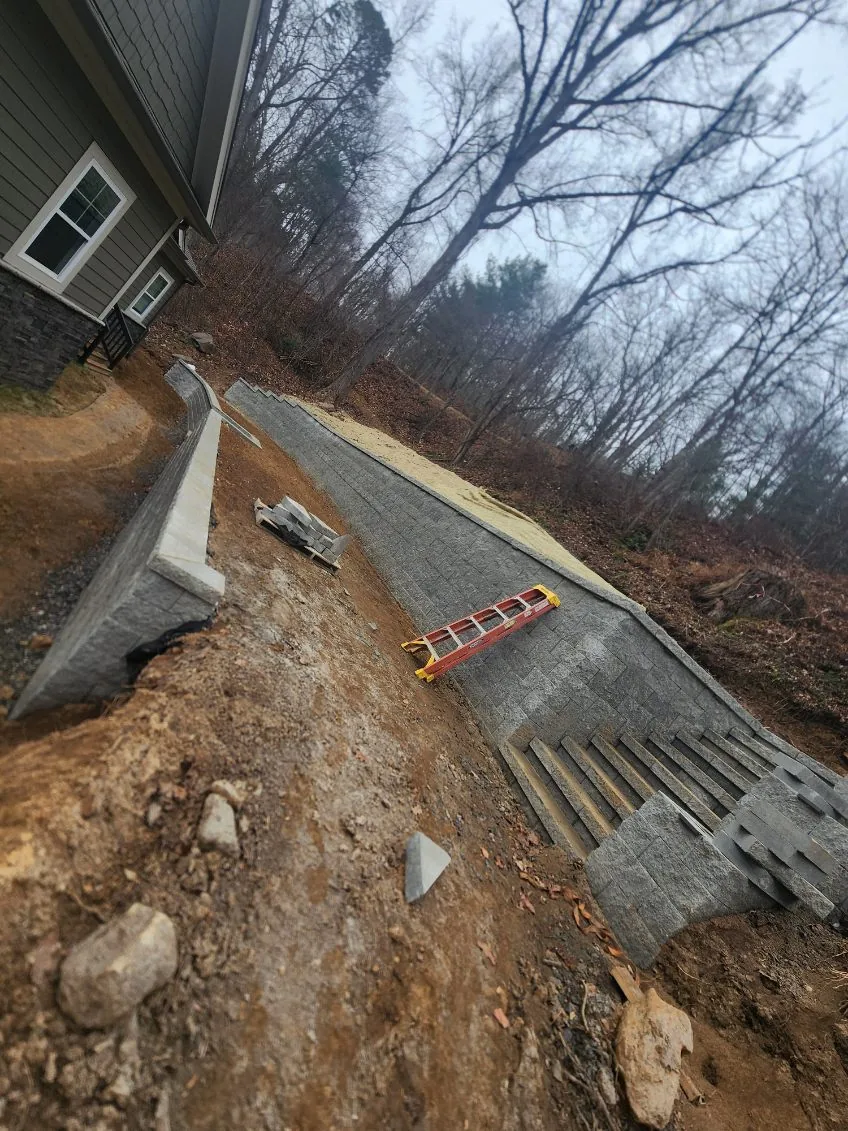
Fieldstone is the material most often misread. Dry-stacked fieldstone with no mortar holds by friction and gravity, and when it starts to go, the stones shift in groups rather than individually. Repairs that treat it like a mortared wall by smearing mortar into the joints trap water and accelerate the failure. The right approach matches the original build method or deliberately converts the wall to a drained, mortared system, and those are two very different scopes. Boulder walls work on a different principle entirely: mass. A boulder wall holds because the stones are heavy enough that saturated soil cannot push them, so when a boulder wall fails, the answer is usually about drainage and base, not about the stones themselves. Block walls are the easiest to diagnose because the failure mode is consistent: the face bows, the cap course separates, or the base course slides out. Timber crib is the one with a clock on it. Treated timbers in mountain soil hold up for a couple of decades at best, and once rot reaches the tiebacks, the wall is holding itself up by memory.
What repair actually costs across Fairview wall types
The honest structure of pricing: small drainage and surface fixes are cheap, structural work on tall walls is not, and the price movers are wall height, access for equipment on a narrow mountain drive, and whether the wall needs engineering. Below is the working picture — line-item detail lives on the Buncombe County retaining wall cost table.
| Scope of repair | Typical range | What drives it |
|---|---|---|
| Drainage correction only (weep holes, gravel, outlet) | $900–$3,500 | Length of wall, where water can go |
| Re-pointing or resetting a fieldstone or block face | $1,200–$4,500 | Square footage, mortar match, stone salvage |
| Timber crib repair (rotten courses, tieback replacement) | $2,000–$7,000 | Rot depth, whether the wall is drained |
| Partial rebuild, block or boulder wall under 4 ft | $3,000–$9,000 | Excavation, base prep, material haul |
| Engineered replacement, tall or loaded wall | $6,000–$18,000+ | Height, surcharge, slope, drainage design |
Two Fairview realities inflate the top end: steep sites where a machine can't reach the wall, and walls that were never drained in the first place, which means the repair includes undoing the original mistake.
Material supply is a quieter cost driver than most homeowners expect. Fieldstone that matches an existing wall has to be sourced, and in Buncombe County that usually means hauling from a quarry or a stone yard, not just picking up pallets at a big-box store. A fieldstone repair that looks seamless often costs more in material sourcing than the labor to set it, while a block wall repair costs less in material and more in excavation. Boulder walls sit in the middle: the stones are heavy and expensive to haul up a ridge, but a good boulder wall that has only lost its drainage may not need new stone at all. That is why the same visible symptom — a wall that has shifted — produces wildly different quotes from one Fairview property to the next.
Water is the reason most Fairview walls fail
Almost every wall we are called to in Fairview has the same story underneath: saturated backfill. Mountain soil on a slope delivers water to the wall face far faster than flatland soils, and a wall without working drainage is essentially a dam. Before anything structural gets sold, the drainage path has to be answered — where roof and driveway runoff goes, whether the wall has functional weep holes, and whether the uphill side is graded to shed away from the wall. The International Code Council treats retaining wall drainage and backfill as core requirements, not optional detail, and local permitting on taller walls follows that same logic.
This is also why a $900 drainage fix sometimes beats a $9,000 rebuild. If the wall has not yet bulged or cracked through, correcting water is the repair. If it has, water control is one line item among several.
The Fairview wrinkle is that water often arrives from somewhere the homeowner does not own. Ridge lots shed onto neighbors downhill, gravel driveways act as channels that concentrate flow instead of spreading it, and natural springs surface after wet winters in ways that did not show on the lot when it was bought. A repair that ignores upstream sources will fail in the next big storm family, and the honest scopes are the ones that trace the water to its actual source before quoting the wall fix. Where site runoff crosses property lines or reaches a stream, EPA stormwater guidance is the reference for what should and should not be directed off a slope, and it is worth reading before agreeing to a fix that just moves the problem downhill. In practical terms, this means the drainage plan needs outlets, not just a gravel layer behind the wall. An outlet is where the water actually goes, and if the answer is "it just drains into the yard," the wall will be back on the repair list.
When repair turns into replacement on a Fairview slope
Three signals that a wall is done being repaired: a bulge you can see from the road, horizontal displacement at the base that grows season to season, and any wall taller than about four feet that has lost its drainage and shows cracking. At that point the honest conversation is replacement, and on a Fairview ridge lot that means engineering — surcharge loads, soil bearing, and drainage design. North Carolina rules via the NC Licensing Board for General Contractors put taller and higher-value retaining work into licensed-contractor territory; that threshold is a protection, not a formality.
Sequencing matters too. On a hillside, replacing a wall without addressing the driveway or slope above it usually means repairing the new wall in a decade. If your situation is closer to new construction than repair, the retaining wall repair service guide and the Fairview contractor guide cover how the two paths differ.
There is also a seasonal reality to scheduling replacement work on these roads. Winter storms and spring saturation are when walls fail, which is exactly when crews are busiest and when access is worst. A wall that has moved but is not in immediate danger is often best replaced in late spring or summer, when the soil is stable enough to excavate against and equipment can reach the site without rutting a driveway or tearing up landscaping. Homeowners who wait until the wall is actively collapsing usually pay for emergency access on top of the structural work, and that premium is avoidable with a scheduled plan.
Choosing a wall crew in this market
Ask three questions and listen carefully. First, what is this wall made of and how does that material carry load — a crew that can't answer has not worked on many Fairview walls. Second, what is the drainage plan, in writing, with outlets on the drawing. Third, what is the engineer's role if the wall is tall or loaded, and who stamps the design. Repair crews differ from replacement crews here, and the best matches on these roads are the ones who have hauled material up a steep drive before.
A fourth question separates the local crews from the drive-through ones: how do they get equipment to the wall. On a Fairview ridge lot, the answer often involves a track machine, a mini excavator that fits through a narrow gate, or hand work where nothing else reaches. A crew that quotes the job without asking about access is quoting a wall they have not pictured. The other tell is whether the crew wants photos and a site visit before quoting or is willing to give a number over the phone. Retaining wall work is one of the few trades where a phone quote is almost always wrong, because the failure mode, the soil, the grade, and the access all live on the property, not in the description.