Why Biltmore Forest lots price differently than Asheville proper
Drive through Biltmore Forest and the first thing a water-feature builder notices is that the lots were laid out for privacy, not for equipment. Deep front setbacks, mature oak and hemlock canopies, long narrow driveways, and yards that fall eight, twelve, fifteen feet from the house pad toward the rear property line. In Asheville proper you often get a flat quarter-acre off the alley; here you get a half-acre with a grade change and a canopy. That changes everything downstream: how a machine reaches the back, where spoils can sit, how tall the pump lift has to be, and whether the water you spill can leave the property the way it came in.
The soils are the other half of it. Buncombe County hillsides are commonly clay-heavy on top of weathered saprolite, and a pond or stream bed cut into that profile needs a proper underlayment and liner or it will leak and shift by the second season. The NC Department of Environmental Quality governs where sediment and stormwater may go during and after construction, and any feature that changes drainage on a graded lot is squarely inside that conversation.
There's a third factor that doesn't show up in most bids: the town's own character. Biltmore Forest is a small, wooded residential community, and rear lots often back up to other rear lots rather than open space. That means your overflow, your pump hum, and your lighting spill all land somewhere visible or audible to a neighbor. Builders who work here regularly plan for that from the first sketch, not as an afterthought once the basin is dug.
Finally, the housing stock itself matters. Many of these homes were built decades ago with mature landscaping planted close to the foundation, and a new water feature has to thread between root zones, irrigation lines, and sometimes old drain tile that nobody has a current map for. A builder who treats the yard as a blank slate will hit surprises. A builder who walks the lot slowly and asks about the irrigation and the old drainage first will price the job honestly.
What a stone waterfall and pond actually includes
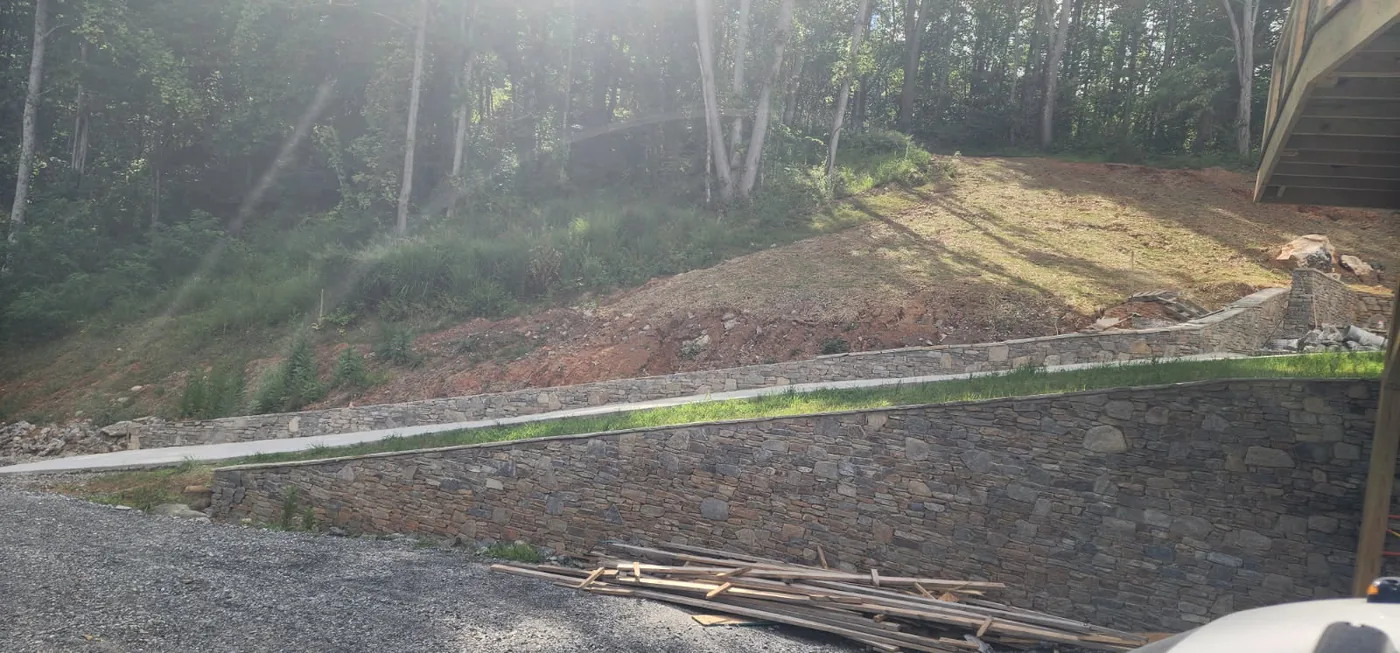
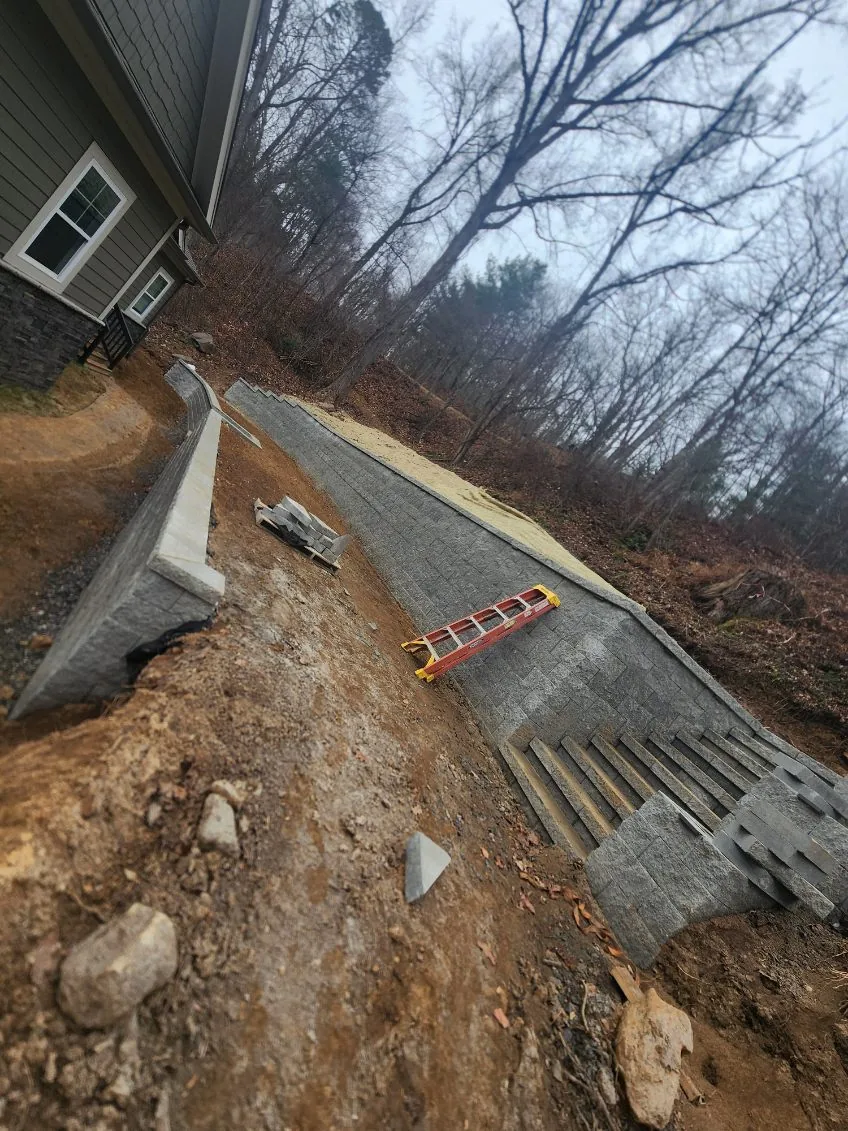
A waterfall is not a product you buy by the square foot. It's a short list of components sized to your grade: a basin or pond with a liner and underlayment, a boulder stack or stacked-ledgestone course carrying the drop, a pump and plumbing circuit sized to the lift, an electrical feed, a skimmer or intake, and planting and edging to close the edges. On a Biltmore Forest estate lot you may also need a retaining structure to hold the uphill side of a pond shelf, a drainage path for overflow, and a way to bring a mini-excavator or tracked dumper to the back without crossing a root plate or a lawn you plan to keep.
That's why two quotes for the same "waterfall" can differ by five figures. The stone is the visible part; the earthwork, access, and water management are the cost. For the wall side of the same job, the Buncombe County retaining wall cost breakdown tracks the same drivers on the structural side.
Stone choice is its own local conversation. Builders around Buncombe County lean on regional granite and fieldstone where it fits the look, and on quarried boulder where the drop needs real mass. Hauling heavy stone up a tight driveway is a line item, not a rounding error, and it's one of the first places a low bid quietly cuts corners.
The pump circuit deserves its own paragraph. On a steep lot, the vertical lift from the basin to the top of the fall drives pump size more than the run length does. An undersized pump gives you a trickle instead of a cascade, and a builder who sizes by habit rather than by measuring the actual rise will hand you a feature you're disappointed in. Ask how the lift was measured.
What Biltmore Forest features typically cost
These are regional bands, not quotes. Slope, access width, stone haul distance, run length, and whether a wall or drainage correction is required move every line. Treat anything under the low end as a design-only figure or a small prefab basin.
| Scope | Typical range |
|---|---|
| Small pondless waterfall, single drop, bagged or local stone | $9,000-$16,000 |
| Pond with liner, skimmer, and short stream run (10-20 ft) | $16,000-$34,000 |
| Boulder cascade with 3-6 ft total drop and planted banks | $24,000-$48,000 |
| Estate-scale feature: pond, stream, multiple falls, lighting, bridge or deck edge | $48,000-$110,000+ |
| Retaining or pond-shelf wall tied into the feature | $4,000-$22,000 |
| Pump, plumbing, and electrical refit on an existing feature | $2,500-$9,000 |
The wall line above overlaps the Biltmore Forest retaining wall contractor page on purpose; on these lots the two trades usually show up on the same permit and the same access plan.
It's worth saying plainly: a quote under the low end of these bands usually means a smaller pond, a shorter stream, or bagged stone instead of hauled boulder. That's a legitimate choice, but it should be your choice, stated in the scope, not a surprise you discover when the basin is filled.
Water, code, and the hillside question
The federal disaster record for this county is the honest backdrop: 19 declared events across 1973-2026, predominantly storm and flood family. Every one of those events dumped water on hillside yards whose drainage was already marginal. In Biltmore Forest, where a rear slope often runs toward a neighbor's basement rather than a street, the overflow plan matters more than the waterfall. Build the feature so that when the pump stops, the rain still has somewhere to go that isn't the neighbor's foundation.
Two code realities to check before dirt moves. Any electrical work at the pond edge falls under the current residential code per the International Code Council family of codes as adopted in North Carolina, and that means GFCI protection and a proper disconnect at the equipment pad. Separately, the scope of the work and its dollar value can pull the project into general contractor licensing thresholds under the NC Licensing Board for General Contractors. Ask your builder how they handle both, and get the answer in writing before the deposit.
Water use is a quieter consideration. A pond loses water to evaporation and splash, and refilling from a well or municipal supply is normal maintenance here. A builder should tell you roughly how much top-off to expect in a dry spell, and how the basin handles overflow after a heavy storm so you're not constantly chasing the level.
Choosing a builder for this neighborhood
Ask three questions that a Biltmore Forest job will expose. First: how do you get equipment past the canopy and the driveway without wrecking either? A builder who has never worked a graded, wooded estate lot will underbid access and then either ask for more or cut the plan on site. Second: what does the liner and underlayment detail look like on clay and saprolite, and who carries the warranty on it? Third: how is overflow managed, and will you show me the path on the plan? See the flagship stone waterfalls and ponds service page for the full scope, or use the form on this page with photos of the grade and a note on your timeline.
A fourth question is fair too: who does the planting, and does the plant list assume shade? A canopy this heavy means sun-loving marginal plants will sulk. The right species palette is different here than on an open Asheville lot, and a builder who names the plants you'll actually see thrive is usually the one who has done this before.
One gut-check before you sign anything: walk the proposed basin location with the builder and picture it full of water. If the spot chosen puts the fall where the roar reflects off the neighbor's wall, or the pond edge where the roots of a favorite tree will drink from it, that's better discovered now. It's a five-minute walk that saves a five-figure revision later.