What actually drives the price on a Barnardsville slope
A wall quote in Barnardsville rarely hinges on the block. It hinges on four line items that show up differently here than they do on flat ground: how far the excavation spoils have to travel, whether the hillside above the wall is stable or sliding, how the water behind the wall gets discharged, and whether a machine can reach the wall face at all. Barnardsville sits in the Reems Creek and Dillingham Creek drainages, where lots climb fast off the road and switchbacks are common — so the same 40-foot wall that prices at one number on a flat lot in the county can price $10,000 higher up a lane that a mini-ex can barely navigate.
The second-tier drivers are wall height, the geogrid requirement as height steps up, and the footing depth needed to get below frost and onto undisturbed soil. Cost anatomy is the honest way to bid these jobs: itemize excavation, haul-off, drainage, base, block, geogrid, cap, and any engineering, then let the site decide the total.
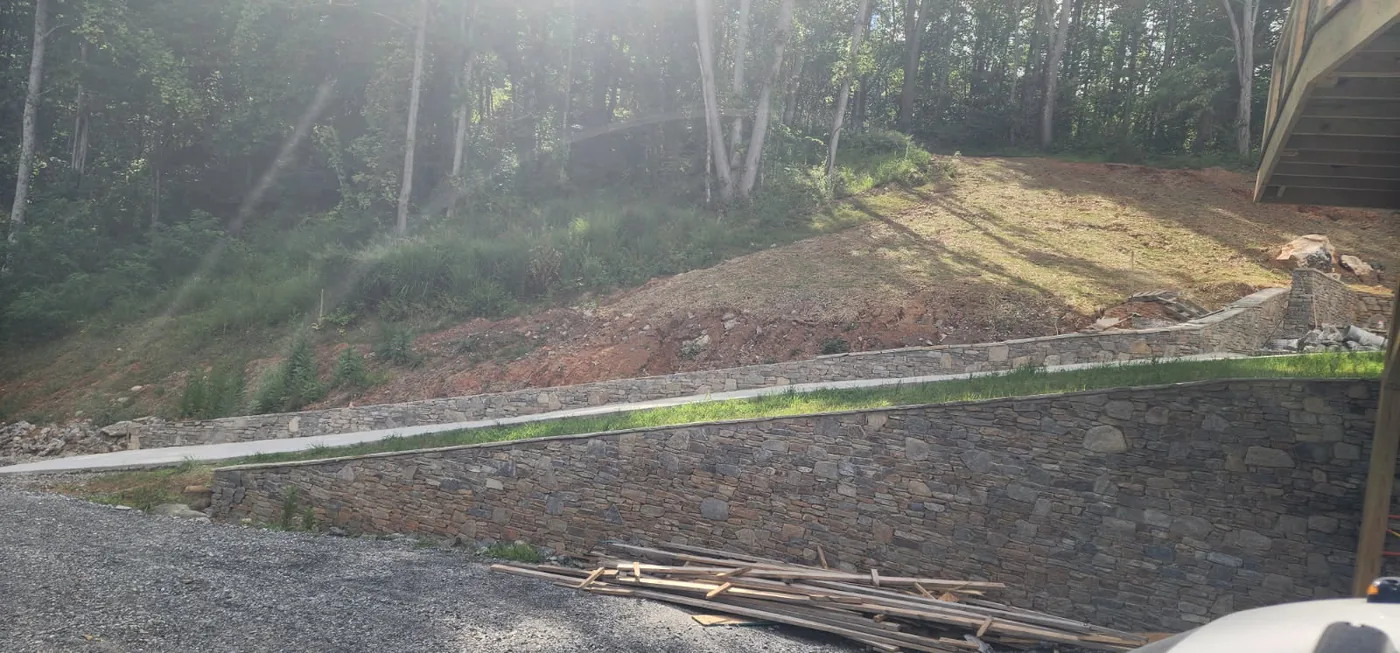
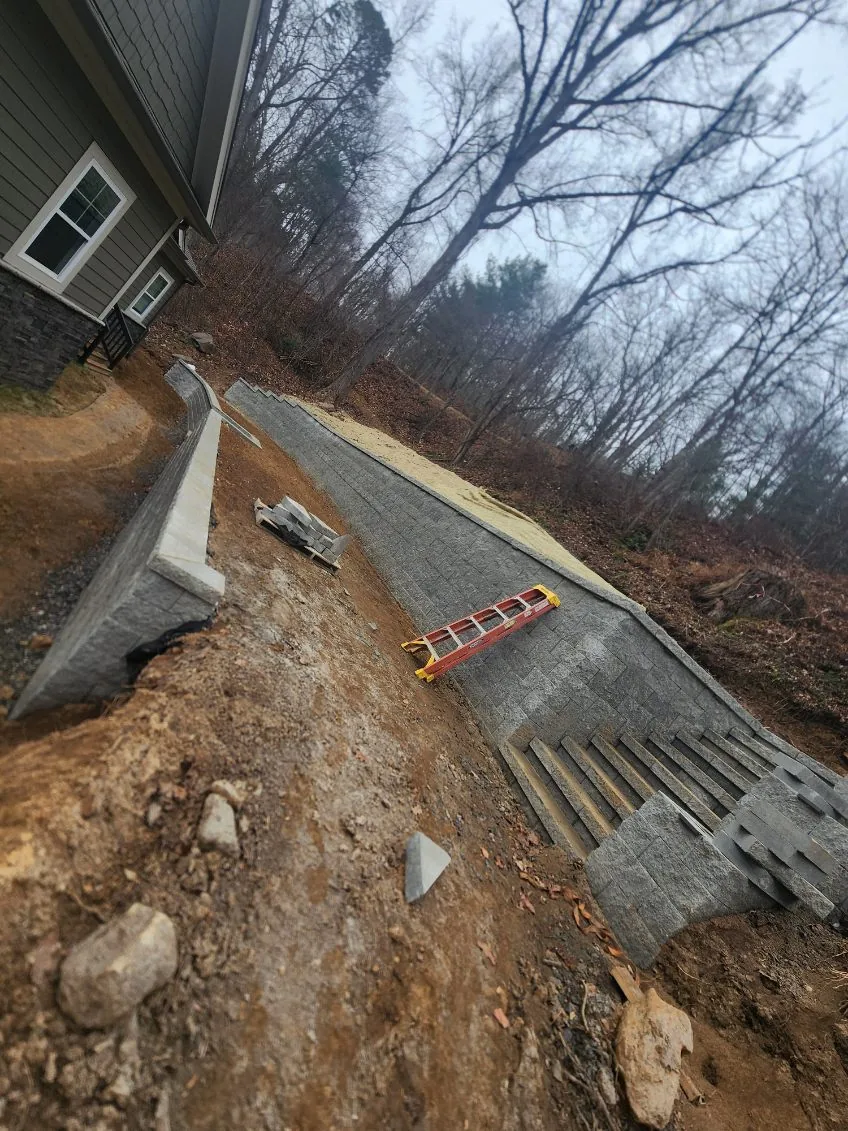
Drive a few of the gravel lanes off Dillingham Creek Road and you can read the cost anatomy off the landscape. A wall at the toe of a steep cut needs the spoils trucked out because there is nowhere on-site to spread them; a wall on a bench cut into the slope may be able to waste spoils uphill behind the wall, saving trucking. That single decision — spoil stays or spoil leaves — often swings a bid by several thousand dollars before a single block is laid. Add a tight switchback and the machine size drops, labor hours rise, and the same wall face costs more per foot.
Barnardsville also mixes new construction with older homesteads, and the two bid differently. A new build on a graded pad has room for a full-size excavator and a clear staging area. A wall added behind an existing house uphill of the creek often means hand-carrying block, protecting mature trees, and working around a septic field or a well line. Those access realities, not the block, are what separate a $6,000 wall from a $16,000 wall of identical dimensions.
The Barnardsville scope-to-price table
These are working regional bands for residential work in Buncombe County, not fixed quotes. See the full Buncombe County cost breakdown for line-item detail across towns.
| Scope | Typical range | What moves the number |
|---|---|---|
| Low garden wall (under 2 ft, dry-stack or block) | $1,800–$5,500 | Length, block choice, whether footings are needed |
| Standard block wall (2–4 ft, gravity) | $4,200–$14,000 | Face feet, drainage stone volume, haul distance |
| Engineered wall (4–8 ft, geogrid + stamped plan) | $14,000–$38,000 | Engineering, geogrid courses, footing depth, machine access |
| Terraced / multi-tier walls | $22,000–$60,000+ | Number of tiers, bench drainage between walls, slope grade |
| Drainage package (footing drain, stone, outlet) | $1,200–$4,500 | Outlet distance, daylight availability, soil type |
| Repair or rebuild of a failing wall | $2,500–$18,000 | Cause (water vs. surcharge), extent of section loss, demo cost |
Read the table by line item, not by total. A 3-foot gravity wall on an accessible Barnardsville lot and a 3-foot wall at the top of a steep gravel drive can share a scope line and still land $6,000 apart. When you compare bids, ask each contractor to break the number into those same rows: excavation, haul-off, drainage, base, block, geogrid, cap, engineering. A bid that is one lump sum tells you nothing, and the cheapest lump sum is often the one that skipped the drainage row entirely.
Water behind the wall decides whether it lasts
Barnardsville's federal disaster record tells the story: 19 declared events touch this county (1973-2026), and they skew heavily to storm and flood family events — the kind that saturate hillsides and push hydrostatic pressure against anything retaining them. A block wall built without a proper footing drain, washed stone, and a daylighted outlet is a wall on borrowed time, no matter how good the block looks on day one. Surcharge pressure from saturated soil is the most common single cause of residential wall failure in this terrain.
Before anyone quotes you a wall here, the water question has to be answered: where does the uphill runoff go, where does the roof discharge, and where does the footing drain outlet. The International Code Council treats retaining and drainage requirements as coupled — and so should any contractor bidding your hillside.
In the Reems Creek and Dillingham Creek hollows, the runoff pattern is the giveaway. Springs and hillside seeps show up after big rain events, sometimes in a line across a slope that looked dry during the site visit. A wall that ignores a seep will bulge within a season or two. The fix is not more block; it is a drained wall — washed stone wrapped in filter fabric, perforated pipe at the footing, and an outlet that daylights downhill rather than dying in a gravel pocket. If there is no daylight below the wall on your lot, that is a design problem to solve before the bid, not after the first freeze.
Roof and driveway water deserve their own sentence. A downspout that dumps uphill of a retaining wall is feeding the exact pressure the wall was built to resist, and a gravel drive without a water bar or ditch channels sheet flow straight to the wall face. Grading and stormwater rules in Buncombe County generally expect you to manage that runoff on-site, which is another reason drainage belongs in the wall bid rather than in a separate change order later. Our repair page shows what happens when the water question is answered late.
Licensing, permits, and what to check before you sign
North Carolina draws a line on construction cost that triggers general contractor licensing, and retaining wall work that includes grading, drainage, or structure frequently crosses it. Verify any contractor's status directly through the NC Licensing Board for General Contractors before you sign — it takes two minutes and screens out the crews that shouldn't be on a wall this size. Walls above certain heights typically need a stamped plan and a building permit, and any wall that also moves water needs to respect the county's stormwater and grading rules.
Three Barnardsville-specific checks: ask whether the crew has built on a slope as steep as yours (a flat-lot portfolio proves nothing here); ask who stamps the plan on walls over the height threshold; and ask what happens if the hillside above the wall is already moving — because a wall placed on unstable ground is a repair bill, not a fix. Our repair page covers the warning signs if a wall you already own is leaning, bulging, or losing block.
Also confirm insurance and who pulls the permit. On a hillside job, a wall that fails can damage a driveway, a structure, or a neighbor's land below, and the permit trail is what documents that the work was done to plan. If the scope includes moving a water line, a septic line, or anything tied to plumbing, the trades involved carry their own state credentials through the NC State Board of Examiners of Plumbing, Heating and Fire Sprinkler Contractors. None of this is paperwork for its own sake; it is the difference between a documented wall and an undocumented one when you sell the property.
Choosing a crew for this terrain
The contractors worth calling in Barnardsville will talk about drainage before they talk about block, will itemize spoil haul distance in the bid, and will tell you when a wall is the wrong answer and a regrade or stepped terrace is the right one. Ask to see a wall they built three or four years ago on a similar slope — not a photo, the actual wall. A wall that is still plumb, still draining at the outlet, and still straight after several mountain winters is the only reference that matters here.
When you are ready to compare scopes, start with the retaining walls overview to see what a complete bid includes, then get two or three itemized quotes and read them side by side. The cheapest bid is almost always the one that left out the drainage line.
One more local habit worth adopting: walk the lot with each contractor and ask what they would do if the wall were their own. The answer that includes a footing drain, a stone backfill zone, and a plan for the uphill water is the one that matches how these hills actually behave. Barnardsville lots reward patience at the bidding stage and punish shortcuts years later, usually after the wettest season in memory.