Where Etowah water comes from, and where masonry has to send it
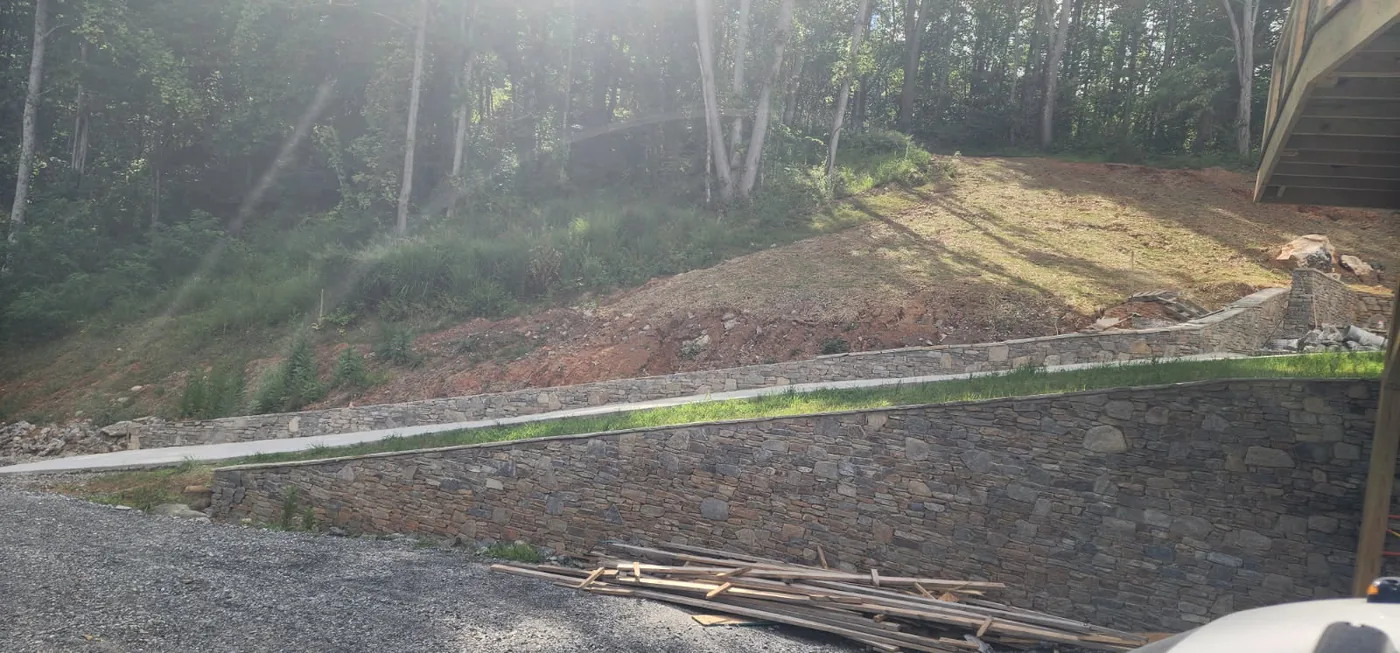
Etowah sits in Henderson County's Blue Ridge foothills, south of Asheville, where the French Broad River bottomlands flatten out below steep hardwood ridges. Most lots here fall into one of two shapes: a cut into the hillside with a wet uphill neighbor above, or a graded bench on river-bottom ground with a high seasonal water table. Both shapes push water at any stone wall you build, and the two move it in opposite directions. On a cut-slope lot, drainage behind the wall has to daylight at a lower point on the property before it ever touches the footing. On a bottomland lot, the wall has to be designed to shed surface flow without trapping groundwater behind it.
That is the whole reason a stone mason in Etowah NC prices differently than one working flat ground in the Piedmont. The stone is the visible part. The drainage is the part that decides whether the wall is still standing in five years. Before a single stone is set, the real work is reading the grade, finding where the water leaves, and confirming the wall has somewhere to send it.
Walk a cut-slope lot off a ridge road and you can usually spot the wet uphill neighbor by the moss line, the darker soil, or the seep that shows after a summer thunderstorm. On the river-bottom side of Etowah, the tell is different: standing water in a low corner after rain, a driveway that holds a puddle, or a lawn that stays spongy into spring. Both are the same story — the ground is already telling you where the water wants to go. A wall that works with that path lasts. A wall built against it is a retaining wall that becomes a dam.
The Etowah stone-and-scope price picture
Henderson County sits in the same regional band as Buncombe for labor and stone hauling, but the terrain adds cost that flatland quotes never show: excavation on a slope runs a machine longer, and retaining walls above a certain height need engineering before a permit issues. The table below is a working range, not a bid. Your number moves with access, wall height, stone type, and how much drainage line has to be buried behind the wall.
| Scope | Typical regional range | What moves the price |
|---|---|---|
| Dry-stack garden wall, under 24" high | $4,500–$9,000 | Linear feet, access for stone delivery |
| Mortared retaining wall, 2–4 ft | $8,000–$18,000 | Footing depth, drainage line, wall height |
| Engineered hillside wall, 4 ft+ | $18,000–$40,000+ | Engineering stamp, excavation, drainage |
| Stone veneer (chimney, foundation, accent) | $9,000–$22,000 | Square footage, substrate prep |
| Stone patio or walkway | $7,000–$20,000 | Base prep, pattern, square footage |
| Stone steps, per flight | $2,500–$7,500 | Rise, run, hand-cut vs. sawn treads |
For retaining walls specifically, the Henderson County retaining wall cost breakdown carries the line-item detail. The same wall on a flat lot and a 30-degree slope can differ by 40 percent or more.
Three things separate a low quote from a high one on the same Etowah lot. Access: whether a truck can back to the wall or stone has to be wheeled down a slope by hand, which can add a full day of labor. Wall height: cost does not rise in a straight line, because a taller wall needs a deeper footing, more drainage stone, and often engineering. Stone type: local fieldstone, Tennessee and North Carolina quarry stone, and sawn or hand-cut treads all haul differently, and the difference shows up in the delivery line, not just the stone line.
On the river-bottom side of the county, a high seasonal water table also raises the drainage scope. Instead of a single gravel trench and a pipe, some walls need a wider drainage envelope so groundwater has room to move without pressuring the footing. That is real cost, and it is also the reason a cheap bid and a durable bid can look identical on paper and completely different underground.
What changes above a certain wall height
North Carolina treats retaining walls the way most mountain states do: below a threshold height, a competent mason builds on a proper footing with drainage and that is that. Above the threshold, or where the wall holds back a surcharge load like a driveway or a structure, the wall becomes a designed system, and the state general contractor threshold applies once the job crosses it, per the NC Licensing Board for General Contractors. Ask any crew how they handle a wall that needs an engineer's letter. The answer separates masons who build retaining walls from masons who build garden walls.
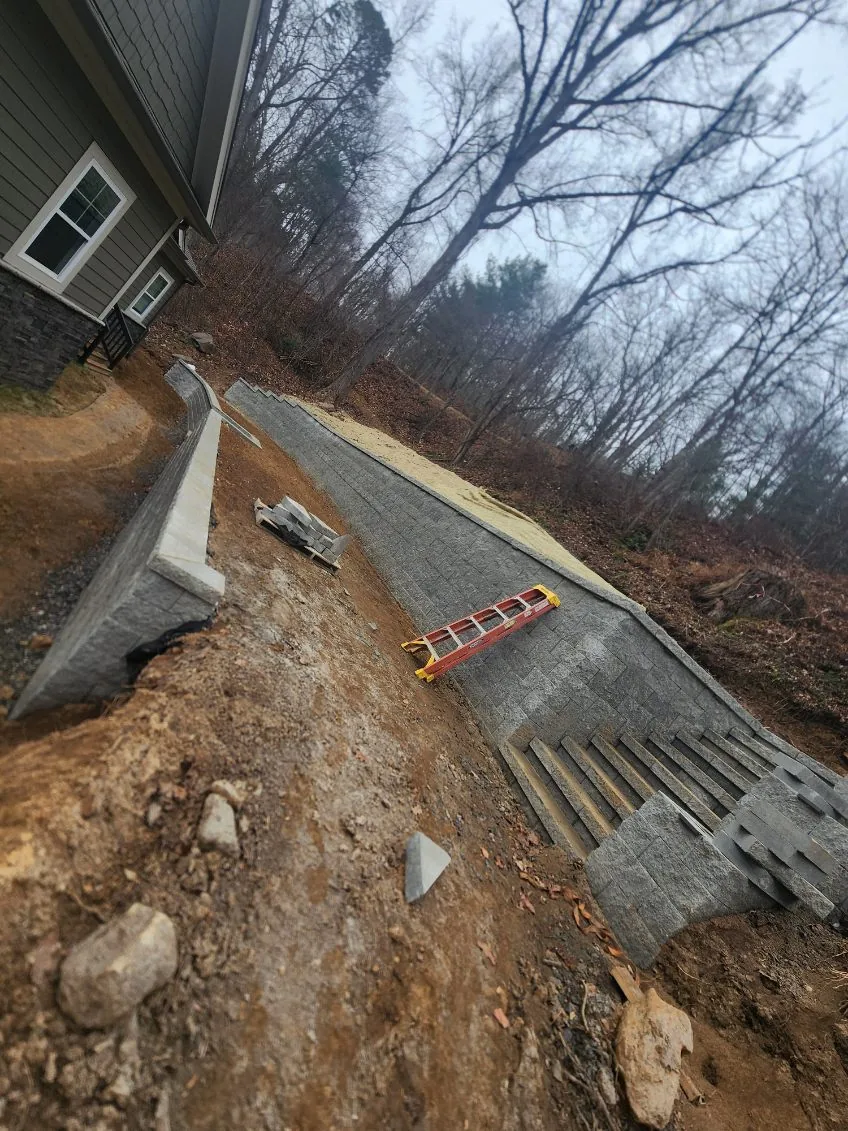
Terracing is the other lever on a steep Etowah cut. Instead of one tall wall, two shorter walls stacked up the slope share the load, move less stone, and are often cheaper to build because each tier sits on its own footing and drains on its own. It also looks like the hillside was meant to be there rather than forced flat. A mason who suggests terracing before pricing a ten-foot wall is usually steering you toward something that will still be plumb after a wet spring.
The much more common failure is a wall built without drainage, and it usually shows up after the first wet winter. Water trapped behind stone weighs more than stone. The International Code Council addresses retaining wall and foundation drainage in the model codes most NC jurisdictions adopt, and the reasoning is simple: the wall is only as good as the path the water takes behind it.
Hiring a stone mason here without getting burned
Three checks specific to Etowah and the surrounding Henderson County ground: ask what happens to water behind the wall, ask for references on walls built on a slope near here, and ask who carries the engineering if the wall needs it. A mason who only talks about stone type is selling you a look, not a wall. A mason who talks about footing depth, drainage stone, and where the outlet goes is selling you a wall that lasts.
On the first visit, the useful conversation is about grade and water, not color swatches. Point out where the seep shows after rain, where the water collects, and where you want it to end up. A good mason will walk the property before measuring anything, because the wall is a small part of a larger water plan for the lot. If the visit never leaves the flat area by the driveway, that is a quote built on a guess.
When you're ready to get a real number rather than a phone estimate, the Etowah retaining wall contractor guide walks through what a proper first visit includes and what to have ready. The retaining walls overview covers wall types and when each one actually fits the lot you own.
Storm history and why it shapes the work
Henderson County has been touched by 16 federal disaster declarations over 1978-2026, dominated by the storm and flood family that hits Western North Carolina. That record is not trivia for a stone mason operating here. Every one of those events tested walls and drainage that were built for a drier assumption, and the ones that failed were almost always the ones that skipped drainage or under-built the footing. The National Weather Service tracks the rainfall patterns that drive it, and the reality is that a wall built correctly for Etowah's ground is built for the water it will actually see, not a dry-year average.
For a mountain-slope lot, that means treating the outlet as seriously as the wall. If the drainage pipe behind a wall simply dumps at the toe, the water has nowhere to go and the next storm puts it right back against the footing. Getting it to a lower grade, a swale, or a daylight point before the property line is the difference between a wall that drains and a wall that just looks like it does.