Fieldstone, boulder, block and timber on Hot Springs ground
Hot Springs sits where the French Broad cuts through Madison County, and the residential ground reflects it: rock ledges showing through the lawn on the river side of town, steep back yards rising toward the national forest, and a housing stock that runs from old timber-frame farmhouses off Highway 209 to newer cabins built on cut pads above the river. That mix decides materials before anything else does. Fieldstone is the honest match for older farmhouse foundations and low garden walls, because it already looks at home there. Boulder work is what the slopes call for, because a dry-stacked boulder terrace holds a hillside that block cannot. And timber is still the right call for steps, edging and small retaining cribs on the wooded lots, since treated timber sheds water and blends into the understory in a way concrete never will.
Water itself is the other half of the decision. Hot Springs properties get a lot of it, and a waterfall or pond that ignores where the ground already drains will fail the first wet season regardless of how it looks on day one. The best local builds read the existing seep lines and fall first, then set stone to them.
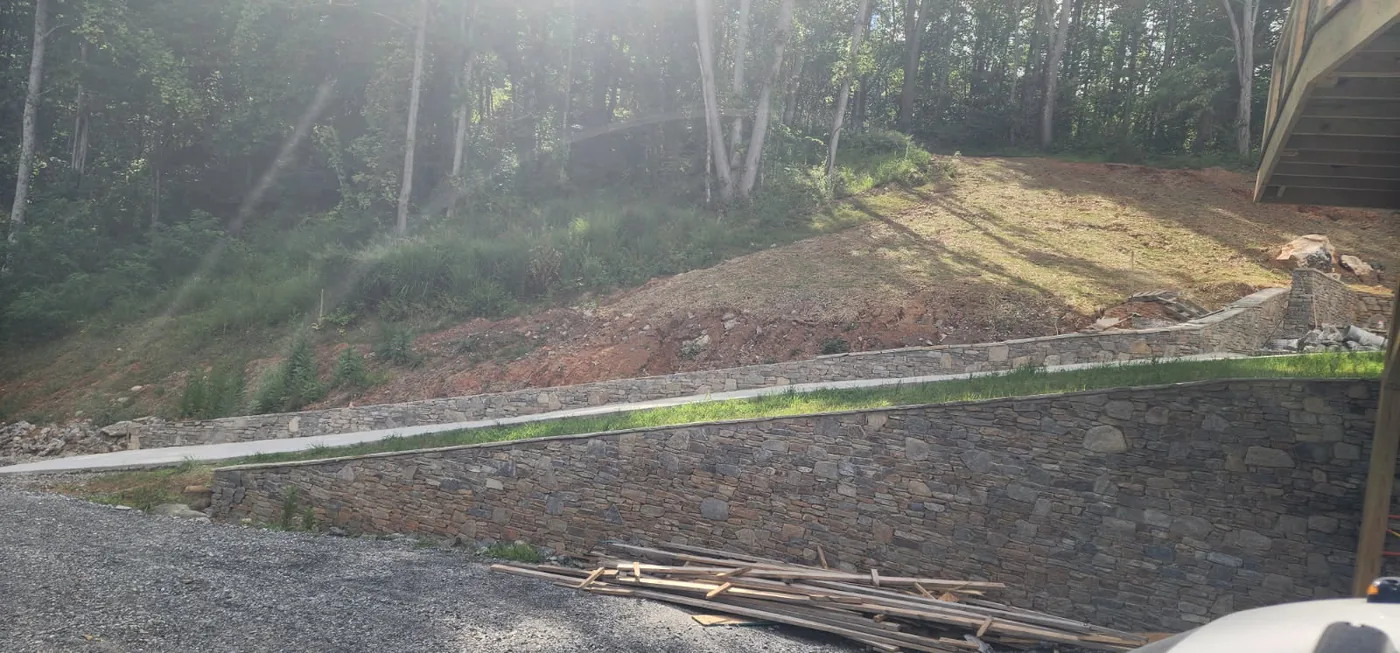
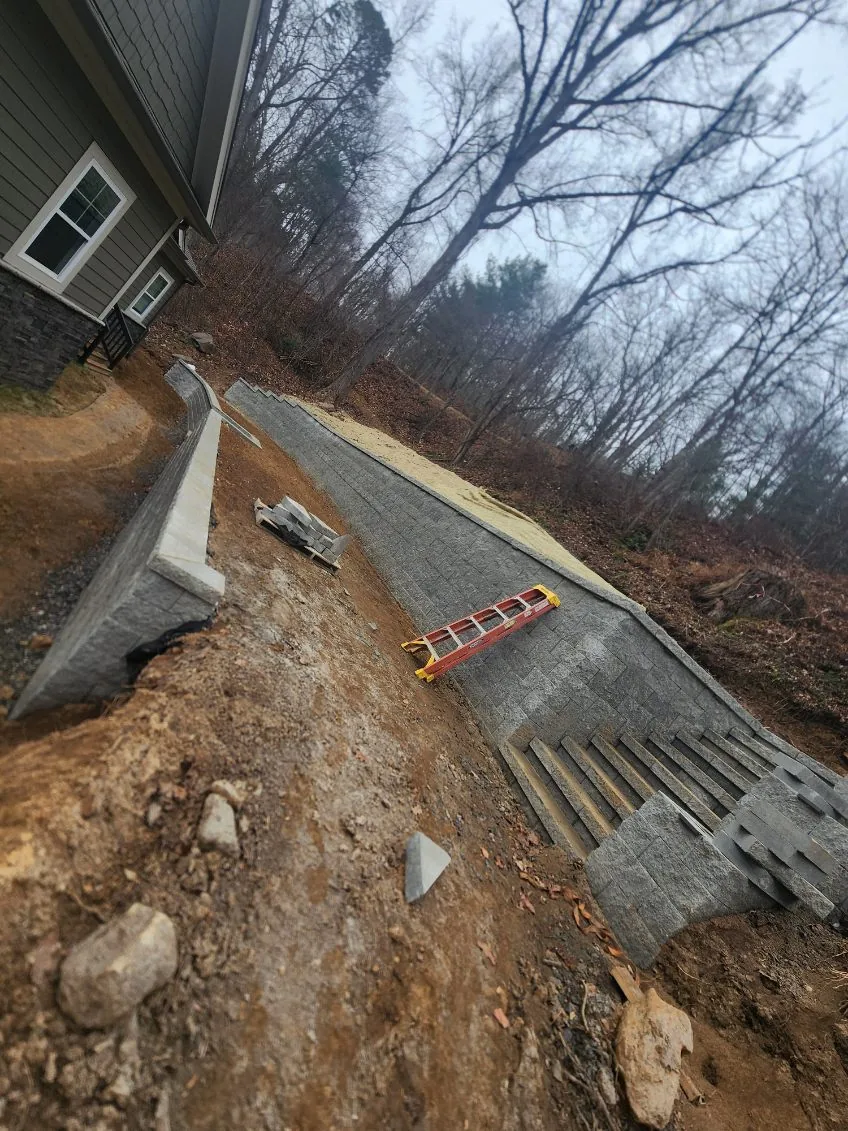
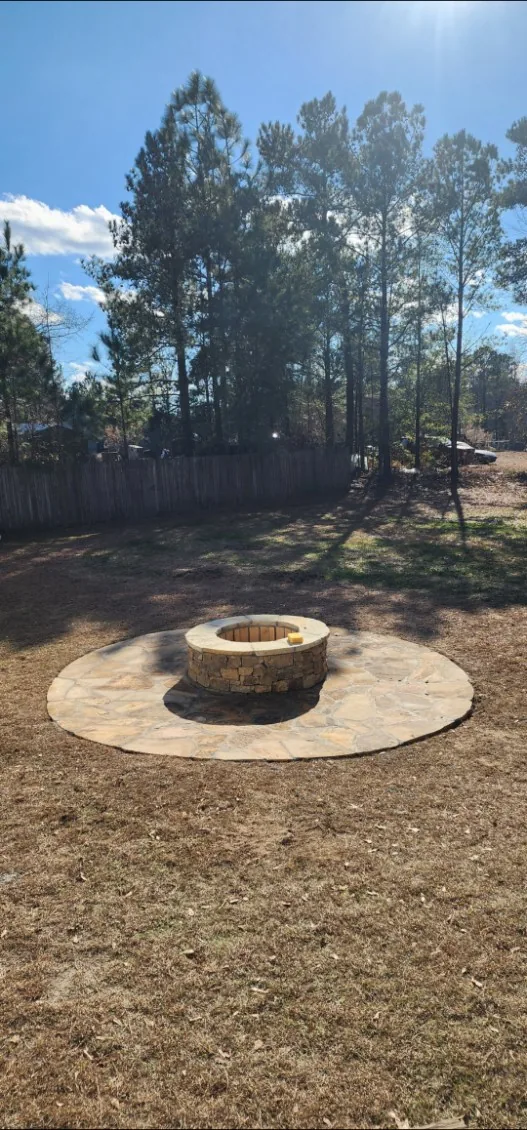
Up close, the material choices show in small ways that matter on this ground. Fieldstone from local fence rows and old foundations gets reused on garden walls, and it comes in flat, hand-stackable pieces that suit a low border along a farmhouse porch. Boulder is the opposite: heavy, rounded river rock and angular hillside stone that has to be set with machine help and pinned so it locks together. On the cut-pad cabins above the river, that means a boulder toe wall at the bottom of the slope to stop the hill from creeping toward the deck, then a stone stair run up through the trees. On the flatter river-terrace lots, a single fieldstone fall with a small basin often does more for the yard than a tall feature, because the water does not have to be pushed uphill to look right. Timber shows up in the same yards as crib steps, edge restraints for gravel paths, and small retaining boxes where a boulder wall would be overkill. The rule of thumb here is: stone for structure, timber for transitions, and let the grade decide which one leads.
What falls, ponds and stone water features cost here
Prices move with three things: how many tons of boulder get set, how many square feet of liner and underlayment the pond needs, and how much machine time the slope requires before any stone is placed. The table shows the working ranges. Madison County terrain means grading and access line items show up on most jobs, and any bid that skips them is incomplete rather than cheap.
| Scope | Typical range | What drives it |
|---|---|---|
| Small fieldstone waterfall, single drop | $3,200-$6,500 | Stone tonnage, pump and plumbing, slope access |
| Multi-drop boulder waterfall with basin | $6,000-$13,000 | Boulder count, liner square footage, machine time |
| Lined koi or wildlife pond, 8x12 ft and up | $5,500-$14,000 | Depth, filtration, edge stone, electrical run |
| Pondless (buried reservoir) water feature | $4,000-$9,500 | Reservoir size, grade change, pump vault |
| Timber and stone steps to a water feature | $1,800-$5,500 | Rise, tread count, cribbing depth |
For comparison, the retaining work that usually sits behind a pond build prices separately; see the Madison County retaining wall cost table for those line items.
Two cost patterns repeat on Hot Springs jobs. First, a lot that already has a natural grade change of three or four feet gives you the waterfall drop for free, and the money goes into stone and liner instead of earthmoving. Second, a lot that is nearly flat but has a spring seep needs the opposite: a reservoir and pump to lift water to a built-up head, plus a drainage plan so the surrounding ground does not stay saturated. The first kind of job often lands near the bottom of the boulder-fall range; the second kind can push past it before planting. It helps to walk the yard in wet weather before pricing anything, because that is when the seep lines show and the real dirt work reveals itself. Homeowners comparing bids should ask each builder to list machine hours, disposal of spoil, and pump electrical separately, since those three line items are where otherwise similar quotes diverge.
Storm and flood history sets the real design brief
The federal disaster record explains why local water features get built the way they do: 21 declared events touch this county across 1978-2026, and they are overwhelmingly storm and flood family. Every one of those events pushed water at yards that were already steep and already wet. That is the design condition, not an edge case. The National Weather Service river and flash-flood guidance for the French Broad basin is the honest starting point for anyone planning a feature near the river corridor, and it changes how much overflow capacity a pond needs and where a waterfall's spillway should send excess.
Practical consequence: a waterfall built without an overflow path becomes a wall of water against the house in the first big storm. The build has to plan where water leaves the system, not just where it falls.
On the ground, that shows up as three details. The pond or basin gets a dedicated overflow pipe or a stone spillway set a few inches below the finished edge, so rising water exits before it undercuts the liner. The waterfall's feed line gets a check valve and the pump sits in a vault that can be reached when the yard is soaked, because the failures happen during weather, not between storms. And the ground behind the feature is graded so sheet flow goes around rather than through. The EPA has plain-language guidance on managing stormwater at home that is worth reading before finalizing a drainage plan, especially on sloped lots where runoff from an uphill neighbor can arrive without warning. Builders who work the Highway 209 corridor and the river terraces already know which yards collect water from above, and they design the overflow to handle more than the feature's own volume.
Permits, licensing and what actually needs paperwork
Water features themselves are usually simple. The complications come from what surrounds them. Any retaining wall over a few feet, any grading that redirects drainage, and any electrical run for a pump can trigger local review, and North Carolina licensing thresholds apply once a project crosses the state's dollar figure, which you can check through the NC Licensing Board for General Contractors. On the environmental side, anything that touches a stream, wetland or the floodplain falls under state rules; the NC Department of Environmental Quality is the agency that enforces them, and a pond or diversion near the river needs that question answered before digging, not after.
Inside the trade, the rules that matter most on a build are structural and electrical. Retaining walls above a certain height need engineering or at least a stamped detail, and the International Code Council publishes the model code language that most local adoptions are based on, so a builder who can point to a code section is usually a builder who has pulled permits before. Pump circuits need GFCI protection, a disconnecting means, and a trench deep enough that a lawnmower or a dog does not find the conduit. None of that is exotic, but it has to be on the plan before the first boulder goes down, because moving stone to fix a missing conduit is expensive. The simplest way to keep a project out of review is to keep the feature away from the floodplain, keep the wall below the review height, and keep the electrical work permitted and inspected like any other outdoor circuit.
Choosing a builder who has worked this ground before
Three checks worth running. First, ask to see work on a slope, because a flat-lot portfolio tells you nothing about whether a crew can set boulder on a 25-degree grade without it walking. Second, ask how they sequence drainage against stone, since the crews who get that order backwards are the ones whose features wash out. Third, ask what happens at the pump and overflow in a power outage, because that is when most local ponds lose their fish and their clarity. Local retaining and hardscape crews who routinely build on Madison County grades are listed through the Hot Springs retaining wall contractor page, and the broader portfolio of this kind of work sits on our stone waterfalls and ponds hub.
A few more questions separate the crews who have built here from the ones who have not. Ask how they handle a spring that shows up mid-dig, because on this ground it happens, and the answer should involve gravel, a liner detail, or a French drain rather than a shrug. Ask where the spoil goes, since a sloped lot in Madison County rarely has room to push dirt out of sight, and hauling it off is a real cost. Ask whether they set boulder with an excavator thumb and a spotter, because hand-setting multi-ton stone is how people get hurt and walls get out of level. And ask for one reference on a yard that is steeper than yours, because the hardest local build is the one that looks like a cliff from the street, and that is exactly the job that proves a crew. Warm-season planting around a new feature also matters here: native ferns, moss, and shade perennials settle into the wet microclimate around a waterfall faster than most nursery stock, and a builder who knows that will tell you before you ask.