How a Weaverville stone job actually runs, start to finish
Most Weaverville properties sit on ground that refuses to stay level. A house off Reems Creek Road might drop eight feet from the driveway to the porch; a cottage near Main Street has a front yard that slopes toward the sidewalk at a grade that was never meant to be walked. When a crew shows up, the first hour is not stone work. It is water work: reading where runoff goes, how the grade falls, and where a step run will collect water if it is built badly.
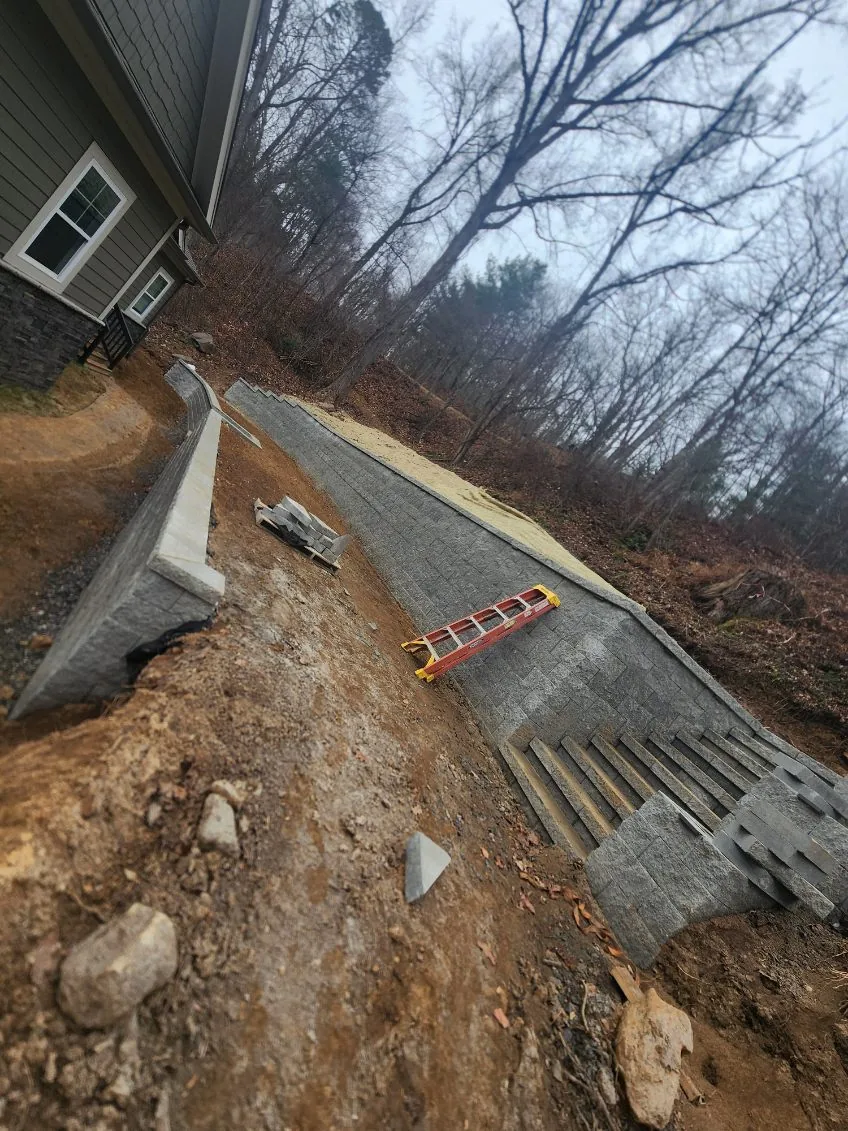
From there the sequence holds. Days one and two are layout and excavation: staking the run, checking fall with a level, digging out the tread footprint, and compacting a base. Day three is usually base stone and gravel, which must be tamped in lifts. Days four and five are the setting of risers first, then treads, working bottom to top so upper courses are not disturbed. The last half-day is mortar, joint cleanup, and backfill. Rain adds days; a steep bank above a retaining wall can add a week if drainage has to be tied in.
The order matters more on Weaverville's hillsides than it does on flat lots. Because the ground falls so fast, a crew cannot set the top step until the bottom is locked, or the whole run slides. That is also why layout takes a full day here: the crew is often sighting fall over thirty or forty feet, not ten. On a lot near the French Broad River bottoms, the concern flips. There the grade is flat but the water table is high, and the base has to be built up rather than dug in, which adds a day of hauling gravel. Reading the site first is what keeps the schedule honest.
What drives the price in Buncombe County
Stone work prices like the dirt underneath it. The table below shows honest regional bands for the scope most Weaverville homeowners are actually buying. These are ranges, not quotes — access, slope, and stone availability move them.
| Scope | Typical range |
|---|---|
| Simple straight walkway, 3 ft wide, 20-30 ft | $3,200-$6,500 |
| Curved or terraced walkway with steps | $6,000-$11,000 |
| Stacked stone steps, 4-8 risers | $4,500-$9,500 |
| Full front-entry rebuild: steps, walkway, landing | $9,500-$14,000+ |
| Drainage tie-in or french drain under walk | $1,200-$3,800 |
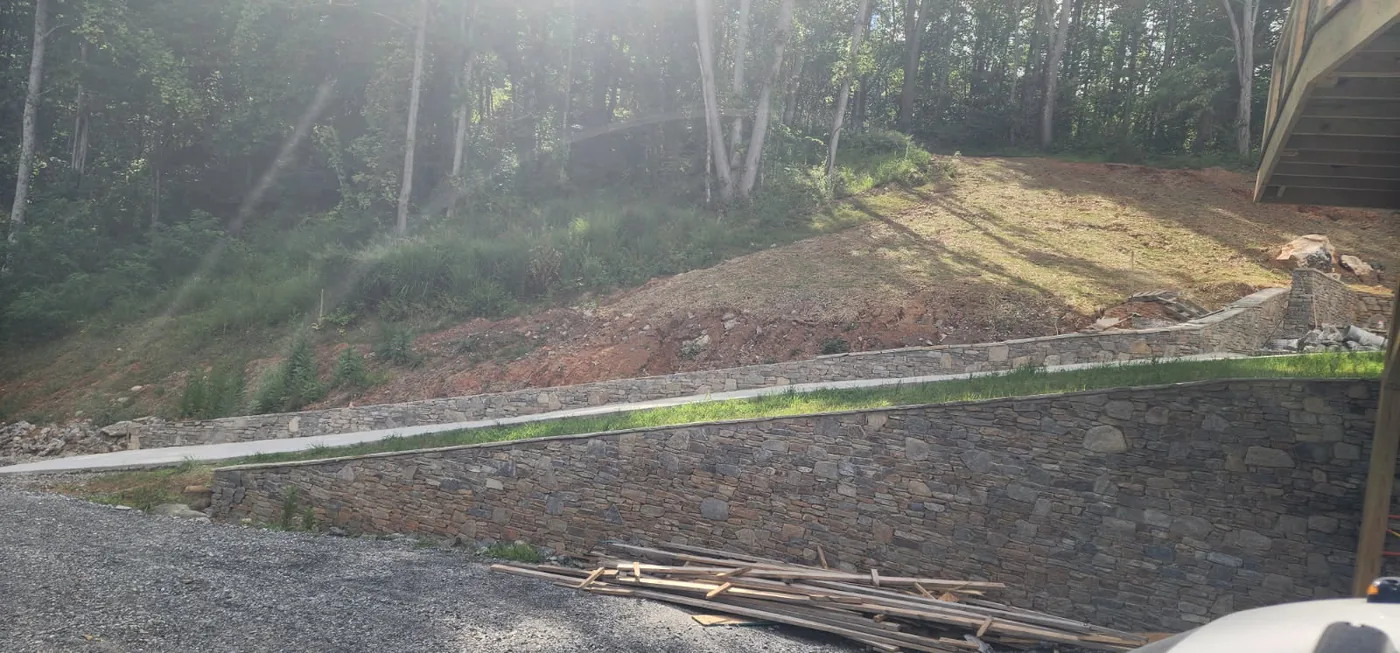
The biggest single variable is not the stone — it is the slope. Flat ground is fast and cheap. A steep bank demands deeper base, more steps, and often a retaining wall to hold the upper grade back. Virginia fieldstone and Tennessee flagstone both run with regional haul costs here, and a dry-laid path prices differently from a mortared one because the labor is different.
Weaverville sits far enough from the quarries that hauling shows up in every bid. A flagstone pallet trucked in from Tennessee crosses the mountains, and fieldstone gathered from Virginia does the same. That cost is real but usually modest next to labor. What surprises homeowners is how much of the budget goes to the parts nobody sees: base gravel, compaction in lifts, and the drainage stone under the path. A walkway is mostly a drainage system with a stone surface on top. When a bid comes in unusually low, the base is usually where it was trimmed, and that is the part that fails in two winters.
Access is the other quiet line item. A lot at the end of a steep gravel drive in the Reems Creek valley may not take a machine. When material moves by wheelbarrow, hours climb fast. A flat lot off a paved road in town is a different job entirely for the same square footage of walkway.
Why water decides the design before stone does
Buncombe County's federal disaster record sits at 19 declarations spanning 1973-2026, and the large majority are storm and flood events. That matters to a walkway because water is what destroys stone work first: it undermines base, freezes in joints, and pushes steps out of alignment season by season. A walkway built to shed water lasts decades; one that traps it fails in a few winters.
The fix is grade work, not rock. Steps should have a slight forward fall, joints should drain, and any uphill runoff should be intercepted before it crosses the path. The NC Department of Insurance treats site drainage as a code-level concern for good reason, and the same logic applies below a house's frost line as it does above. When you bring in a crew, ask how they will handle storm water before they talk about stone selection. If the answer is vague, the price is wrong regardless of what it says.
Our freeze-thaw cycle is the detail that separates local work from generic paver advice. A wet joint that freezes overnight pries stone apart from the inside. That is why local crews favor deep, well-draining base over tight, sealed joints on exterior paths. The EPA's guidance on stormwater and runoff is written for larger sites, but the principle holds at a front door: slow the water, spread it, and let it soak in where it will not undercut anything.
Homeowners near the river bottoms know this already. When the ground saturates and the water table rises, a path laid without fall or drainage becomes a shallow pond, and ponded water under stone is the beginning of the end. The honest answer for those lots is to elevate and drain, and that work belongs in the first bid, not the second repair.
Choosing a crew and knowing when licensing matters
Stone steps and walkways are often small enough to fall under the state's general contractor threshold, but once a project crosses it — typically when the job is a fixed-price undertaking of a certain size or involves a structure — the NC Licensing Board for General Contractors comes into play. Any wall over four feet, any work attached to a foundation, or anything tied to a larger remodel will usually pull a licensed contractor and, in most jurisdictions, a permit.
Beyond paperwork, ask two questions: has the crew built on Weaverville-grade slopes before, and can they show a finished example from the last year? Hillside stone work is a different trade from flat-lot pavers. If you need the wall side of the project, see retaining wall contractors in Weaverville; if you are still comparing shapes and styles, the stone steps and walkways overview walks through the options.
One more local habit worth checking: does the crew know how to stage on a shared driveway? Many Weaverville lots share narrow gravel access, and a crew that parks a dump truck in the wrong spot blocks the neighborhood. The good ones walk the site with you, mark the dumpster location, and plan where spoil goes before day one. That kind of planning is not a line item, but it is the difference between a calm project and a complaint.
If you are comparing bids, compare the drainage scope line by line. A bid that names the base depth, the drain location, and the fall of the treads is a bid you can trust. One that only describes the stone is a bid you cannot. In this county, the water detail is the whole job.
Time, weather, and what to expect on site
The single most common homeowner surprise is time. Stone work is not a one-day job even for a modest path. Excavation, base compaction, setting, and mortar all need real hours, and mortar needs a cure window before foot traffic. A typical Weaverville residential walkway with four to six steps finishes in three to six working days. Add a retaining wall or major drainage and those days double. The National Weather Service forecasts for the Asheville area are worth checking before scheduling, because a single heavy storm mid-set can cost a week.
Plan on a staging area near the work, a dumpster for spoil, and a path the crew can actually get material down. On steep lots, material often moves by hand or wheelbarrow, which is exactly why slope shows up in the price.
Fall is the busiest season here because the weather is stable and the ground is dry. Spring is a gamble. Summer thunderstorms roll in fast off the ridges, and an afternoon downpour can flood a freshly dug trench. Winter work happens, but mortar and base both suffer in cold, so crews build in more cure time. If your project is small, a dry week in late spring or early fall is the sweet spot. If it is large, book early, because the good crews in this valley fill their calendars.
What you should expect day to day: a clean site at the end of each day, a tarp over open base if rain is coming, and a walkthrough before the mortar sets. Ask for photos of the base before it is covered. Once the stone is down, nobody can see the part that matters. A crew that documents the base is a crew that expects to stand behind it.