Why Hendersonville walls fail differently than Asheville's
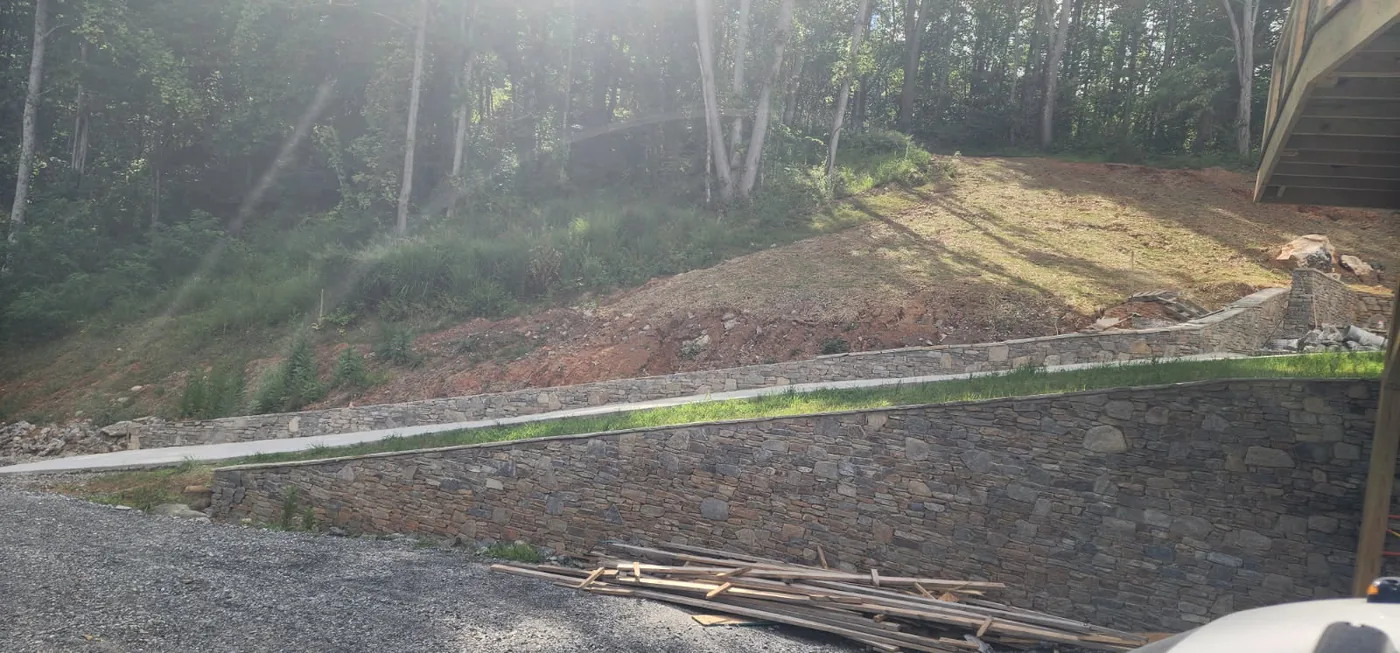
Hendersonville sits on a different geology than Asheville proper. The town and its neighboring communities — Laurel Park, Flat Rock, Horse Shoe, Mills River — were laid out on steep, weathered clay and saprolite slopes tucked against the Blue Ridge escarpment. Lots are often narrow, terraced, and drop sharply at the rear property line, which means almost every home on a hillside here has at least one retaining wall, and often two or three stacked in series. Those walls are doing more work than the walls on flatter Asheville lots, and they fail earlier.
The failure signature is local: clay soil that swells when wet and shrinks when dry pushes a wall outward every season, water pools behind the wall because there is nowhere for it to drain downhill, and you end up with a wall that bulges, tilts, or drops a course of block after a heavy spring. Older Flat Rock and Laurel Park properties frequently have dry-stacked or mortared native stone walls dating back decades — beautiful, but built before anyone here was specifying geogrid or drainage aggregate. Those walls rarely collapse suddenly; they lean for years and then fail after one wet winter.
What actually drives the repair scope on a Henderson County wall
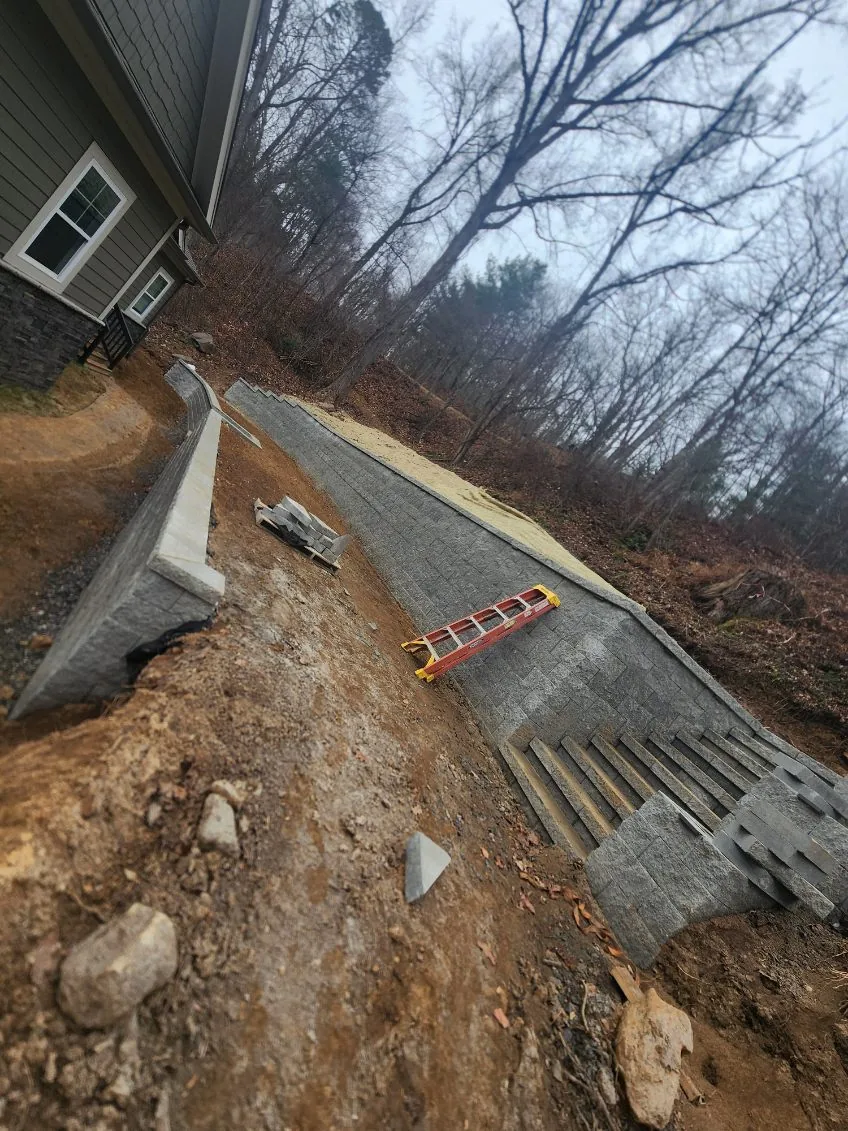
Three things decide what a repair costs: how tall the wall is above grade, what is behind it, and whether the failure is water or structure. Water is the cheap fix — clear the weep holes, re-establish the drainage gravel and perforated pipe, regrade the uphill side, and repoint or re-cap. Structure is expensive — that means the wall has rotated, the base course has heaved, or the soil above is sliding and taking the wall with it. Structural failure on a slope here is a different trade than patching, and it usually means partial or full rebuild with an engineered design.
Homeowners also ask the harder question too late: is this wall even doing what it was built to do? A wall holding back a small planting terrace is decorative; a wall holding back a hillside so the house pad stays put is a structural element. The retaining wall repair overview walks through how to tell the difference before getting quotes. In Hendersonville, deciding that early saves real money — a decorative wall can be rebuilt in kind, while a structural wall on a Laurel Park slope should go through design review with the county before anyone breaks ground.
Henderson County price picture
These ranges reflect the region, the soils, and the access realities of hillside lots — tighter, steeper, and more drainage-heavy than comparable work in Buncombe County. The Henderson County cost breakdown has the full working table; below is the scope-versus-price summary.
| Repair scope | Typical range | Notes for this county |
|---|---|---|
| Minor repointing, weep hole clearing, cap reset | $1,200–$3,500 | Common on 4–8 ft native stone walls; drainage regrade often added |
| Full drainage correction behind wall (gravel, pipe, filter fabric, regrade) | $3,000–$7,500 | Clay slope drainage is the usual root cause; cost scales with wall length |
| Partial rebuild, 4–8 ft wall (one section, reusing stone) | $6,000–$14,000 | Laurel Park and Flat Rock hillside lots; access can add labor |
| Full engineered rebuild, taller or structural wall (with geogrid and design documents) | $15,000–$45,000+ | Hillside pads, driveway-holding walls, terraced systems |
Two price movers dominate here: slope access (how a machine or dump truck reaches the wall) and whether the wall is a permitted structural element subject to design review. A wall under roughly four feet of retained height on flat ground is often cosmetic; a wall over that on a Henderson County hillside should be treated as engineered work and quoted accordingly.
Permits, licensing, and when a wall stops being landscaping
In North Carolina, retaining walls are treated as construction once they cross certain thresholds, and the licensing rules that apply to the crew depend on the contract value and scope. A wall that simply holds back a terrace often falls under landscaping; a wall that holds back a slope above a structure or a driveway typically crosses into engineering territory, and the design needs to meet the state building code. The NC Licensing Board for General Contractors publishes the thresholds that determine when a contractor must be licensed for a job of this size. The code itself lives with the NC Building Code Council, which adopts the residential and building codes governing retaining structures. If your Henderson County wall is taller than four feet, near a property line, or supporting anything other than soil, assume design review is required and ask your contractor for the plan.
Water, storm history, and why drainage is not optional here
The federal disaster record for this county tells the story of a place that gets hit hardest from above: 16 federally declared events affecting the area over a 1978-2026 record, heavily weighted toward storms, floods, and heavy-rain events. Every one of those events pushed water into hillside lots and behind walls that were built for a drier assumption. In Henderson County, fixing a retaining wall without fixing the drainage behind it is a waste of money — the wall will fail again after the next wet season. The EPA publishes guidance on stormwater and erosion control that's worth reading before designing drainage on a slope. If the wall is holding back a residential pad, HUD's guidance on site drainage at hud.gov is also a useful reference for homeowners dealing with persistent water issues.
Hiring a crew in this market
Ask three things of any Hendersonville-area contractor: whether they have built retaining walls on comparable slopes here, not just flat-ground landscaping; whether they can document how the drainage behind the wall will be detailed, because clay slope drainage is the local variable that most changes cost and outcome; and whether they carry the license required for the contract value under state rules. A proper scope should name the drainage materials, the base depth, the backfill spec, and how the wall meets the slope — a bid that says only "rebuild wall" is not a real quote. The Hendersonville retaining wall contractor guide goes deeper on vetting questions. If a wall has already started leaning or dropping, do not wait for the next heavy rain to schedule the visit.