Where the water comes from on a Black Mountain wall
The first thing a stone veneer job has to answer in Black Mountain is not which stone — it is where the water goes. Most of the town's residential lots sit on slopes that shed toward the house, and the same ridge that gives a porch its view sends rainwater down the hill behind it. On a west-facing wall off Montreat Road, that water arrives from the wooded slope above; on a downtown cottage, it arrives off the roof and out of a gutter that has been aimed at the foundation since before anyone on the block was born. A veneer that ignores that flow will show it in two winters — efflorescence, cracked mortar, and stone that has started to sound hollow when you tap it.
What makes Black Mountain different from a flatland job is that the water has two entry points, not one. The first is direct: rain driven against the wall by the same storms that funnel up the Swannanoa Valley. The second is subsurface — groundwater moving downslope under the yard and finding the path of least resistance, which is often the base of a retaining wall or the footing of a veneered foundation. A wall that handles the first and ignores the second will weep at the base course within a season.
The fix is a drained wall assembly: a weather-resistant barrier over the sheathing, a drainage plane behind the stone, weep screeds at the base, and a site grade that carries water a few feet away before the drainage takes over. That detail is what separates a veneer that lasts a generation from one that has to be redone at a fraction of the original cost. The stone veneer overview walks through the assemblies we build here.
The price picture for stone veneer in this corner of Buncombe
Black Mountain sits in Buncombe County, and pricing runs close to the county picture — the working table for retaining and hardscape work lives on the Buncombe County cost breakdown, and stone veneer tracks a similar band because the labor details overlap. The short version: small accent jobs (a fireplace surround, a porch column base) start in the low thousands; a full front facade typically runs $14,000–$28,000 depending on square footage and stone selection; and any job on a steep lot carries drainage and staging line items that flatland quotes never show. Treat a bid without those line items as incomplete, not cheap.
| Scope | Typical range |
|---|---|
| Accent wall / column base / small feature | $1,200–$4,500 |
| Single wall or partial facade | $6,000–$14,000 |
| Full front facade with drainage prep | $14,000–$28,000 |
| Whole-house veneer (typical single-family) | $28,000–$55,000+ |
| Retaining wall face veneer (per sq ft) | $22–$45 |
| Chimney or fireplace surround | $2,500–$9,000 |
The movers are square footage first, then stone type (local fieldstone and full-bed native stone cost more than manufactured veneer), then access — a wall that has to be hand-carried up a slope adds labor no catalog price reflects. On the steep streets between the golf course and Chestnut Hill, a crew may spend more time setting up fall protection and staging than laying stone; that is real labor, and it shows up in a competent bid.
Stone selection itself moves the number in ways homeowners do not always expect. A manufactured veneer from a regional supplier arrives on pallets, uniform in thickness, and goes up fast. Local fieldstone from a quarry on the county's edge arrives in a jumbled mix of sizes that has to be sorted, squared, and sometimes split on site before it is usable — beautiful, but slower. Full-bed native stone is the heaviest and most labor-intensive of the three, and it belongs on walls where a thin veneer would look out of place against the existing masonry. None of those choices change the drainage assembly behind them, which is why the prep cost line looks similar across stone types even when the material line does not.
Substrate and drainage before a single stone goes on
Stone veneer in this climate has to be detailed as a drained assembly, not a glued-on skin. The best-practice reference is the manufacturer's installation standard and the residential code that governs moisture management — the NC Department of Insurance codes division publishes the state's adopted residential requirements, and a proper wall needs a water-resistive barrier, a drainage gap, corrosion-resistant lath and fasteners, and a weep screed at the base so any water that reaches the cavity can leave instead of sitting against the framing.
That detail matters more here than in flatland because Black Mountain walls get driven rain from more than one direction and sit humid for long stretches of the year. A wall built without that layer can look perfect for two seasons and then fail all at once. If your house has an uphill slope, the grade and the wall drainage are the same conversation — which is exactly the conversation a good contractor will start before talking about color.
The order of operations matters as much as the materials. On a retrofitted facade, the existing wall covering comes off first, then any rot or soft sheathing gets replaced, then the water-resistive barrier goes on and gets lapped correctly at the top and sides so water cannot get behind it. Lath goes over that, fastened through to framing with the right spacing, then a scratch coat, then the stone in courses from the bottom up so the weep screed stays clear. Skipping any of those steps is what produces the callback pattern — a wall that looked fine at the walkthrough and stains at the base a year later.
Why the mountain-lot version is its own job
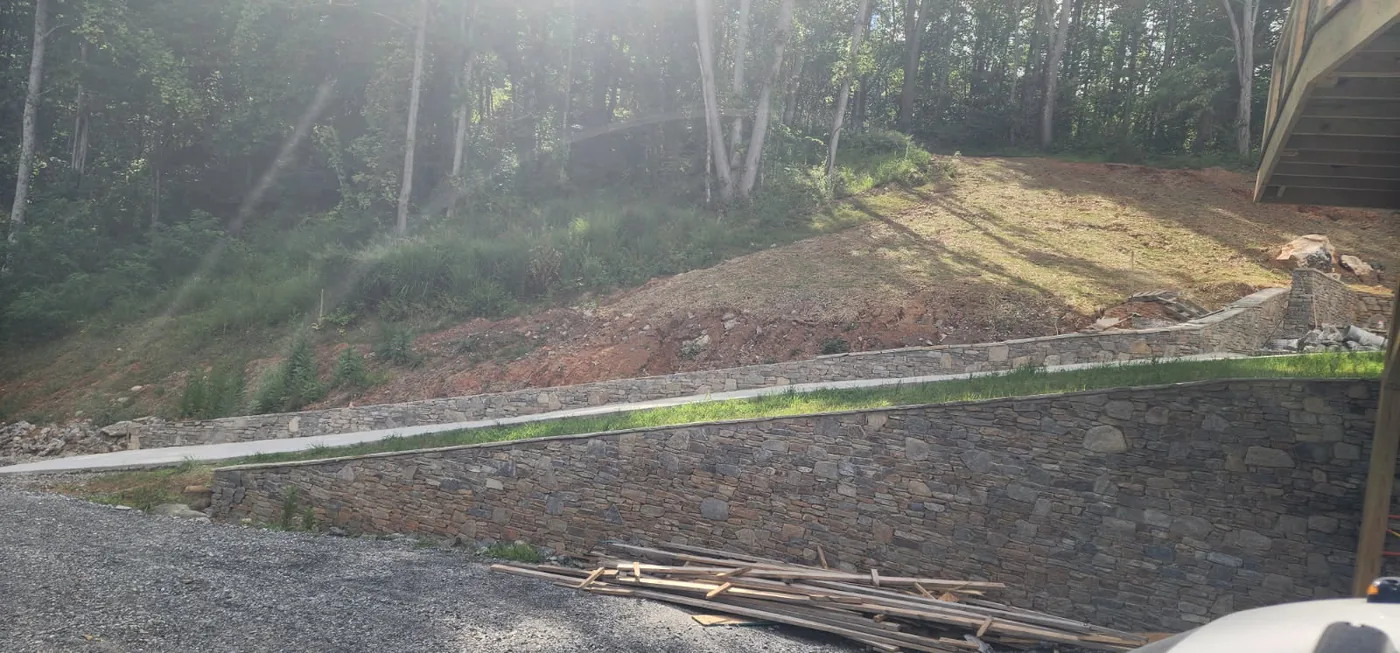
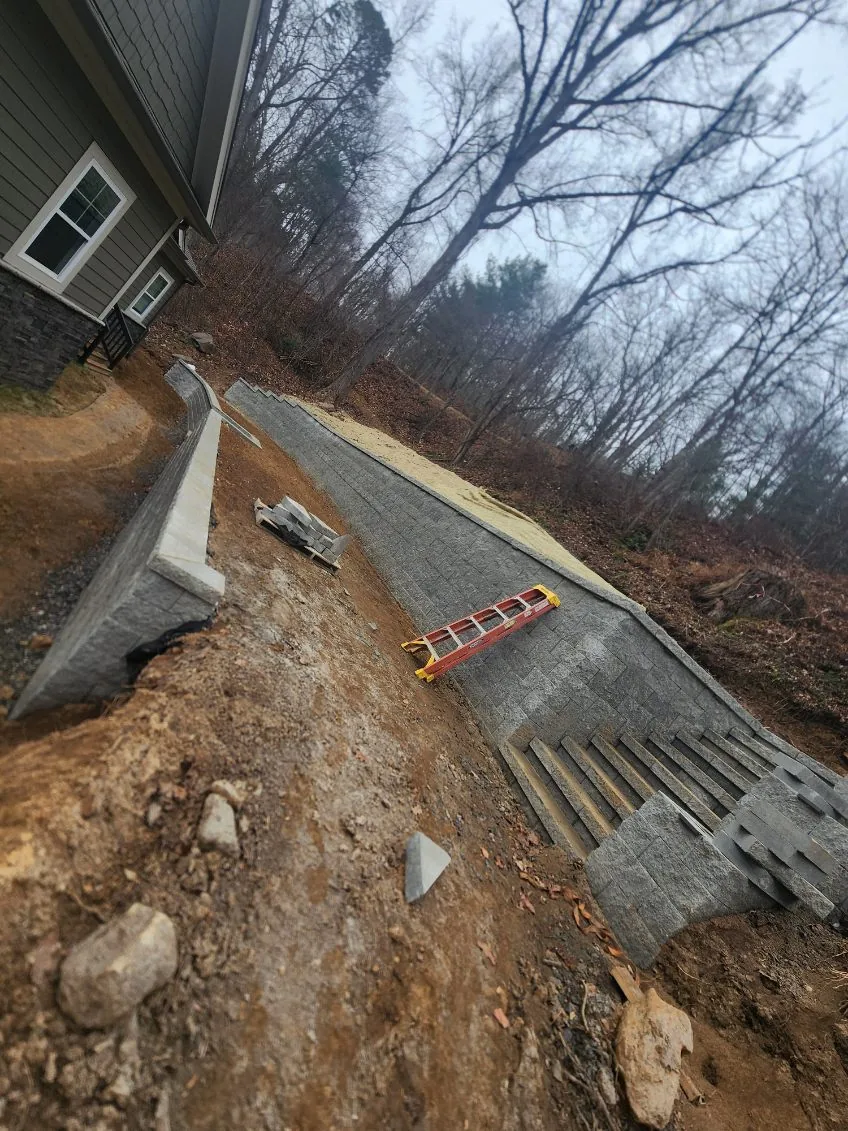
Homes built into the grade are the norm here, not the exception, and they are the jobs that look simplest in a photo and get complicated fastest. A retaining wall that holds a driveway pad, a foundation wall cut into the slope, a porch pier that lands on rock — veneer on any of those has to sit on a substrate that tolerates the wall moving slightly under frost and water load. Tying the stone directly to a wall that moves is how you get cracks that start as hairlines and widen with every freeze.
Two black-bear sightings and a narrow driveway are the practical details that separate a Black Mountain stone job from a flat-lot job in town. Steep lots need staging plans, retaining solutions for the workspace itself, and hand-carrying for anything the truck cannot back to. That shows up in the quote, and a bid that ignores it will either grow or cut corners.
For walls and terracing near the house, the trade overlaps directly — see the Black Mountain retaining wall contractors page for the crews who handle both the structural wall and the stone face. The American Society of Civil Engineers' guidance and the manufacturer's installation instructions are the technical floor here, and the NC licensing threshold applies once a project crosses the residential dollar cap — verify any contractor through the NC Licensing Board for General Contractors.
Storm history is why the water detail is not optional
Buncombe County's federal disaster record — 19 declared events spanning 1973-2026 — is dominated by storm and flood family events, and every one of them pushed water at walls that were built for a drier assumption. That history is the reason we lead every veneer scope with drainage rather than finish. The National Weather Service's local climate record for the Asheville area (through weather.gov) shows the same pattern: wet years, dry years, and the occasional event that tests everything at once. A drained wall assembly handles all three.
For a homeowner, that translates into one practical question to ask before signing anything: where does the water that hits this wall go after it hits? If the answer is anything other than 'down and away,' the scope is incomplete. The stone veneer overview and the Buncombe County cost breakdown both spell out what a complete scope includes, so a bid can be compared line by line rather than total to total.