Where the water comes from on a Maggie Valley wall
Almost every stone veneer problem in this valley starts uphill. Lots are cut into grades that shed rain fast, upslope neighbors send runoff down, and the freeze-thaw line moves through the wall more times in a Haywood County winter than most of the piedmont sees in a decade. A veneer wall that looks like a finish decision is actually a drainage decision wearing a stone coat.
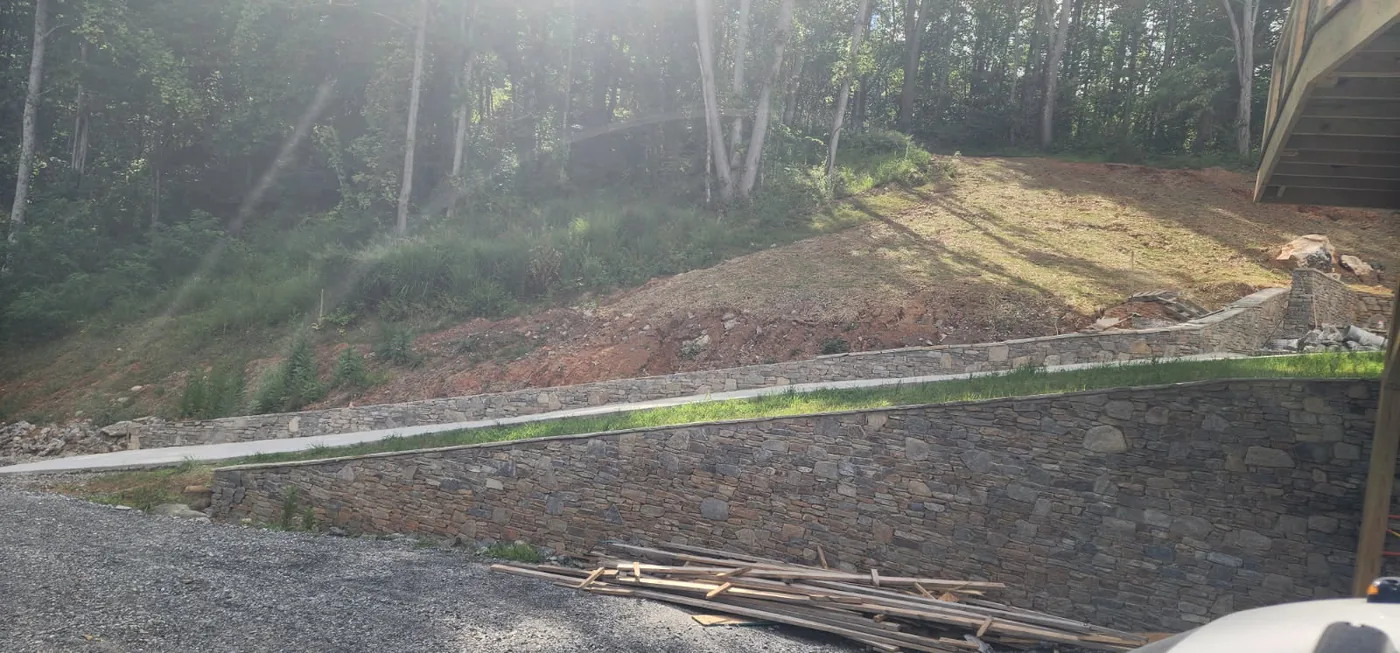
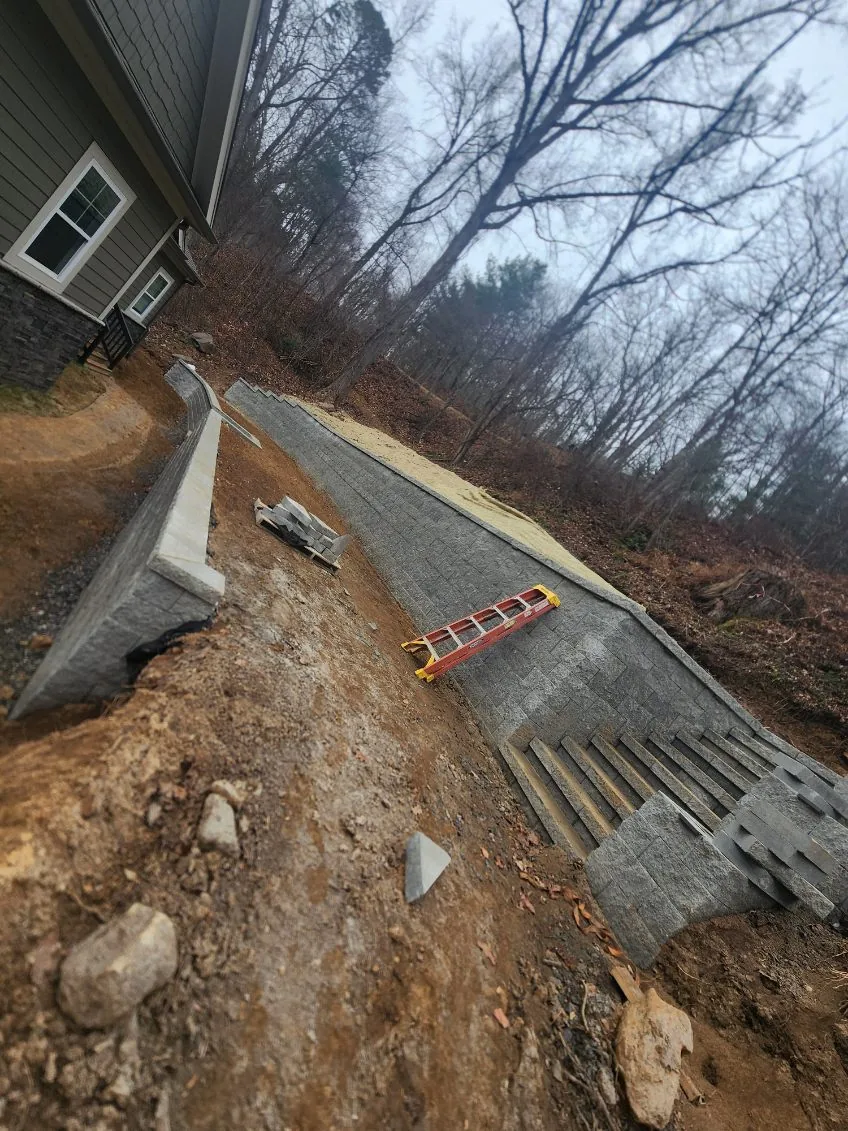
The detail that matters is the drained cavity behind the stone: a drainage plane, weep screed at the base, and a route that sends water out and away instead of pooling at the footing. On a flat suburban lot you can almost get away with sloppy work. On a graded lot off Soco Road or a steep parcel above the valley floor, that water has no natural exit, and it will find your wall. If the plan doesn't include a retaining wall or a proper grade break, see what that scope actually costs in the Haywood County retaining wall cost table before you approve any veneer bid.
The terrain around Waynesville and Maggie Valley makes this worse than it sounds. The town sits in a bowl where the mountains drop fast, and the housing stock reflects it: split-levels stacked into the slope, daylight basements that were never meant to be below grade, and driveways that turn into chutes during a summer thunderstorm. Each of those conditions changes where the veneer wall sits relative to the water table and the surface flow. A wall at the bottom of a driveway on a Maggie Valley hillside sees everything the drive collects. A wall under a set of exterior stairs sees whatever the treads shed. The stone doesn't care where the water came from. It only cares whether the cavity behind it can dry.
Consider the practical sequence a local installer has to walk through before a single stone goes up. First, where does the roof water land? On an upslope lot the gutter downspouts may discharge directly onto the grade above the veneer wall, which means the wall is being asked to be a French drain it was never designed to be. Second, where does the grade break? If the finished grade sits above the weep screed, the weep path is buried and the wall is effectively a moisture trap. Third, where does the lath terminate at the bottom? If it runs past the screed into the soil, capillary action pulls water up into the scratch coat. None of this is exotic. It is the basic water logic of a mountain lot, and it is the reason two bids for the same wall can look identical on the surface and perform nothing alike.
What stone veneer actually costs here
Maggie Valley pricing runs above flatland averages for one honest reason: access. Short driveways, slope staging, and tall walls that need scaffolding add labor that a curb-adjacent install never pays. The bands below reflect local scopes, not catalog prices.
| Scope | Typical installed range |
|---|---|
| Wainscot / knee wall, 3–4 ft, easy access | $18–$30 per sq ft |
| Full-height wall, 8 ft+, simple rectangular runs | $14–$24 per sq ft |
| Corners, arches, window surrounds, soldier courses | $30–$45 per linear ft |
| Chimney chase, re-clad existing masonry | $3,200–$9,500 per job |
| Free-standing feature wall or pillar pair | $4,000–$13,000 per job |
| Tear-off old siding or stucco to expose substrate | $4–$9 per sq ft |
| Flat or cast veneer on a tall grade-grade wall (drainage critical) | $30–$45 per sq ft |
Two line items are not optional on steep lots and show up in any honest bid: corrosion-resistant lath and fasteners, and a proper drainage layer behind the scratch coat. A quote without them is not a cheaper quote, it is an incomplete one. The general shape of a proper stone veneer scope is the same everywhere, but the water line is where valley jobs diverge.
It helps to understand what actually drives the number on a Haywood County bid. Stone material itself is often the smallest line. Labor and staging dominate, and staging on a slope is where a job either stays in band or blows past it. A wall that can be reached with a ladder and a wheelbarrow is one price. A wall that needs a pump jack, a track machine to move pallets, or a crew hand-carrying stone up a switchback is another. Corners and openings are priced by the linear foot because they eat time: every opening needs flashing, every corner needs alternating pieces to read correctly, and soldier courses and arches need layout before a single stone is set. A wall with three windows, a door, and two outside corners can carry more labor than a longer plain run. That is why the per-square-foot number is a range and not a rate, and why any bid that quotes a flat square-foot price without walking the access should be read carefully.
Freeze-thaw is the local durability test
Haywood County winters cycle above and below freezing repeatedly, and that cycle loads every stone and every mortar joint. The federal disaster record backs the caution: 19 declared events touch this county going back 1973-2026, and storm-driven water against walls is the recurring theme. The ICC family of codes treats adhered veneer as a cladding with explicit water-resistive-barrier and drainage requirements for exactly this reason. If the veneer goes over a wood-frame wall with no gap and no weep path, freeze-thaw will pop it loose.
Field-test the bid on three points: what water-resistive barrier goes up before lath, where weep screed sits at the base, and how the installer is detailing flashings at roof-to-wall and window-to-wall transitions. On a masonry chimney, the same question applies against a different substrate.
What freeze-thaw actually does to a bad wall is worth understanding. Water enters the scratch coat or the cavity behind it through a failed flashing, a buried weep, or a crack that opened at a control joint. Overnight, that water freezes and expands. The next day it thaws and the ice lens collapses, leaving the void slightly larger than before. Repeat that cycle dozens of times over a mountain winter and the mortar bond between stone and scratch coat fatigues. The first sign is usually a hollow sound when you tap the wall. The next sign is a stone on the ground after a cold snap. By the time an entire panel is loose, the water has been getting in for more than one season, and the fix is a rebuild of the affected section, not a patch. This is why an inspection done in early spring, after the last hard freeze, tells you more than one done in August.
There is a substrate difference that matters too. Over a wood-frame wall, the water-resistive barrier and drained cavity are the whole game, because the framing behind the veneer needs to stay dry. Over an existing masonry or concrete wall, the veneer still needs a drainage plane and flashing, because the masonry itself can wick and hold water that then has nowhere to go but into the scratch coat. In both cases, the code expects a path for water to leave, and on a slope, that path has to daylight somewhere below the wall. The 2018 and later IRC provisions that North Carolina has adopted treat adhered veneer this way, and local plan reviewers in Haywood County apply them to any wall that is part of the building envelope or that carries a structural role.
Hiring on a valley timeline
Ask for references on a wall that has stood through at least two winters, not one. Ask whether the crew will do the drainage correction before the veneer, or after the callback — the answer tells you whether they understand this terrain. And ask about a contract once the job crosses the state threshold: NC Licensing Board for General Contractors rules kick in for work above the statutory dollar amount, and the licensed crew is the one that can be held to the scope.
Timing matters here too. Maggie Valley gets cold early, and mortar adhesion and curing slow once overnight lows start dipping. Fall installs go up faster in the warmer middle of the day, which is the practical reason to schedule in late summer or early fall. A Maggie Valley retaining wall contractor who is already on-site for a grade correction can often sequence the veneer into the same scope and save a mobilization.
There is also a real difference between a crew that has worked mountain lots and one that has only worked flat subdivisions. Ask a prospective installer to describe the worst drainage problem they solved on a slope, and listen for whether they talk about the grade above the wall or only about the wall itself. The ones who understand this terrain will mention the upslope first. They will also know the practical access constraints: that a lot of Maggie Valley and Waynesville driveways cannot take a loaded stone truck past the mailbox, that material has to be staged at the bottom and moved, and that weather windows in January and February are short enough that a mortar job may sit for days waiting for a thaw.
If the wall is part of a larger exterior project, the veneer can often be sequenced to follow the grade work, the roof work, and the gutter corrections. Doing the drainage once, before the stone goes on, is cheaper than doing it twice. A homeowner who lines up the retaining wall, the downspout reroute, and the veneer in the same season usually ends up with a wall that performs better and a scope that costs less than three separate mobilizations. That is the honest argument for planning the exterior as a whole rather than as a list of unrelated projects, and it is the one local crews make again and again on jobs above the valley floor.
Which stone, and why it matters for this climate
Cast concrete veneer is the common choice on valley homes: lighter, more uniform, and it holds color through the freeze cycle without the spalling that sedimentary stone can develop when it wicks water. Natural stone — especially the thin-cut sandstone and fieldstone that reads as authentic in the Smokies — costs more per square and demands a seasoned installer because the variation and weight distribution change the layout. Neither is wrong. The wrong choice is a stone that was quarried for a dry climate and installed with a mortar that traps water. Ask the installer what stone they have put on a similar wall within two valleys, and how it survived the last hard winter.
The region has its own stone vocabulary. Fieldstone and native-looking ledgestone read as local because they echo the retaining walls and old chimneys that are already part of the Haywood County landscape, and a lot of homeowners want the new veneer to feel like it grew there. That is a legitimate goal, and it is achievable with cast products that mimic the regional look without the weight and porosity of genuine fieldstone. The trade-off is honest: cast is more predictable, natural is more distinctive, and both need the same drainage detail behind them. What a homeowner should not accept is a proposal to install natural stone with a mortar that holds water against the back of the stone, or a cast veneer set without a drainage plane because the installer claims the product is waterproof. No veneer product is a substitute for a drained wall.
Color and weathering matter in a different way in this climate. The wet side of a Maggie Valley wall, the north and west faces that stay damp longer, will grow a patina faster than the south face that dries quickly. Some homeowners like that; some don't. An installer who has worked both sides of a valley can tell you what a given stone looks like after five years on a shaded wall versus a sunny one, and can order accordingly. That kind of local knowledge is not in any product catalog, and it is one of the better reasons to hire someone who has actually built walls in this county rather than someone who learned the trade somewhere flatter.