What it actually costs to get stone up a Montreat driveway
A Montreat estimate is written by a trucker before it is written by a mason. The town sits in a narrow valley off the Swannanoa River, just outside Black Mountain, and most homes sit on grades between 15 and 30 percent, up gravel drives with switchbacks, low tree canopies, and no room to turn around a full-size dump truck. That route costs real money: palletizing material, offloading by hand or with a mini skid steer, or running half loads up one at a time. On some of the older lanes off Georgia Road or up toward the Montreat Conference Center, a tandem-axle truck simply cannot finish the last stretch, and the stone has to be shuttled from a staging spot near the gate.
Material travels roughly 15 miles from quarries around Black Mountain, Fletcher, and Weaverville, so fuel and haul distance matter less than the last 500 feet. A flat-lot job in an open subdivision might add 5 percent for delivery. A steep Montreat driveway can add 15 to 25 percent before a single stone is set. Ask any bidder how they plan to get material to the work area. The answer tells you whether you are reading a real number or a wishful one.
Time of year changes the math too. In a wet spring, a loaded truck can spin out on a gravel switchback that it climbed fine in August, so crews build in extra trips and sometimes a tracked carrier. Frozen ground in a hard winter can be just as bad. The mason who has worked this valley for years will price those days into the bid instead of discovering them on your driveway at 7 a.m.
Scope-by-scope ranges for Montreat stonework
Values below reflect Buncombe County pricing for work at this kind of grade. Treat them as bands, not quotes.
| Scope | Typical price range | How Montreat terrain moves the number |
|---|---|---|
| Stone veneer (interior or exterior) | $45–$85 per sq ft | Elevated scaffolding on stacked or terraced walls adds labor hours. |
| Full bed stone or structural masonry | $70–$130 per sq ft | Handling weight on a slope requires equipment rental or more bodies. |
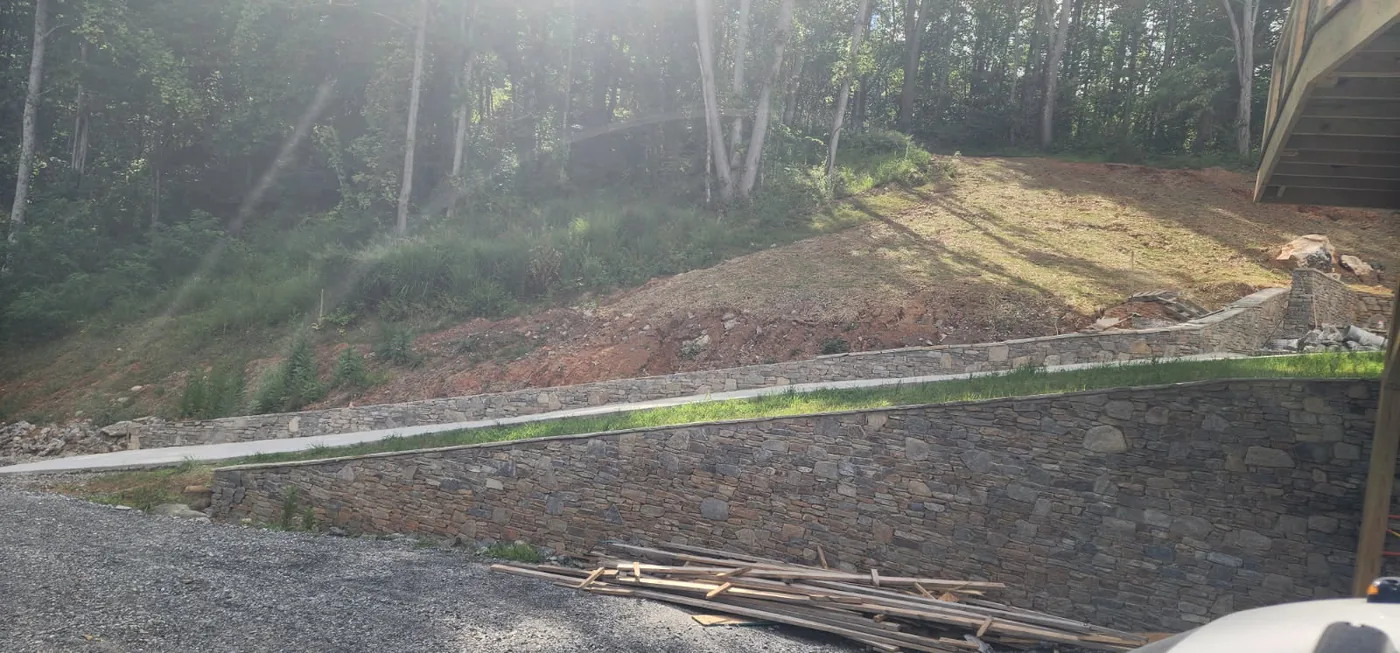
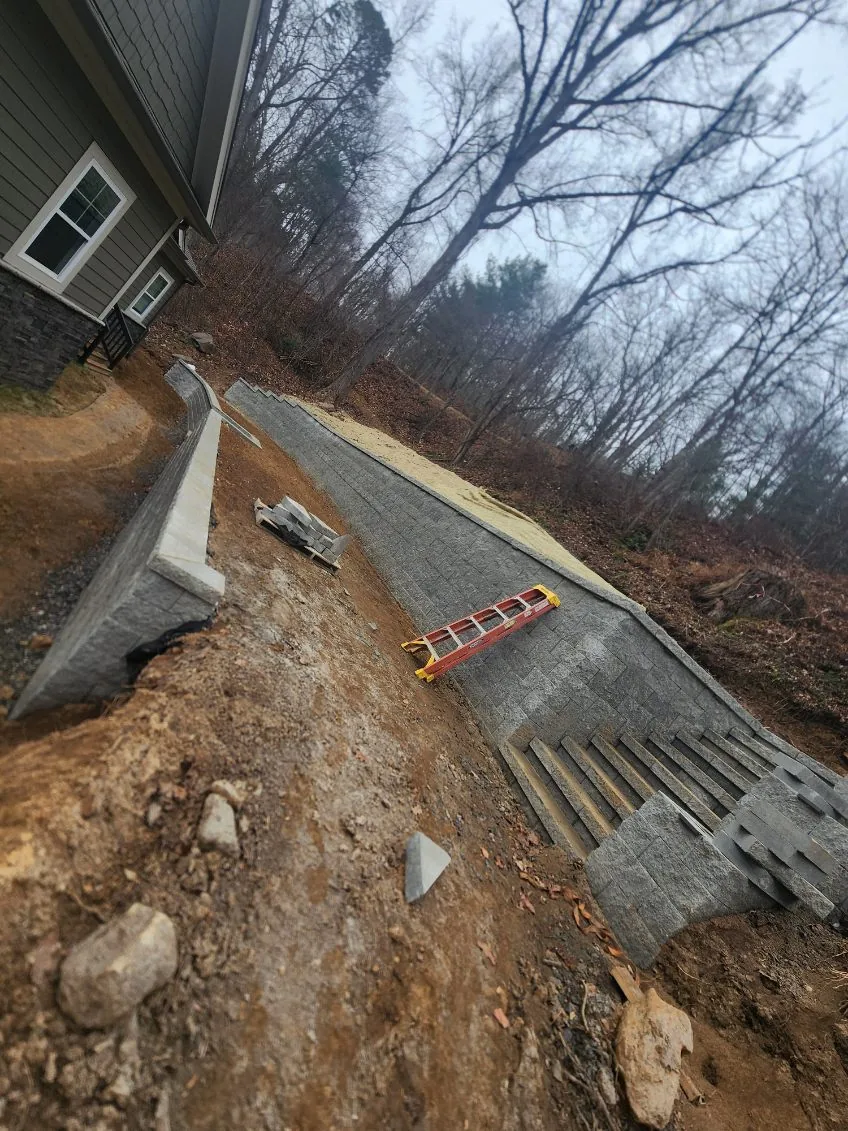
| Retaining wall (engineered, above 4 ft) | $55–$95 per sq ft | Drainage, batter, and geogrid design scale with grade; steep lots may need engineering. |
| Stone steps and walkways | $2,400–$8,500 | Cut stone treads shipped and carried; stair placement depends on fall line. |
| Stone fireplace or chimney | $8,000–$25,000+ | Access dictates whether material arrives by crane or by line and pulley. |
| Repointing and repair | $25–$60 per sq ft | Scaffolding on uneven ground is a real line item here. |
Two jobs of the same square footage can land at opposite ends of a band. A wall at the top of a gentle driveway with room to stack pallets is a different project from the same wall on a terraced lot where every stone rides up in a wheelbarrow. That is why a real Montreat bid walks the site before it quotes, and why a phone estimate from a crew that has never seen your switchback should be treated as a placeholder.
Water on a mountain slope: design before mortar
Montreat's federal disaster record explains more about wall failures here than any design fault. 19 declared events touch Buncombe County across 1973-2026, mostly storm and flood family, and each one pushed water at walls built for a drier assumption. A wall that holds on a flat lot will fail on a 25 percent slope if the drainage behind it was sized for the wrong storm. On these lots, hillside seepage, roof runoff, and the uphill neighbor's runoff all arrive at the same wall. The Swannanoa valley funnels heavy rain fast, and by the time water reaches a retaining wall it is often carrying soil with it.
Any Montreat retaining wall or foundation-adjacent masonry should be designed with drainage first: gravel backfill, filter fabric, and a perforated drain that has a place to daylight. The NC Department of Environmental Quality tracks stormwater rules that often apply when work touches a slope near a waterway, and the International Code Council standards that NC builds on treat retaining-wall drainage as structural, not decorative. Our retaining wall guide covers what a properly drained assembly looks like and how it is inspected. If your bid doesn't name drainage, that's the answer you needed.
Freeze-thaw matters here as much as rainfall. Montreat sits high enough that winter swings above and below freezing repeatedly, and water trapped behind a wall or inside a chimney will expand, push, and spall the stone. Weep holes that clog with soil in year one stop working by year three. A drainage detail that looks fussy on paper is the difference between a wall that lasts decades and one that leans out after two wet seasons.
Retaining walls on Montreat grades are their own trade
A 2-foot garden wall and a 6-foot engineered wall that holds a driveway share vocabulary and nothing else. On Montreat's slopes, the second kind is common, and once a wall crosses roughly 4 feet of retained height, most local building departments will want a design from a licensed engineer. The NC Licensing Board for General Contractors sets the threshold at which a job also requires a licensed general contractor rather than a handyman or a landscape crew, and that threshold is lower than most homeowners expect. The Buncombe County retaining wall cost breakdown shows line-item ranges for excavation, drainage, geogrid, and stone so you can compare bids item by item. If you want to shortlist crews who actually work these grades, the Montreat retaining wall contractors page is where to start.
The permit path itself is part of the cost. A wall that triggers an engineer's letter also triggers plan review, and review takes calendar time before a shovel touches the slope. Homeowners who line up the engineer early keep a project moving through a dry season; those who wait often end up stacking stone in the rain because the permit finally cleared in October. Ask the mason whether they carry the engineering coordination or leave it to you, because that line item alone can swing a bid by several thousand dollars.
Hiring a stonemason who has worked this terrain
The single best filter in Montreat is a reference from a neighbor's driveway you can drive up yourself. Ask three questions on the first call. First: how will you get the material in, and what equipment do you need to bring? Second: does the scope include drainage, footings, and a design letter if the wall is above the local threshold? Third: who is doing the actual setting, because on a steep lot the crew composition changes how long the job runs.
A good stonemason in this town will recognize your driveway from the call alone. A bid that comes in 30 percent under the others is usually missing access, drainage, or both. Take your time, get three numbers on paper, and read the line items before you read the total.
Also ask how they protect the site. A tracked machine on a wet slope leaves ruts that cost money to repair, and stone dropped near a mature oak or a rhododendron bed can scar landscaping that took decades to grow. The crews worth hiring walk the property, note the trees and the drainage swales, and plan the staging area before the first pallet arrives. That kind of care is hard to price line by line, but it shows up in how the finished job sits in the landscape years later.