Why access sets the price before stone ever does
Lake Junaluska is a small lakeside community inside Haywood County, and it has a specific shape: a level ring of streets close to the water, then a hard climb onto the surrounding ridges. A walkway job on a flat lot off Lakeshore Drive and a walkway job two switchbacks up a gravel drive above town can use the same Tennessee flagstone and land thousands of dollars apart. That gap is labor and logistics, not material.
Three things move the number here. First, driveway grade: if a loaded stone truck cannot back within reasonable distance of the work, every pound gets moved by machine, wheelbarrow, or hand. Second, staging room: narrow lakeside lots often have no place to dump and sort, so the crew works from the street and re-handles material two or three times. Third, quarry distance. Most of the stone that feeds Haywood County comes out of the Tennessee and western NC quarries, and the further the yard, the more trucking is baked into the delivered price per ton. Before you compare bids, ask each mason what access assumption their number is built on. A low bid that assumed a flat driveway will not survive your actual driveway.
The Lake Junaluska price picture
The ranges below reflect residential work in and around the Lake Junaluska and Waynesville area — straightforward access, decent staging, standard materials. Treat them as bands, not quotes, and expect steep or tight lots to run above them.
| Scope | Typical range | What moves it |
|---|---|---|
| Simple flagstone walkway, reset | $1,800-$3,600 | Length, base prep, whether old material is salvageable |
| New laid walkway, dry-set or mortar | $2,800-$5,500 | Stone type, width, edging, drainage correction |
| Garden or entry steps, 3-6 risers | $2,400-$5,200 | Rise, tread size, retaining on the sides |
| Full flight with landings | $5,500-$9,500 | Number of landings, slope, footing depth |
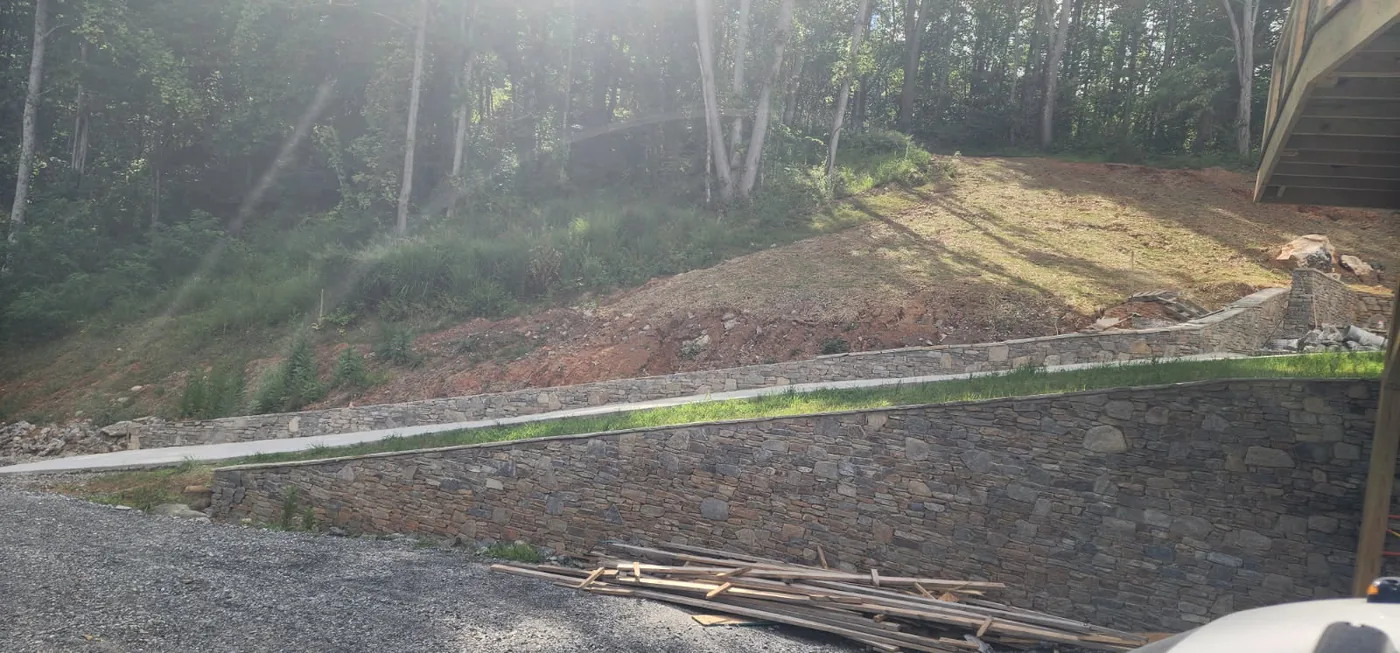
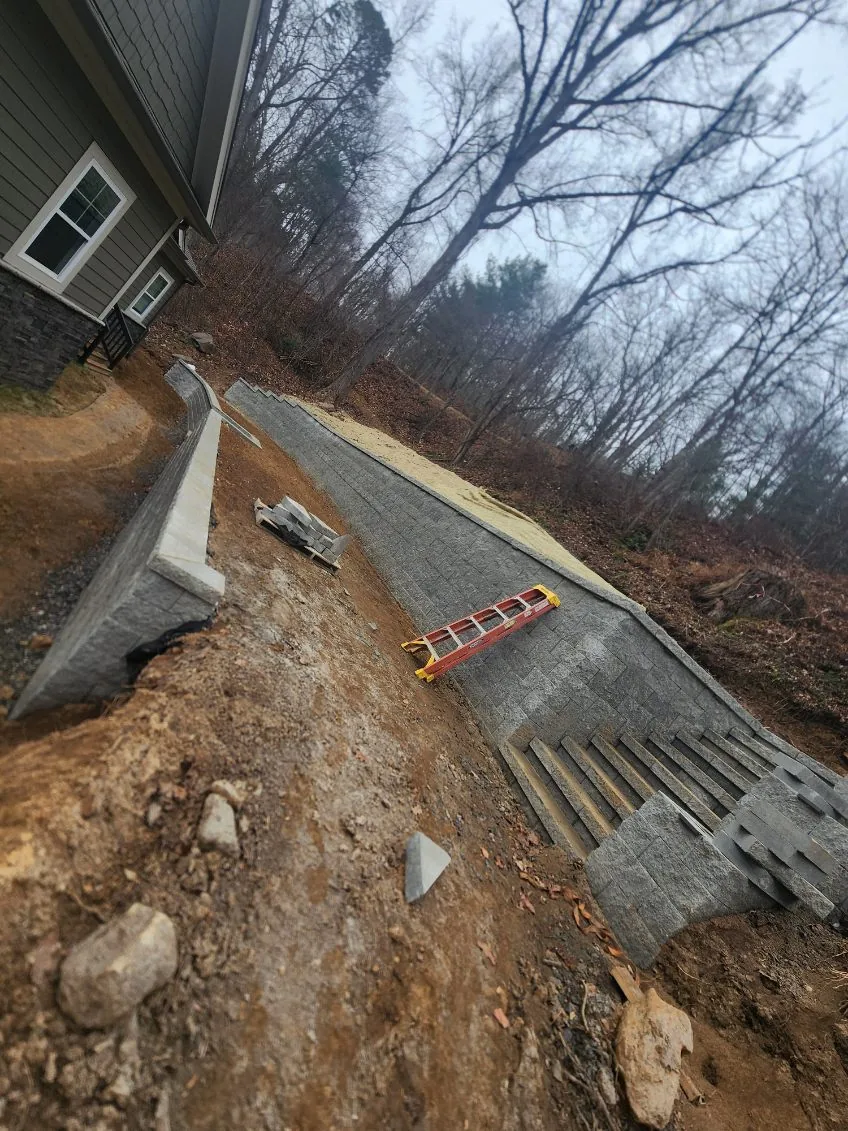
| Steps integrated with a retaining wall | $6,000-$14,000 | Wall height, engineered need, drainage line items |
| Access surcharge (steep, no staging) | Add 15-40% | Machine vs. hand carry, distance from parking to work |
If your project is really a wall with steps cut into it, the deeper cost picture lives in the Haywood County retaining wall cost breakdown rather than here.
Terrain, freeze, and why the base matters more than the stone
Western North Carolina sits in a climate where the ground freezes and thaws repeatedly through winter, and that cycle is what destroys most bad walkways. A step that is set on a thin bed of sand over undisturbed clay will look perfect in June and be rocking by February. The fix is unglamorous and invisible: excavate deep enough, compact a proper granular base, and give water somewhere to go.
That last part matters on a slope. Water that sheets down a hillside and hits a step or a wall face has to be redirected, not merely blocked. The International Code Council residential provisions treat footing depth and drainage as structural requirements for a reason, and the NC Licensing Board for General Contractors sets the threshold at which a project legally needs a licensed general contractor rather than a handyman — worth checking before you sign anything, because steps tied into a tall retaining wall can cross it. Plan for frost depth, plan for water, and the flight will still be level when the daffodils come up.
Storm water is the local wildcard
Haywood County has a long record of federally declared disasters — 19 events spanning 1973-2026 — and the overwhelming majority are storm, flood, and landslide family. That history is directly relevant to hardscape, because a walkway or step set that survives ten dry years can be undermined in one wet week when runoff arrives from a neighbor's slope above you. The National Weather Service forecast office tracks these events, and the pattern is not subtle.
Practically, this means two things for a Lake Junaluska project. First, any walkway on a grade should be designed with surface drainage in mind from the start, and any step run should have a way for water to escape under and around it. Second, if your property has visibly moved during past storms, that is a drainage and slope stability question before it is a masonry question. Getting the water right is cheaper than rebuilding the steps every few years, and it is the difference between a crew that builds hardscape and one that builds hardscape that lasts.
Choosing the right crew for a lakeside property
Lake Junaluska has a mix of housing that spans generations: older cottages close to the water, mid-century homes, and newer builds on the ridges above. Each foundation sits on different ground, and the walkway that suits one will not suit another. Ask any mason you consider three questions. Have you built on a grade like mine, and can you show me one? How do you handle drainage at the base of the run? And how will you get material to the work area, given my driveway?
The third question is not a trick — it is the one that tells you whether the bid you are holding is real for your property. When you are comparing full project approaches rather than just steps, the stone steps and walkways overview and the local retaining wall contractor guide both cover what a proper scope should include before you commit.