Fieldstone, boulder, block, and timber against Hot Springs' actual housing stock
Hot Springs sits where the French Broad cuts through Madison County, and the town's lots tilt accordingly. A hillside cottage off Bridge Street may need fifteen feet of rise solved in one narrow run; a newer build on the flat above the river wants a straight, clean flight that looks deliberate. Those are two different material conversations. Fieldstone and boulder steps match the older porches, stacked walls, and rock outcrops that already define the town. Dressed block with timber edging suits the newer construction and the tighter budgets that come with it, and it goes in faster where a machine can't reach.
Madison County's ground is the deciding vote. Much of it is residual soil over steep bedrock, so a step run often has to cut into slope before it can hold a tread. Timber risers pinned into that ground move seasonally. Boulder steps set on compacted base do not. The right call depends on what's under the run, not on a catalog.
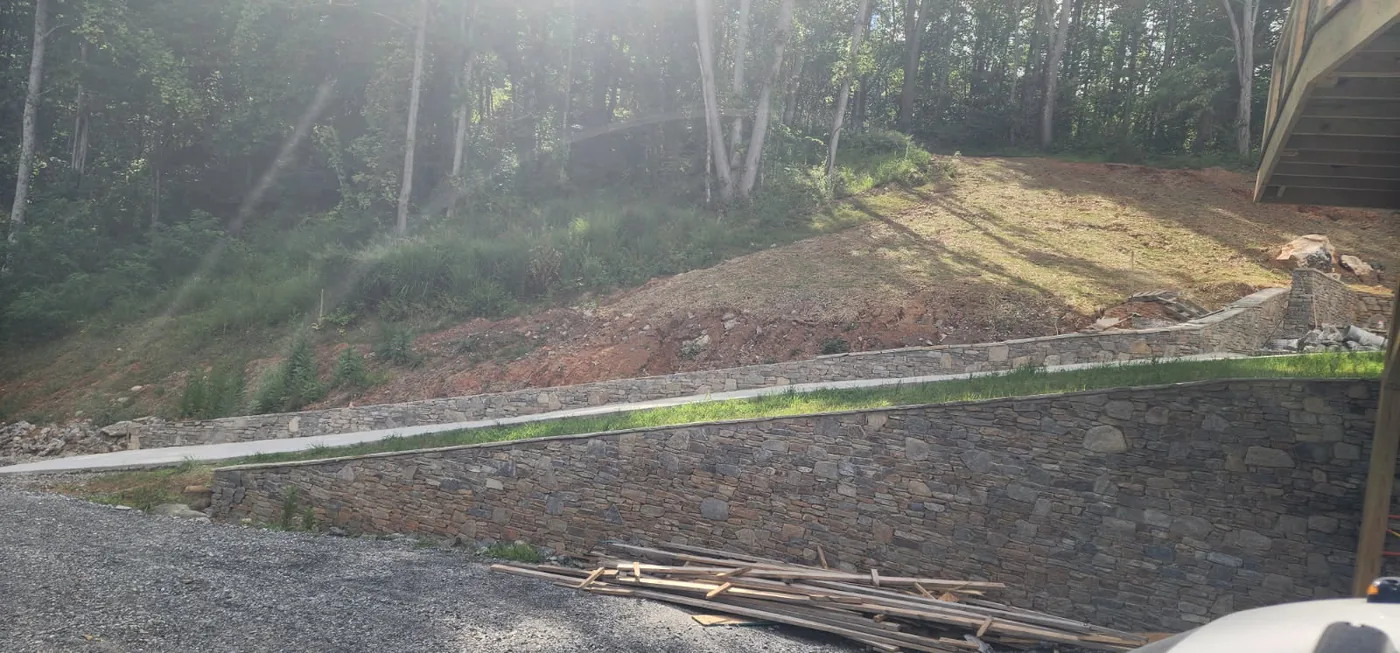
Walk the alley behind the main street blocks and you'll see what the town already does well: rough stone stacked without mortar, porches sitting on piers of local rock, and retaining walls that were laid by whoever owned the lot decades ago. A new flight that ignores that vocabulary looks like a Home Depot display dropped onto a hillside. The trades that work here read the existing stone first, then match it. That's also why so many Hot Springs projects reuse rock turned up during grading or pulled from a failed foundation elsewhere on the property — it's the same material the town is built from, and it costs less than trucking in palletized veneer from a supplier off the interstate.
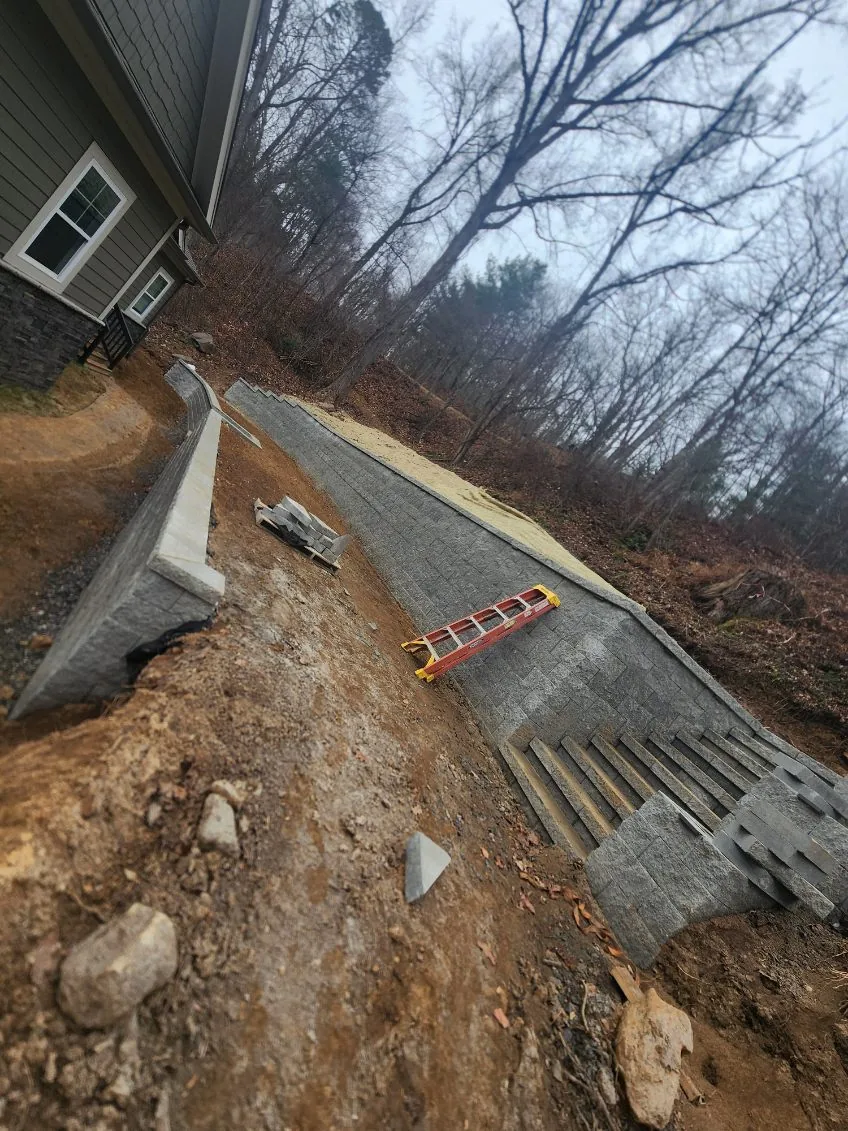
Newer construction on the flats near the river tends to be tighter and more uniform, often with a garage or a side entrance that wants a straight run rather than a winding path. Block-and-timber works there because the lines are clean and the budget usually has less slack. The honest trade-off: block-and-timber reads as modern, and on a 1920s cottage it can look pasted on. On a build from the last fifteen years it looks intentional.
What the price actually tracks in Madison County
Three things move a quote here: total rise, material type, and access. A staircase that a mini-excavator and a wheelbarrow line can reach is a different job from one carried in by hand up a bank off Highway 25/70. See the Madison County retaining wall cost breakdown for the wall-side numbers, since steps and walls usually get built together on these lots.
| Scope | Typical range |
|---|---|
| Short block-and-timber run (3-5 steps, easy access) | $2,400-$4,200 |
| Fieldstone steps, 6-10 rises, hand-set | $4,500-$7,500 |
| Boulder stair integrated with slope and drainage | $6,000-$9,000 |
| Walkway only, flagstone or pavers over prepared base | $18-$40/sq ft |
| Steps plus flanking retaining wall (combined scope) | Quote as one package |
Anything above a few thousand dollars in combined hardscape scope is worth checking against the licensing thresholds published by the NC Licensing Board for General Contractors.
Access is the quiet multiplier. A lot with a driveway that reaches the bottom of the run lets a machine do the digging, which keeps labor hours down. A lot where the truck has to park on the shoulder of Highway 25/70 and every bucket of base rock comes up a bank by hand or by winch is a different animal entirely. On those jobs the stone itself is often a small part of the total; moving dirt and materials is the bulk of it. That's also why combining steps with a wall in one mobilization usually beats doing them as two separate projects a season apart — the excavation, the access, and the crew are already there.
Drainage gravel, filter fabric, and compacted base are not upsells. They are what stands between a tread that stays put and one that lifts after the first hard freeze. If a quote doesn't list base prep and drainage as line items, ask where they live in the number.
Water decides whether steps survive their first winter
The federal disaster record for this county — 21 declared events across 1978-2026 — is dominated by storm and flood family events, and every one of them sent water down slopes that had steps built without a drainage plan. On a Hot Springs hillside, water arriving from above the run is the single biggest cause of settled treads, heaved risers, and washed-out base. Grade, cross-slope, and where the uphill water goes matter more than tread thickness.
Check the National Weather Service point forecast for the town before scheduling a build — weather.gov — because wet-season excavation on these slopes turns into mud handling fast. And confirm locally whether your project touches a stream buffer or steep-slope rule, since the NC Department of Environmental Quality governs the water-adjacent side of Madison County work.
The practical detail that trips people up on these slopes: water doesn't arrive at the steps, it arrives above them and picks up the whole hillside on the way down. A run of stone treads set into a wet slope with nowhere for uphill water to go becomes a chute during a heavy storm. The fix is usually a shallow swale, a French drain, or a cross-drain above the top step that diverts flow around the flight instead of through it. On lots that back up against a steep bank, a short section of flanking wall that also acts as a flow break often does double duty. Once the drainage is right, the stone almost takes care of itself.
Matching the build to the town, not to a showroom photo
Hot Springs is small, and a walkway that ignores the surrounding stone reads wrong immediately. The best results here pull from what's already on the property: boulders turned up during grading, fieldstone from an old foundation, native rock from the same hillside. That keeps cost down and makes the new work look like it was always there.
Where the budget is tight, the honest move is to build fewer, wider, lower-rise steps with a proper base and let the planting soften the edges, rather than a narrow showcase flight that fails in two seasons. See the stone steps and walkways guide for how a solid base gets built, and talk to Hot Springs retaining wall contractors when steps and slope stabilization belong in one scope.
The tread proportions matter on these hillsides too. A rise that feels fine on a flat lot feels brutal when it's also climbing a 25 percent grade, so runs here often use shallower rises and deeper treads than the same budget would buy on level ground. Wider treads also give a place to land and a place for the eye to rest, which reads better against weathered rock than a narrow, steep flight does. On a hillside lot in Hot Springs, going wider and lower almost always looks more at home — and lasts longer — than trying to squeeze maximum rise into minimum footprint.
Tread material choice should also respect freeze-thaw. Smooth, tight-finished surfaces get slick when the town ices over; a slightly rougher split or natural face gives grip where it counts. That's not a style preference so much as a safety one, and it's consistent with how the region's older stonework was finished in the first place.