How Leicester's ground and housing stock pick your material
Leicester sits west of Asheville in Buncombe County, where the land rolls from flat creek-bottom pasture up into hardwood ridges, and the housing stock follows that split. Older farmhouses and mill cottages sit close to the road on modest lots, many with steps that have settled or cracked over decades of mountain freeze-thaw. Newer builds tucked onto graded ridge lots often need a whole run of steps just to get from the driveway to the front door. Drive a few minutes out Leicester Highway toward Sandy Mush or Alexander and you pass both worlds in a single trip: a tin-roofed farmhouse with a stoop worn smooth by generations, then a freshly graded pad where the builder left a raw slope for someone to solve later.
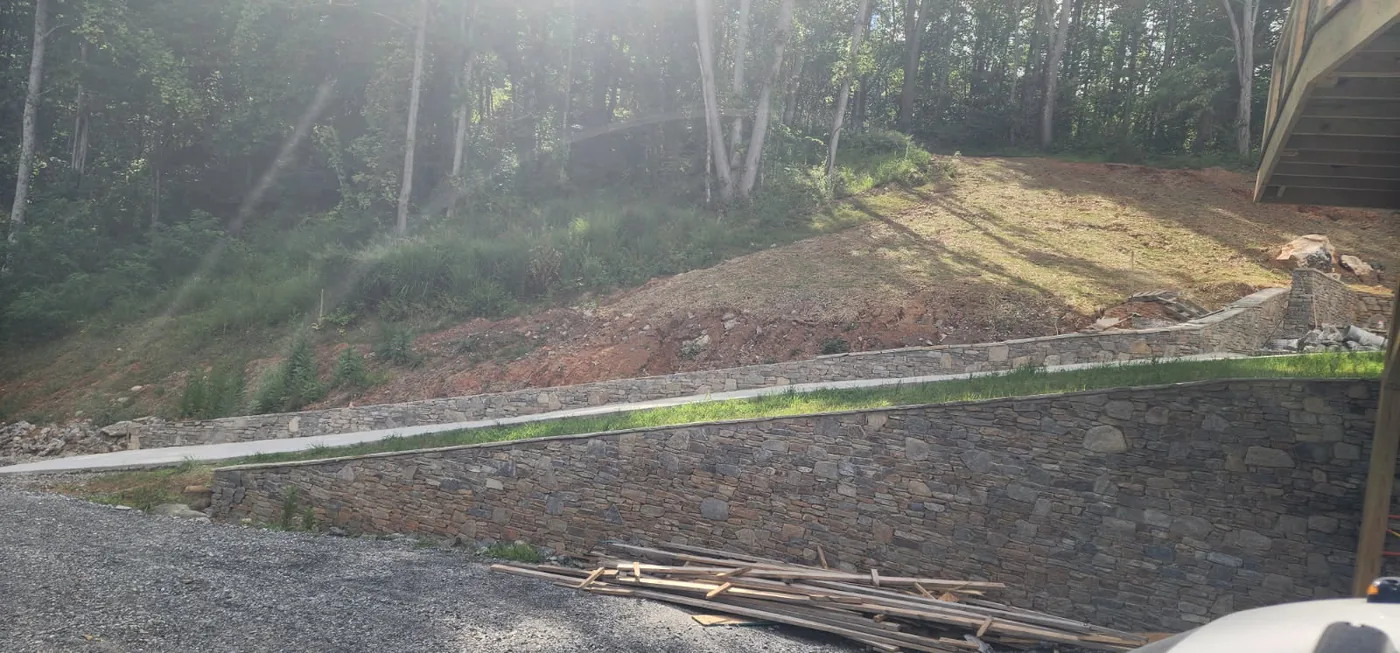
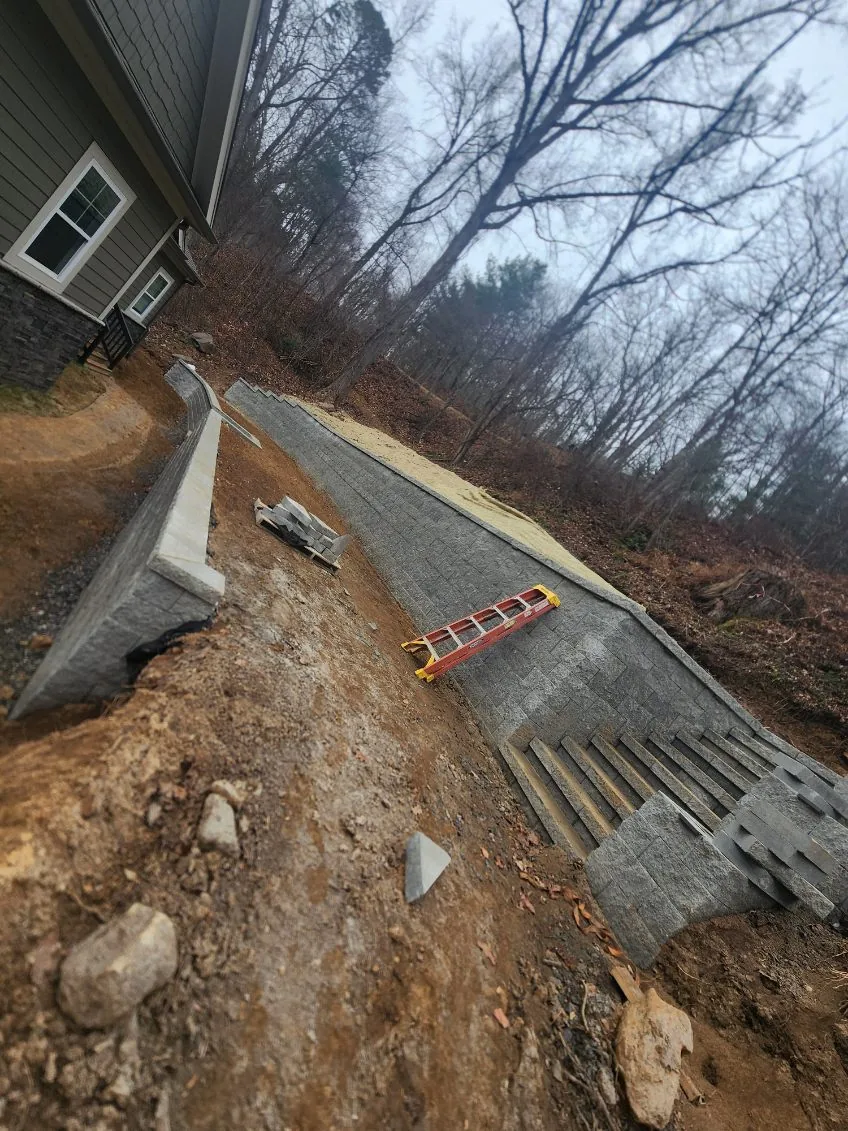
That split is why material choice here isn't cosmetic, it's structural. Fieldstone gathered or quarried locally gives an old farmhouse the right weathered look and drains well, but it's the most labor-intensive build on this list. Boulder steps suit steep graded lots because one boulder can be a riser by itself. Manufactured block and timber are the budget answer for straight, low runs where the grade is gentle. If your yard is too steep even for terraced steps, the conversation usually shifts to a retaining wall contractor in Leicester NC before anyone sets a tread.
There's a practical middle ground a lot of Leicester homeowners land on: fieldstone treads with block or timber risers hidden underneath, or boulders used only at the steep pinch points with an easier material above. You get the local look where people see it and the budget stays sane where they don't. Talk through those hybrids early, because the material decision shapes the excavation, the truck access, and how many hands the job needs each day.
The Leicester price picture
Leicester lots price like the rest of Buncombe County, and the working numbers below are for this trade specifically. Bids that come in far under these ranges usually mean thin base prep, no drainage, or steps set directly on topsoil. Treat those as incomplete rather than cheap.
| Scope | Typical installed range |
|---|---|
| Short straight step run, 3-4 risers, block or timber | $1,800-$3,500 |
| Curved or terraced walkway, fieldstone dry-laid | $3,500-$8,000 |
| Boulder steps on graded slope, per step | $600-$1,400 |
| Full walkway with steps, landings, and drainage | $6,000-$14,000 |
| Mortared stone steps with footing | $300-$700 per step |
The variables that move a Leicester quote most: slope angle, how far stone has to be carried in by hand, whether drainage has to be added, and whether the crew is working around an existing driveway or foundation. Retaining structures that back up a step run are priced separately, and the Buncombe County retaining wall cost breakdown covers those numbers.
A few Leicester realities show up in the line items over and over. Long gravel driveways off the main highway sometimes can't take a loaded stone truck to the work area, so stone gets staged at the road and moved by machine or wheelbarrow, and that handling shows up as labor. Creek-adjacent lots in the Leicester valley may need the step run set higher or keyed into bankstone so high water doesn't scour underneath. And on ridge lots, the grade often falls away from the house in two directions, which means a straight run won't do and the design has to switchback or terrace. None of that is exotic here, but it's easy to miss if the person quoting has only seen flat in-town yards.
Water, freeze-thaw, and why mountain steps fail
Federal disaster records explain a lot of the drainage work this county sees: 19 declared events have touched Buncombe County across 1973-2026, overwhelmingly storm and flood related. Every one of those events pushed water at steps and walkways built without a plan for where runoff goes. Leicester's freeze-thaw cycle does the rest. Water gets under a tread, freezes, lifts the stone, and by the next spring the step rocks when you stand on it.
The fix has to come before the stone, not after. Proper base excavation, compacted gravel, and a graded bed that sheds water away from the house are what separate a set of steps that lasts decades from one that needs resetting in three years. The NC Department of Insurance, Engineering and Codes division treats foundation drainage as a first-class requirement for good reason, and the logic applies to a step run just as much as a crawl space. Treads should also pitch slightly forward so rain runs off the front edge instead of pooling on top or wicking back toward the riser joint. If you've ever seen a set of stone steps in Leicester with a green moss stripe down the middle after a wet spring, you're looking at water that's staying where it shouldn't.
On slopes that stay damp, a French drain or a gravel-filled trench behind the top riser gives that water somewhere to go instead of sitting against the stone. It's unglamorous work that nobody photographs, but it's the difference between a walkway you use for thirty years and one that heaves the first hard winter after it's built. When a step run is also holding back soil, that's a retaining wall question and the stone steps and walkways guide walks through where that line falls.
Hiring a stone crew in this market
Three Leicester-specific checks before you sign anything. First, ask whether the crew has actually built on a graded mountain lot, because a flat driveway walkway and a 30-degree brick cottage stoop are not the same job. Second, ask who handles the permit or engineering letter if the project involves a wall over the state's inspection threshold, licensing rules via the NC Licensing Board for General Contractors apply once a job crosses that line. Third, ask how the crew plans to move stone onto the site. Hand-carrying fieldstone up a narrow Leicester driveway adds labor hours, and any quote that ignores that detail is guessing.
Also ask about the base. A good crew will tell you exactly how deep they excavate, what gravel they compact, and how they tie the steps into whatever drainage already exists. Anyone who can't answer those questions in plain language is selling stone, not masonry. If a wall is part of the plan, a dedicated Leicester retaining wall contractor is often the right first call so the structural and step work are sequenced together.
Timing matters too. Late fall and winter in the Leicester hills bring frozen ground and short workdays, and a dry stack laid in freezing weather can shift as the bed thaws. Spring mud is its own problem, because tracked equipment on saturated clay leaves ruts that cost more to fix than the steps cost to build. The shoulder seasons, when the ground is workable but not soaked, tend to produce the cleanest base prep. Ask any crew how they handle weather delays in their scheduling, and be wary of a bid that treats mountain weather as an afterthought.